

If you plan to own and operate a building or buy major equipment, an SBA 504 loan is usually the better long-term fit: a 10% down payment, a fixed rate and a term of up to 25 years. Hard money fits a different job: a fast, short-term, asset-based bridge that you repay or refinance within months, not decades. The two are not really rivals. Many owners use hard money to move quickly and then replace it with a 504 loan. This guide shows how each works, what each costs, and how to choose.
TL;DR
- SBA 504 is long-term, fixed-rate financing for owner-occupied real estate and equipment, with as little as 10% down.
- Hard money is short-term, asset-based lending from private lenders. It closes quickly, and you repay it with a balloon payment or a refinance.
- Hard money is built for speed and flexibility. The 504 is built for low payments and long-term stability.
- If you will occupy the property and keep it, price the 504 first. If you need to close fast, plan the exit into 504 financing from day one.
- We publish our current 504 rates on our site: 6.58% for 10-year equipment, 6.73% for 20-year real estate and 6.77% for 25-year real estate.
Table of Contents
- How an SBA 504 loan is structured
- How hard money is structured
- 504 vs hard money side by side
- Down payment and cash left in the business
- Rates, fees and the real cost of carrying the loan
- Speed: where hard money wins
- What lenders look at
- Which projects and businesses qualify for the 504
- When each loan makes sense
- Using both: bridge first, 504 second
- Our perspective
- Talk to us about your 504 financing
- FAQ
- Sources
How an SBA 504 loan is structured
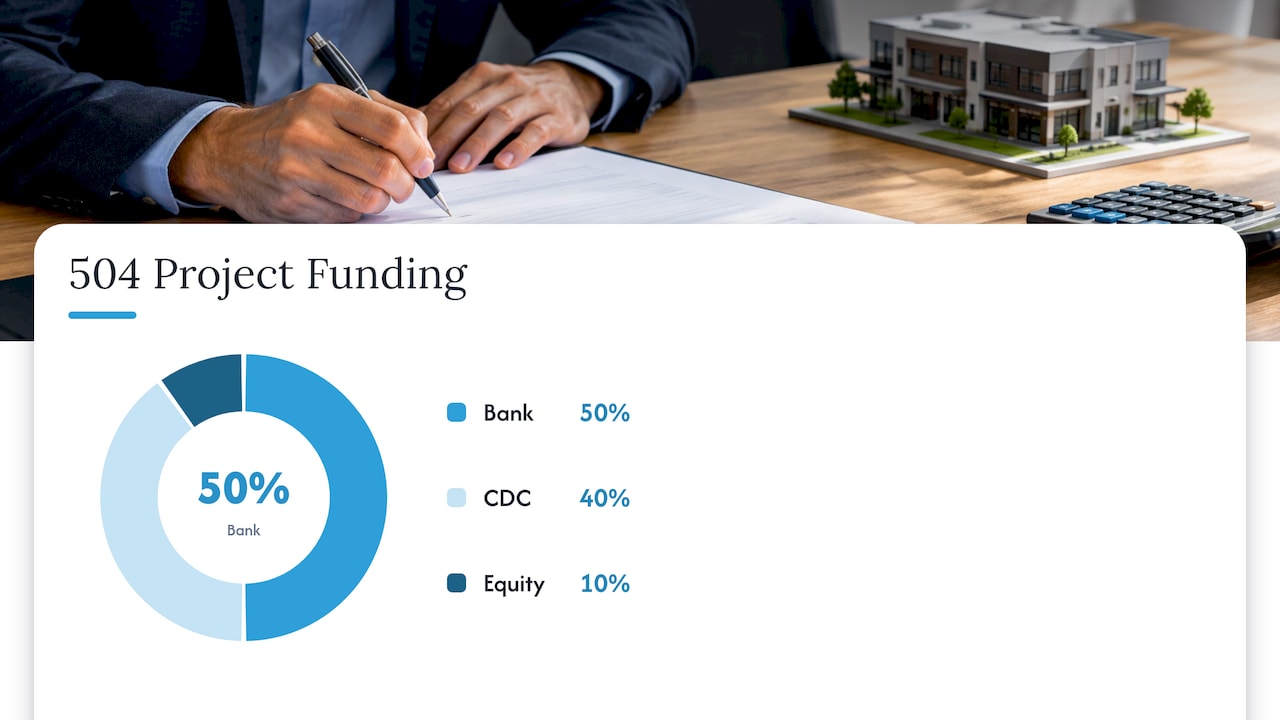
A 504 loan is not a single loan. SBA says it is originated through a Certified Development Company (CDC) working with a senior lender. In the typical structure, a private-sector lender takes a first lien for up to 50% of project cost, the CDC loan covers up to 40% with a junior lien, and you contribute at least 10% equity. The CDC portion is funded by a debenture that SBA guarantees.
On a $2,000,000 building, that works out to roughly:
| Piece | Share | Amount |
|---|---|---|
| Bank first mortgage | 50% | $1,000,000 |
| CDC (SBA 504) loan | 40% | $800,000 |
| Your down payment | 10% | $200,000 |
The CDC portion carries a fixed rate for the life of the loan. That is why 504 payments are predictable for 10, 20 or 25 years. You can read a deeper walkthrough in our guide to the 50/40/10 SBA 504 structure.
SBA states the maximum 504 loan amount is $5.5 million. Extra equity can be required in some cases, such as a new business or a special-purpose property, so confirm your project’s structure with a CDC early.
How hard money is structured
A hard money loan is a short-term, asset-based loan secured by real estate and issued by private lenders. Repayment periods are short, and the loan typically ends with a balloon payment. The “hard” refers to the hard asset, the property, which does most of the work in underwriting.
That has real advantages. The lender looks mainly at the property, the plan and the exit, so approval can be quick and the process less paperwork-heavy than a bank or SBA file. It is a tool for deals where timing matters more than the cost of money: an auction, a distressed purchase, a property that needs work before a bank will lend on it.
The tradeoff is cost and time. Hard money generally carries higher interest rates and higher origination points than permanent financing, and the term is measured in months. Loan-to-value limits are also tighter. One lender survey puts stabilized properties at 70% to 75% of as-is value and value-add deals at 65% to 80% of after-repair value, so you often need 25% to 35% down, not 10%.
504 vs hard money side by side
| Factor | SBA 504 | Hard money |
|---|---|---|
| Purpose | Owner-occupied real estate, long-term equipment | Fast acquisition, bridge, rehab, flips |
| Down payment | As little as 10% | Commonly 25% to 35% |
| Rate | Fixed for the full term | Higher, often interest-only |
| Term | 10, 20 or 25 years | Months, usually ending in a balloon |
| Underwriting focus | Business cash flow, property value, job creation | Property value and the exit plan |
| Speed | Slower, two credit reviews | Faster |
| Best for | Staying put and building equity | Moving first and refinancing later |
The down payment range for hard money comes from the loan-to-value limits above. Individual lenders set their own terms, so treat the table as a framework and not a quote.
Down payment and cash left in the business
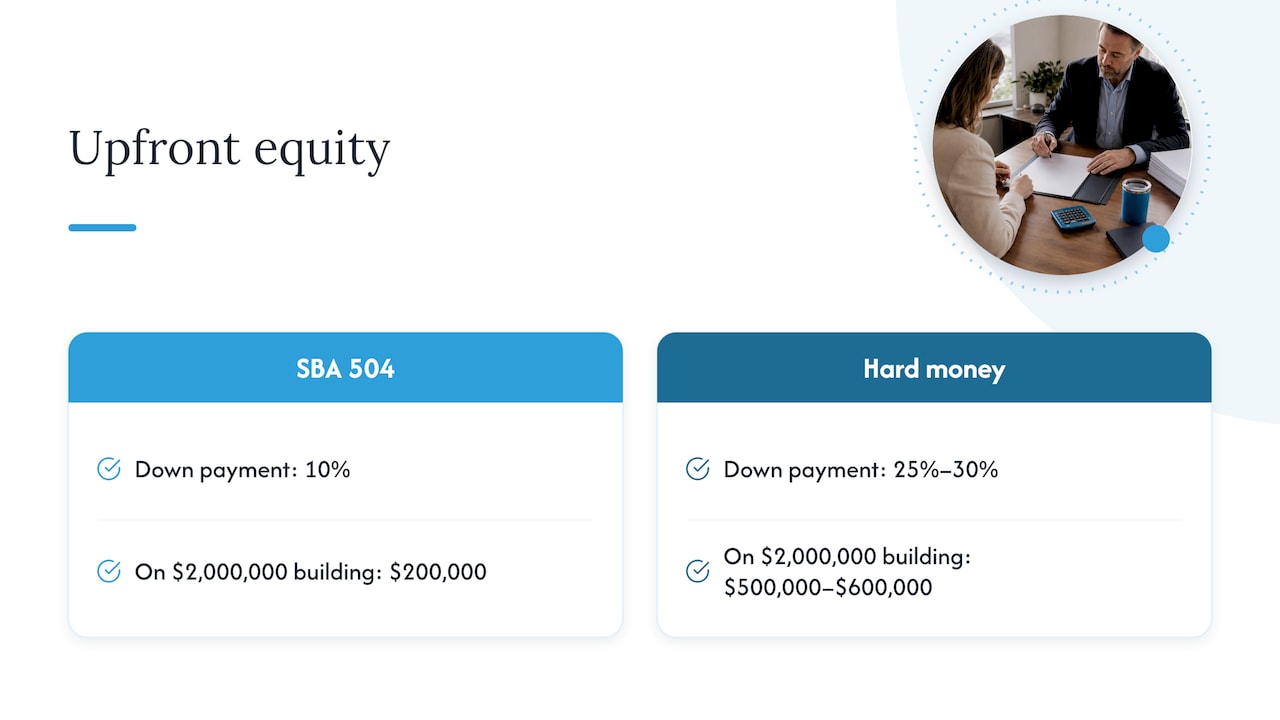
The gap is largest here. With a 504 you contribute as little as 10%. On that $2,000,000 building, you put in $200,000. With a hard money loan at 70% to 75% of value, you would need $500,000 to $600,000 before closing costs.
That difference matters beyond the closing table. Cash that stays in the business can fund hiring, inventory and marketing. This is the idea behind “preserving working capital,” and it is a core reason owner-occupants choose the 504. If the 10% itself is a hurdle, our Down Payment Assistance Program was designed to help New England businesses bridge it.
Rates, fees and the real cost of carrying the loan
Compare cost over the time you will actually hold the debt, not just the headline rate.
504 loans. The CDC portion is fixed for 10, 20 or 25 years, and the first mortgage from the bank is priced separately. Our published fixed rates for the CDC portion are:
- Equipment, 10-year fixed: 6.58%
- Real estate, 20-year fixed: 6.73%
- Real estate, 25-year fixed: 6.77%
Those are the rates shown on our rates page as of our latest update, and they change with the market, so confirm the current figure before you plan around it. Debenture timing can also add interim interest between closing and funding. We explain how to manage that in avoiding interim interest on SBA 504 debentures.
Hard money. Cost comes in two parts, interest and upfront points deducted from proceeds, and both are typically higher than on permanent loans. Because the loan is short, you must also budget for a second set of closing costs when you refinance out of it. A rough rule: if you expect to hold the property longer than about a year or two, the monthly carry of hard money tends to erode what you saved by closing fast.
Speed: where hard money wins
Hard money is faster, and we will not pretend otherwise. A 504 involves two underwriting processes: the bank and the CDC each underwrite the deal separately, so you satisfy two credit reviews. There is also an appraisal and an SBA authorization step.
There are ways to narrow the gap:
- Start with a complete package. Several years of business tax returns, interim financials, a debt schedule and a purchase contract keep both underwriters moving.
- Choose a CDC with Premier Certified status. We hold it, and it is designed to support faster approvals.
- Negotiate a realistic closing date. Sellers of owner-occupied commercial property will often accept a reasonable timeline when you show an approved lender is behind you.
- Line up the bank early. The first lender’s commitment runs in parallel with the CDC work.
If a seller will not wait, hard money can secure the property, with a 504 refinance as the planned exit.
What lenders look at
Underwriting differs sharply between the two.
SBA 504. Lenders review several years of business tax returns and interim statements, normalize owner compensation and one-time items, and run a global cash flow analysis that includes guarantors’ personal income and obligations. The focus is on whether your operating company can repay. Collateral is largely the financed property: the first lienholder sits at about 50% loan-to-value, which generally keeps the owner’s personal residence out of the picture, though owners of 20% or more give personal guaranties.
Hard money. The property and the exit are the center of the file. That is helpful if your financials are uneven this year, but it also means the loan is only as safe as your ability to sell or refinance on schedule.
Which projects and businesses qualify for the 504
A 504 is not for every purchase. SBA says eligible businesses must be operating, for-profit, located in the U.S. and small under SBA size standards, with qualified management, a feasible business plan, good character and the ability to repay. Funds can finance the purchase, construction or renovation of existing buildings or land, and long-term machinery or equipment with at least 10 years of useful life. If your project is heavy machinery, the same fixed-asset logic applies as with construction equipment financing in general.
Two limits to plan around:
- SBA says loans cannot go to businesses engaged in nonprofit, passive or speculative activities. A pure buy-and-flip investor is not the 504 borrower. Hard money is made for that.
- 504 proceeds cannot be used for working capital, inventory or debt consolidation, though a refinance of qualifying real estate debt follows its own rules.
Occupancy matters too. Our guides on 504 occupancy and eligibility and 504 loan requirements in New England cover the details.
When each loan makes sense
Choose the SBA 504 when:
- You will occupy the building and plan to keep it for years.
- You want a fixed payment you can budget around.
- You want to keep cash in the business instead of the property.
- You are buying or upgrading equipment with a long useful life.
Choose hard money when:
- The deal closes in weeks and a long approval would lose it.
- The property is not yet in a condition a long-term lender will fund.
- You are flipping or repositioning, and the plan is a sale or refinance within a short window.
- You have a clear, dated exit, such as a 504 refinance.
For investors weighing a short flip against permanent options, see our comparison of hard money and conventional loans. If you are comparing the 504 with other permanent options, we also cover CMBS, the 7(a) loan and sale-leasebacks.
Using both: bridge first, 504 second
The strongest plan for some owner-occupants is sequential. You buy with short-term money, make improvements, move your operations in, and then refinance into a long-term fixed-rate 504. Because the 504 funds the purchase, construction or renovation of existing buildings, the project can often be structured to take out the bridge.
Before you start, ask three questions:
- Will the property meet 504 occupancy rules when the bridge matures?
- Does the bridge have a prepayment penalty or extension fee that changes the math?
- Is the timeline realistic if the refinance takes longer than planned?
If you already hold a loan on owner-occupied property, our SBA 504 Refinance Program and our guide to refinancing commercial real estate with a 504 show how existing debt can move into long-term fixed financing.
Our perspective
We have spent more than 70 years financing New England businesses, and we have invested more than $2.3 billion in the region. What we see is that owners rarely regret keeping their cash.
The 504 is designed for exactly the owner who wants to own the building that houses the business. A 10% down payment, a fixed rate for up to 25 years and a structure that lets the bank and the CDC share the project give you a payment you can plan around. For veterans and their spouses, our VetLoan Advantage Program adds incentives, and our Down Payment Assistance Program is built for borrowers who need help reaching the equity contribution.
We respect what hard money does. When a seller needs a close in two weeks, a bridge can win the deal. Our advice is to decide the exit before you sign: if the building will be your home base, talk to us before you close the bridge so the 504 is lined up behind it.
PHENYX
Talk to us about your 504 financing
We offer SBA 504 financing for commercial real estate and equipment across Massachusetts, Rhode Island, Vermont, New Hampshire and Connecticut, with fixed rates for up to 25 years and as little as 10% down. We also offer refinancing, down payment assistance and a veterans’ program. See our current rates and start your project at CDC New England.
Veterans and spouses can review the VetLoan Advantage Program, which lists a 1.0% processing fee.
FAQ
Is a 504 loan cheaper than hard money?
For a property you will hold for years, usually yes. The 504 offers fixed rates for up to 25 years and a 10% down payment, while hard money is short-term and generally carries higher rates and points. Hard money can still be the right tool when speed is the priority and the hold is brief.
Can I use hard money to buy a property and then refinance into a 504?
Often you can, if the property and your business meet 504 requirements when you refinance. Plan the exit before you sign the bridge, and talk with a CDC about occupancy, appraisal and timing so the bridge does not mature first.
Can I use a 504 loan for a flip or a rental investment?
No. SBA says 504 loans cannot be made to businesses engaged in nonprofit, passive or speculative activities. The program is for operating small businesses that occupy the property or use the equipment.
Does a 504 loan put my home at risk?
The 504 is largely secured by the financed project, and the first lienholder sits at about 50% loan-to-value. Owners of 20% or more still give personal guaranties. Review the guaranty terms with your attorney and lender before closing.
Sources
- 504 loans, U.S. Small Business Administration
- SBA lender resources, U.S. Small Business Administration
- Hard Money Loans: Pros and Cons to Consider, Chase
- Bridge Loan Requirements, Capital XO
- How SBA 7(a) and 504 Loans Are Underwritten, Underridge
- SBA Collateral: Not a Decline Test, but a Guaranty Test, MMC Invest
- Commercial Real Estate Loans, SoFi
- Construction equipment financing, TrueBrady


