If the debt you want to replace is tied to commercial real estate or major equipment, the SBA 504 refinance is usually the stronger fit, because it gives you a long fixed rate on a fixed-asset project. If you also need working capital, or your debt is a mix of purposes, the SBA 7(a) is built for that flexibility. This guide compares the two on eligible debt, structure, rates, terms, costs and prepayment, so you can match the program to your situation.
TL;DR
- Choose the 504 when the debt you are refinancing financed land, a building or long-lived equipment, and you want a fixed rate for up to 25 years.
- Choose the 7(a) when you need to refinance varied debt or add working capital in the same loan.
- A 504 is split financing: a private lender, a Certified Development Company (CDC) and your own equity. A 7(a) is a single loan from a lender with an SBA guaranty.
- Both programs have rules on what counts as a benefit to you and on prepayment, so read those before you sign.
Table of Contents
- The core difference in one minute
- Side-by-side comparison
- How a 504 refinance is structured
- What debt qualifies for each program
- Rates and payment stability
- Fees and prepayment: read this before you choose
- Which one fits your situation
- A quick checklist before you apply
- Our perspective
- See what a 504 refinance could do for your payment
- FAQ
- Sources
The core difference in one minute
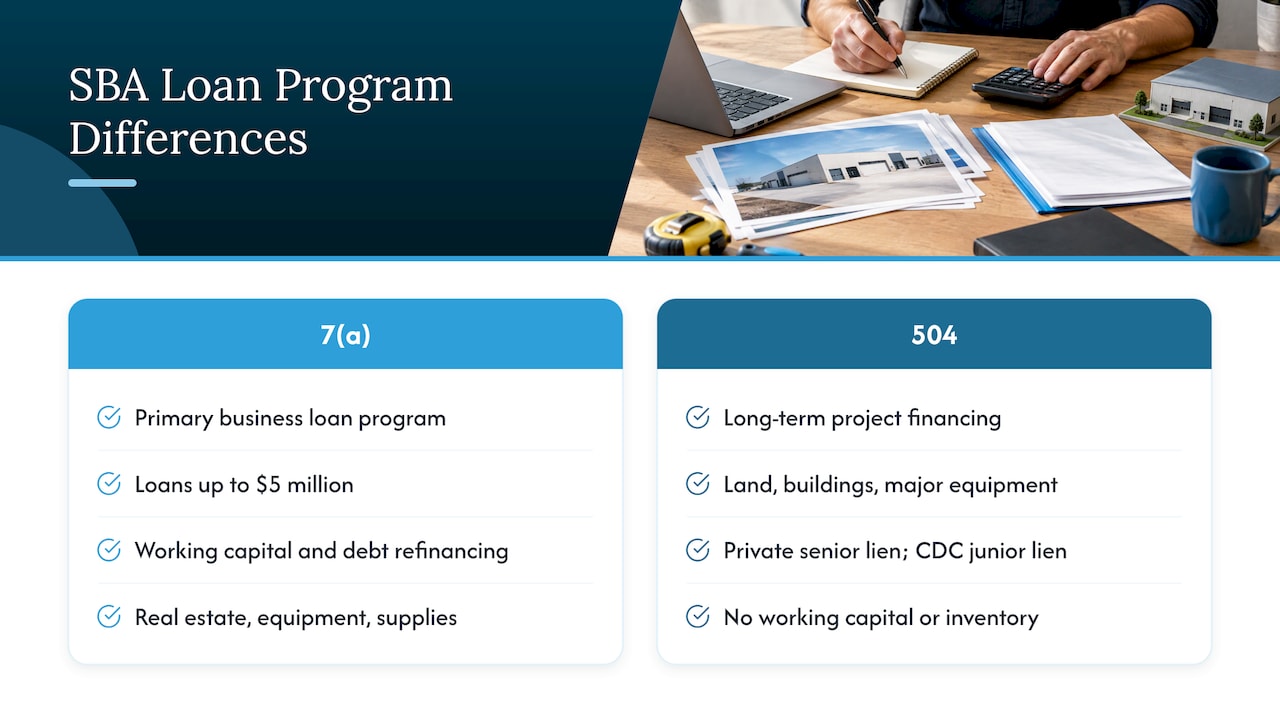
The two programs solve different problems. SBA describes the 7(a) as its primary business loan program, with loans up to $5 million for real estate, working capital, debt refinancing, equipment, supplies and changes of ownership (SBA 7(a) loans). That breadth is its strength.
The 504 is narrower and deeper. The Federal Register describes it as long-term financing for land, buildings and major equipment, with a private-sector senior-lien loan and a junior-lien CDC loan backed by an SBA-guaranteed debenture (Federal Register, 504 Debt Refinancing). SBA also states that a 504 loan cannot be used for working capital or inventory (SBA 504 loans).
So the question is not which loan is better in general. It is which one matches the debt on your balance sheet and what you need next.
Side-by-side comparison
| Factor | SBA 504 refinance | SBA 7(a) refinance |
|---|---|---|
| Best for | Debt that financed real estate or major equipment | Mixed debt, working capital, or acquisitions |
| Structure | Senior lender loan plus CDC loan plus borrower equity | One loan from a lender, partly guaranteed by SBA |
| Rate | Fixed for the full term | Fixed or variable, negotiated with the lender, subject to SBA maximums |
| Maturity | 10, 20 or 25 years | Up to 25 years, generally 10 unless real estate or long-lived equipment |
| Working capital | Not allowed | Allowed |
| Maximum size | Set by program rules and project structure | Up to $5 million |
The rate and maturity details come from SBA. The 504 offers 10-, 20- and 25-year maturities, with the debenture rate pegged to an increment above the current 10-year U.S. Treasury rate (SBA 504 loans). For 7(a), federal regulations cap maturity at 25 years and generally limit loans to 10 years unless they finance or refinance real estate or equipment with a useful life beyond 10 years (13 CFR Part 120, Subpart B).
How a 504 refinance is structured
A typical 504 project has three pieces. A private lender provides a senior-lien loan covering at least 50% of project cost. A CDC provides a junior-lien loan of up to 40% of total cost, funded by a 100% SBA-guaranteed debenture. You contribute at least 10% equity (Federal Register).
In a refinance, your existing equity in the property can often serve as that contribution, which is why many owners who bought years ago find the equity side easier than expected. For a deeper look at who funds which piece and when, see our guide to the 50/40/10 SBA 504 structure.
The CDC portion is where the long fixed rate lives. Our published rates, read from our site in September 2026, were 6.58% for Equipment 10-Year Fixed, 6.73% for Real Estate 20-Year Fixed and 6.77% for Real Estate 25-Year Fixed. Because the debenture rate follows Treasury yields, current numbers change, so confirm them on our rates page before you plan around them.
What debt qualifies for each program
504 refinancing rules
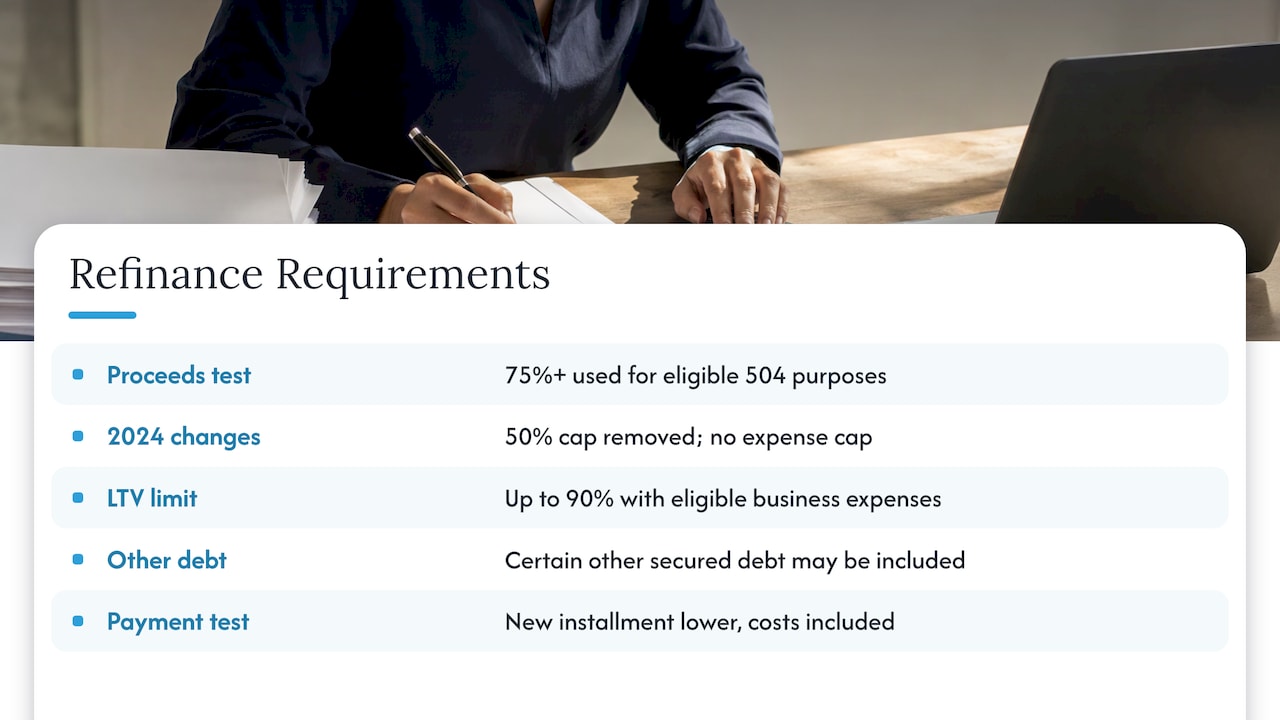
For a 504 debt refinance, 75% or more of the original loan proceeds must have been used for eligible 504 purposes, such as acquiring land, buildings or equipment (13 CFR § 120.882). In plain terms, the loan you are replacing needs to have gone into fixed assets, not into operating costs.
The 2024 SBA rule loosened the refinance-only path considerably. It removed the earlier 50% cap, raised the loan-to-value limit to 90% for projects that include eligible business expenses, eliminated the cap on those eligible expenses and allowed certain other secured debt to be included (Federal Register). That matters if you have a bank loan on your building plus a secured line or note you would like to fold in.
There is also a payment test. Refinancing must provide a substantial benefit, meaning the new installment attributable to the refinanced debt is lower than the existing installment or installments, with penalties, fees and other financing costs included (13 CFR § 120.882). Our team runs this comparison early so you know whether a deal works before you invest time in an application.
If your debt is an emergency disaster loan, we cover the specifics in EIDL refinance with an SBA 504 loan.
7(a) refinancing rules
The 7(a) lists debt refinancing among its permitted uses, alongside working capital, equipment and ownership changes (SBA 7(a) loans). Because the program is general purpose, it can suit debt that does not meet the 504’s fixed-asset test, such as a mix of equipment notes, a line of credit and operating obligations. The trade-off is that the rate can be variable, depending on what you negotiate with the lender, within SBA maximums.
Rates and payment stability
The biggest practical difference for most owners is what happens to the payment over time. On a 504, the CDC portion is fixed for the full term, so that part of your payment does not move. On a 7(a), the SBA permits fixed or variable rates negotiated with the lender (13 CFR Part 120, Subpart B). A variable rate can start lower and then rise, which makes budgeting harder for an owner-occupied building you plan to hold for decades.
If you are weighing the fixed rate against a faster paydown, our article on 25-year fixed rate vs. fast recast walks through both options for commercial owners.
Fees and prepayment: read this before you choose
Both programs carry costs beyond the interest rate. For 7(a), the guaranty fee depends on loan size and guaranteed portion, and for loans longer than 12 months the lender may pass it to you after the first disbursement. Lenders may also collect specified expenses such as filing or recording fees and legal services (13 CFR Part 120, Subpart B).
Prepayment deserves the most attention. On a 7(a) with a maturity of at least 15 years, SBA rules impose a subsidy-recapture fee when you voluntarily prepay more than 25% of the highest outstanding principal balance during any of the first three successive 12-month periods (13 CFR Part 120, Subpart B). If you may sell or refinance again soon, factor that in.
The 504 has its own prepayment schedule on the CDC debenture portion. The mechanics are specific enough that we explain them separately in SBA 504 prepayment: when borrowers pay a premium in years 1 to 10. Knowing the schedule up front lets you choose a term that fits how long you expect to hold the asset. For equipment, the 10-year term generally pairs with a shorter premium period than the 20- and 25-year real estate terms.
Which one fits your situation
Use these scenarios as a starting point.
- You own your building and your bank loan is about to reset or balloon. A 504 refinance can replace it with a long fixed rate. This is the classic case.
- You bought equipment with a short note and want lower monthly payments. The 504 equipment term is 10 years fixed, and the payment test described above applies. See 504 vs. equipment financing for the details.
- Your debt is a blend of real estate, a line of credit and operating needs, and you need new working capital. A 7(a) is the more natural structure, since a 504 cannot fund working capital.
- You are buying a business and want to finance goodwill. That is a 7(a) use case, not a 504 one, because the 504 is limited to fixed assets.
- You are comparing against a securitized or sale-leaseback option. We compare those in SBA 504 vs. CMBS and sale-leaseback vs. SBA 504.
One planning note for equipment owners: financing choices interact with tax planning. A guide to the Section 179 equipment deduction is a good companion read, and your CPA can tell you how it applies to your purchase.
A quick checklist before you apply
- List each debt you want to replace, its original purpose, balance, rate and monthly payment.
- Confirm that 75% or more of the original proceeds went to land, buildings or equipment if you are leaning toward a 504.
- Estimate your equity in the property, since it can serve as the borrower contribution.
- Add any prepayment charges and fees on the old debt to the cost side of the comparison.
- Decide whether you need working capital. If yes, price that need separately or consider a 7(a).
- Ask what your timeline looks like. Plans to sell within a few years change how much prepayment terms matter.
Our perspective
We work with New England owners every day who assume SBA financing means one program with one answer. In practice, the right choice follows the asset. When the debt behind you is a building or equipment, the 504 refinance gives you something few other loans do: a fixed rate for up to 25 years, with a structure built around the property itself.
That stability is what we hear owners value most. A fixed payment on a building you occupy is a number you can plan payroll, expansion and succession around. It preserves working capital for the business instead of tying it up in a payment that can change.
We also see the 504 as a program that rewards good preparation. Because we are a CDC with more than 70 years of experience and more than $2.3 billion invested in regional businesses, we can model the substantial-benefit test with you before you commit, and explain exactly how the pieces fit together. Our Premier Certified status is designed to support faster approvals.
For veterans and their spouses, we offer the VetLoan Advantage Program, and for owners who need help with the equity side, our Down Payment Assistance Program is built for that purpose. If your debt is fixed-asset debt, we believe the 504 deserves to be the first option you price.
PHENYX
See what a 504 refinance could do for your payment
We can review your current debt and show you how a 504 refinance would compare, including the payment test, equity position and term options. Our SBA 504 Refinance Program is built for owners of commercial real estate and equipment who want to replace existing debt with a long fixed rate.
Start on our SBA 504 Refinance Program page. If you served, ask about the VetLoan Advantage Program, which lists a 1.0% processing fee, or about down payment assistance if you are buying rather than refinancing. For more on refinancing property specifically, read how to refinance commercial real estate with an SBA 504 loan and our comparison for New England businesses.
FAQ
Can I refinance an existing 7(a) loan into a 504?
Often yes, if the original loan financed eligible fixed assets and the new payment meets the substantial-benefit test. The rules require that 75% or more of the original proceeds went to eligible 504 purposes (13 CFR § 120.882). Check any 7(a) prepayment charges first, then talk with us about your numbers.
Can a 504 loan include working capital?
No. SBA states that a 504 loan cannot be used for working capital or inventory (SBA 504 loans). If you need working capital alongside your refinance, a 7(a) may be the better structure for that part of the need.
How much do I need to put down on a 504 refinance?
A 504 project normally calls for at least 10% borrower equity (Federal Register). In a refinance, equity you already hold in the property can often count toward it. We can estimate your position once we see your property value and loan balance.
Which program offers a fixed rate?
The 504 offers a fixed rate for the term, with 10-, 20- and 25-year maturities (SBA 504 loans). The 7(a) allows fixed or variable rates, negotiated with the lender within SBA maximums, so the answer depends on the loan you are offered.
Sources
- SBA: 7(a) loans
- SBA: 504 loans
- Federal Register: 504 Debt Refinancing (2024)
- 13 CFR § 120.882, Eligible project costs for 504 loans
- eCFR: 13 CFR Part 120, Subpart B, maturities and interest
- eCFR: 13 CFR Part 120, Subpart B (December 14, 2020)
- Section 179 equipment deduction guide