Yes, SBA 504 loans carry a prepayment premium on the CDC (debenture) portion of the loan, and it applies only during a statutory declining period. For 20 and 25-year debentures, that period runs 10 years; for 10-year debentures, it runs 5 years. The premium disappears entirely once you clear that window, and federal regulation requires you to pay off the entire loan at once, not in pieces.
TL;DR:
- Prepayment premiums on SBA 504 loans only apply during the first 5 to 10 years, depending on loan term, and are based solely on the debenture rate at closing.
- The premium amount declines each year, dropping roughly 10 percentage points annually for 20/25-year terms and disappearing after the specified period.
- Fully prepaying requires a wired payment within a strict schedule that avoids landing on semi-annual debenture payment dates to prevent extra interest and fees.
- Additional fees such as subsidy recoupment charges may apply if prepayments exceed thresholds in the first three years, doubling the total payoff amount.
- Running a detailed payoff calculation that considers the declining premium schedule, fees, and interest savings helps determine if early repayment or refinancing is more advantageous.
Table of Contents
- Why SBA 504 Prepayment Carries a Premium at All
- How the Prepayment Premium Is Calculated
- Scheduling Your Payoff: Windows, Wires, and Deadlines
- Other Fees That Show Up in Your Payoff Amount
- Is Prepaying Your SBA 504 Loan Actually Worth It?
- Your Step-by-Step Payoff Checklist
- What CDC New England Brings to a Payoff Decision
- A Note on Getting This Right the First Time
- Get a Payoff Quote or Explore Refinancing With CDC New England
- Sources
- FAQ
Why SBA 504 Prepayment Carries a Premium at All
Your 504 loan is really two loans stitched together: a conventional first mortgage from a bank, and a second mortgage funded through a CDC-issued debenture backed by the SBA. The prepayment premium only touches the second piece.
That distinction matters because of how debentures get funded. CDCs pool debentures with similar rates and maturities, then sell them to investors who expect a predictable stream of payments. When you prepay early, the CDC has to prepay your corresponding debenture, and investors in that pool get paid back pro rata ahead of schedule. The premium exists to offset the lost return those investors were counting on.
- Your bank-held first mortgage: usually no prepayment penalty, though terms vary by lender.
- Your CDC/debenture second mortgage: subject to the premium described in 13 CFR § 120.940, which spells out that a full payoff must include principal, unpaid interest, fees, and any prepayment premium in the note.
Repayment on 10, 20, or 25-year terms runs through the Central Servicing Agent, the entity that actually processes your payments and payoff requests.
How the Prepayment Premium Is Calculated
The premium is based on the debenture rate locked in at closing, not the blended effective rate you were quoted. That gap trips people up constantly. Your all-in rate might combine the bank rate and the CDC rate into one tidy number, but the premium calculation only cares about the debenture side.
Pro Tip: Pull your original closing documents and find the debenture rate specifically. It’s usually listed separately from your blended effective rate, and it’s the only number that matters for calculating your prepayment cost.
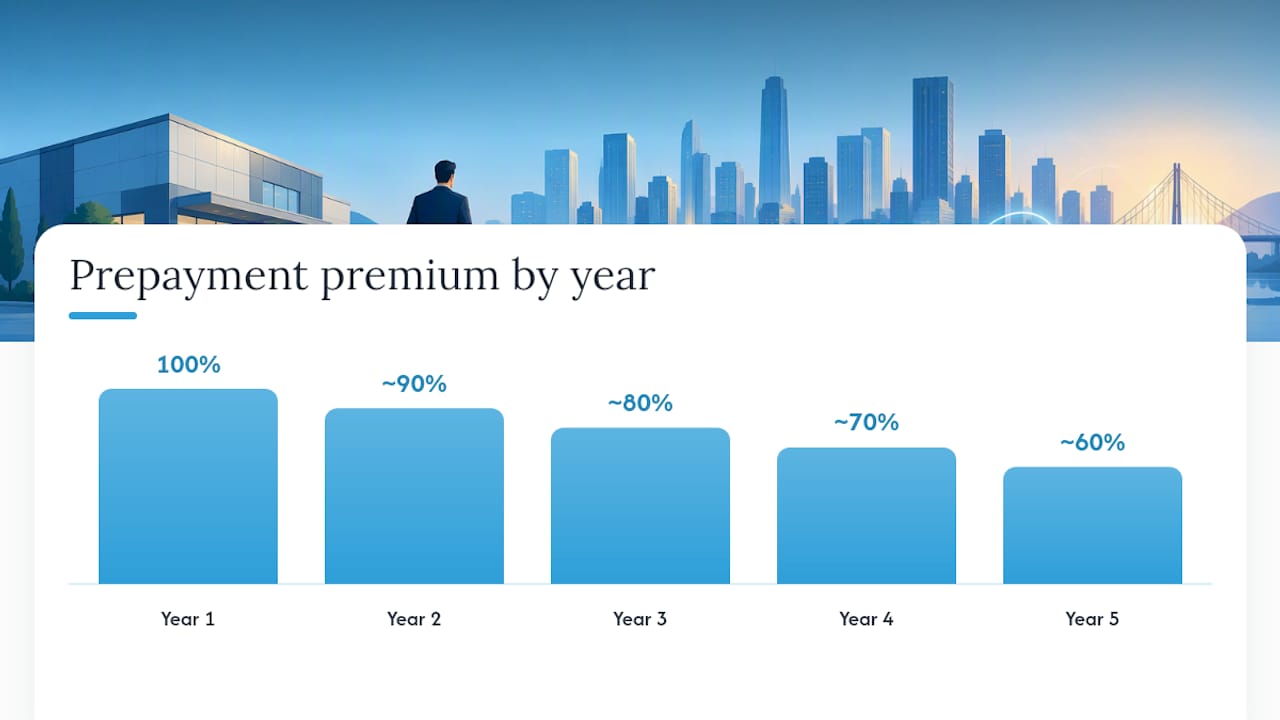
The schedule declines in even steps:
- Year 1: 100% of the debenture rate applied to the outstanding CDC balance.
- Years 2 through 9: drops roughly 10 percentage points per year on 20/25-year debentures.
- Year 10 and beyond: 0%, no premium at all.
- 10-year debentures follow the same logic compressed into a 5-year window.
That’s a rough illustration, not a quote. NerdWallet’s breakdown of early SBA repayment confirms this declining structure and the fact that partial prepayment isn’t an option. You pay the whole CDC balance or none of it.
Scheduling Your Payoff: Windows, Wires, and Deadlines
Prepaying a 504 loan runs on a fixed calendar, not on your convenience. Debenture payments settle semi-annually, and your CDC needs to slot your payoff into a specific window tied to that schedule.
- Submit a written prepayment request to your CDC well before your target payoff month.
- Confirm your prepayment lands within the correct scheduling window, typically between the 6th business day and the 3rd Thursday of your chosen month.
- Wire the funds. The SBA’s servicing process requires wire transfers only for 504 payoffs; personal or business checks won’t work.
- Include your loan number and borrower name explicitly in the wiring instructions to avoid a misapplied payment.
Pro Tip: Never schedule your payoff to land on or right around a semi-annual debenture payment date. Doing so can tack on extra interest and processing fees that a slightly earlier or later date would have avoided.
Other Fees That Show Up in Your Payoff Amount
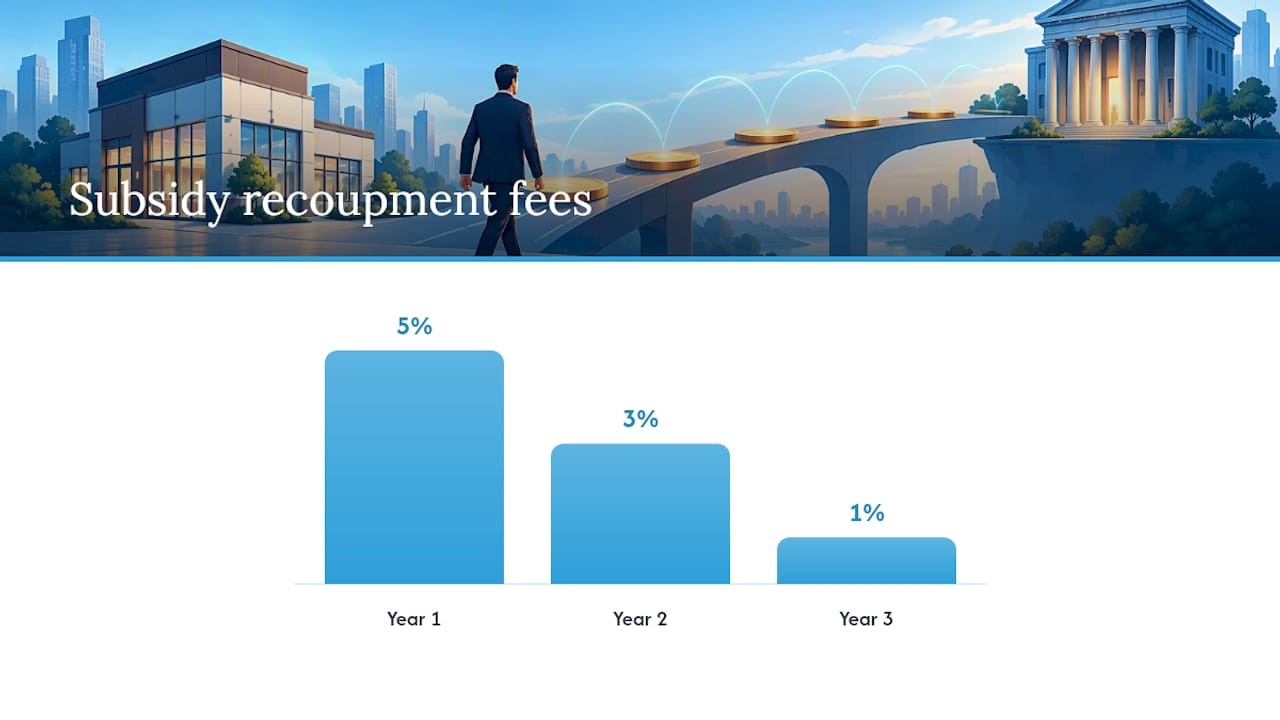
The prepayment premium isn’t the only line item you’ll see. If your prepayments in the first three years after your initial disbursement exceed certain thresholds, 13 CFR § 120.223 triggers a subsidy recoupment fee: 5% of the excess in year one, 3% in year two, and 1% in year three. This mostly hits borrowers who refinance or sell within that early window and pay far more than their scheduled amount.
Your official payoff figure will typically bundle:
- Remaining CDC principal balance.
- Unpaid accrued interest.
- The prepayment premium, if you’re still inside the declining period.
- CSA servicing fees and SBA guarantee fees.
- Annual charges tied to the debenture, which the SBA publishes by fiscal year since they shift over time.
- CDC processing fees, any late fees, and outstanding receivables.
Always request a written payoff quote and confirm every line item with your CDC before wiring funds. Verbal estimates and back-of-envelope math have burned more than a few borrowers who assumed their payoff was lower than it actually was.
Is Prepaying Your SBA 504 Loan Actually Worth It?
Run the math before you commit. Compare the dollar cost of the prepayment premium against how much interest you’d actually save by eliminating the debt early. If your remaining CDC balance is small and you’re near the end of the declining period, the premium might barely register. If you’re in year 2 with a large balance, it could erase most of your projected savings.
- Calculate total interest saved over the remaining loan term at your current debenture rate.
- Weigh that against the premium plus any subsidy recoupment or servicing fees.
- Consider whether paying down your (often higher-rate) first mortgage delivers better returns than prepaying the lower-rate CDC portion, an approach NerdWallet specifically recommends because the interest math frequently favors it.
- Look at whether an SBA 504 refinance makes more sense than a straight payoff, especially if rates have shifted since your original closing.
- Use CDC New England’s SBA 504 loan calculator to model a few scenarios before deciding.
Larger payoff decisions deserve a conversation with your accountant or financial advisor, particularly if tax implications or cash flow timing are part of the picture.
Your Step-by-Step Payoff Checklist
Getting the timing wrong costs money. Here’s the sequence that avoids the common mistakes:
- Contact your CDC in writing to request an official payoff figure, ideally up to six months ahead of your target date.
- Confirm the figure includes every fee: principal, interest, premium, servicing charges, and any recoupment fee exposure.
- Choose a payoff month that avoids landing on a semi-annual debenture payment date.
- Schedule your prepayment no later than eight calendar days before the 3rd Thursday of that month.
- Arrange your wire transfer with the loan number and borrower name clearly noted.
- Confirm the CSA has received the funds and request written confirmation or a release letter for your records.
For rate context before you request that quote, check what rate you’re currently paying and compare it against current market conditions.
What CDC New England Brings to a Payoff Decision
An experienced CDC has invested billions in regional businesses over several decades, financing commercial real estate and equipment purchases for owners across multiple New England states. That history means practical familiarity with payoff timing, refinance structuring, and the fee schedules borrowers actually run into.
- SBA 504 loan calculator for modeling payoff and refinance scenarios.
- Historical rate trend data to see whether your original debenture rate is high or low relative to today’s market.
- Dedicated refinance guidance for borrowers weighing a payoff against restructuring existing debt.
A Note on Getting This Right the First Time
Run your numbers before you call your CDC, not after. The math on prepayment versus paying down a higher-rate first mortgage isn’t always intuitive, and the difference can run into thousands of dollars depending on where you sit in the declining schedule.
The mistakes that cost borrowers the most are almost always timing errors: missing the scheduling window, wiring funds without the right loan reference, or triggering a subsidy recoupment fee by prepaying too aggressively in year one or two. None of these are complicated to avoid. They just require asking your CDC the right questions early, rather than assuming your payoff will be simple.
— PHENYX
Get a Payoff Quote or Explore Refinancing With CDC New England
CDC New England gives you a direct path to an accurate payoff number instead of guesswork pulled from a generic formula. Because we service 504 loans across New England every day, we can walk you through your specific debenture rate, your position in the declining schedule, and whether a payoff or a refinance actually saves you more.
If refinancing looks like the smarter move once you run the numbers, our SBA 504 Refinance Program is built for borrowers replacing existing debt with better terms. Veterans and their spouses can also ask about the VetLoan Advantage Program, and buyers who need help clearing the down payment hurdle can look into our Down Payment Assistance Program. Start by running your own numbers on the SBA 504 loan calculator, then reach out to our team for a written payoff estimate before you schedule anything.
Sources
- eCFR :: 13 CFR 120.940 – Prepayment of the 504 loan or Debenture.
- SBA: Loans - 504 loan program page
- Should you repay an SBA loan early? - NerdWallet
FAQ
Which states ban prepayment penalties?
State laws on prepayment penalties mostly apply to conventional mortgages and consumer loans, not federally structured SBA 504 debentures. The 504 prepayment premium is governed entirely by federal regulation under 13 CFR § 120.940, so it applies uniformly regardless of your state.
What are SBA 504 rates right now?
Rates vary by loan type and term, and CDC New England currently lists 6.58% on its Equipment 10-Year Fixed program, 6.73% on Real Estate 20-Year Fixed, and 6.77% on Real Estate 25-Year Fixed. You can check current SBA 504 rate trends directly on our historical rates page.
Are SBA 504 loans still available?
Yes, the SBA 504 program remains active and continues funding commercial real estate and equipment purchases nationwide, with terms of 10, 20, or 25 years depending on the asset financed.
Can SBA loans be paid off early without penalty?
Not during the declining premium period. A 504 loan’s CDC portion carries a premium for the first 10 years on 20/25-year debentures or the first 5 years on 10-year debentures, after which you can prepay the debenture with no penalty at all.
What triggers a subsidy recoupment fee on an SBA 504 loan?
A recoupment fee applies when voluntary prepayments exceed certain thresholds within the first three years after your initial disbursement, per 13 CFR § 120.223. The fee runs 5% of the excess in year one, 3% in year two, and 1% in year three.