An equipment line of credit gives you revolving access to funds for buying or upgrading equipment, secured by the equipment itself, with interest charged only on what you draw. It fits businesses with ongoing or seasonal equipment needs, like a fleet operator replacing trucks every year. If you’re financing one large piece of equipment you plan to own for decades, a term loan or an SBA 504 loan usually costs less over time.
TL;DR:
- An equipment line of credit is best suited for businesses with recurring equipment purchases, offering flexible redraw options and interest only on the borrowed amount.
- Qualification depends on business cash flow, equipment resale value, and collateral quality, with good credit scores and consistent revenue aiding approval.
- Costs include origination fees, annual facility fees, and appraisal charges, with interest rates varying based on collateral strength and whether they are fixed or floating.
- For single, long-term equipment acquisitions, SBA 504 loans often provide better fixed-rate terms and lower overall costs than revolving lines.
- Businesses should match their equipment spending pattern with the appropriate financing type, choosing flexible lines for recurring needs and fixed-rate loans or SBA programs for major, long-term investments.
Table of Contents
- How Does an Equipment Line of Credit Work?
- What Are the Benefits and Risks of an ELOC?
- Who Qualifies for an Equipment Line of Credit?
- What Do Equipment Line of Credit Rates and Fees Look Like?
- ELOC vs. Term Loan vs. Leasing: Which Should You Choose?
- How Do You Apply for an Equipment Line of Credit?
- When Does SBA 504 Financing Beat an Equipment Line of Credit?
- Matching the Financing to the Business, Not the Other Way Around
- How Cdcnewengland Helps Businesses Finance Equipment the Right Way
- Where to Learn More
- Sources
How Does an Equipment Line of Credit Work?
An equipment line of credit (ELOC) is a revolving facility, not a one-time loan. You get approved for a maximum credit limit, draw against it when you need to buy equipment, repay what you’ve borrowed, and then draw again. That’s the core distinction from a term loan, which hands you a lump sum once and starts amortizing immediately.
The lender secures the line with a lien on the equipment you buy, which is why ELOCs are typically asset-secured and can offer competitive rates compared to unsecured credit. Your available credit, often called the borrowing base, gets sized to the value and quality of your equipment pool. Availability shifts as assets are added, sold, or depreciated, similar to how an inventory line of credit adjusts as stock moves.
A few mechanics worth knowing upfront:
- Interest accrues only on the drawn balance, not your total credit limit (common among ELOCs).
- Lines typically renew on an annual basis subject to a review of your financials and collateral.
- Paying down principal frees up that same capacity to draw again, without a new application each time.
What Are the Benefits and Risks of an ELOC?
The appeal of an equipment line of credit is flexibility. Once you’re approved, you can draw funds for a new purchase without submitting a fresh loan application every time, which matters if you’re outfitting a growing fleet or replacing machinery on a rolling schedule.
Here’s how the advantages and drawbacks typically stack up:
- Flexibility. You draw only what you need, when you need it, rather than borrowing a lump sum against future purchases you haven’t made yet.
- Preserved working capital. Because equipment secures the line, you’re not tying up as much cash reserve as you would with an unsecured facility.
- Reusable credit. Repay a draw, and that capacity becomes available again, unlike a term loan that closes out once funded.
- Restricted use. Most ELOCs limit spending strictly to equipment purchases, so you can’t redirect funds toward payroll or inventory.
- Repossession risk. Default on the line, and the lender can seize the specific equipment tied to that draw.
- Ongoing oversight. Lenders often require field exams, insurance verification, and covenant compliance to keep the line active.
Pro Tip: Coordinate ELOC draws with vendor financing offers on new equipment. Sometimes a manufacturer’s promotional rate beats your line’s rate for that specific purchase, and you can save the credit line for the next one.
Who Qualifies for an Equipment Line of Credit?
Lenders underwrite equipment lines around the strength of your cash flow and the quality of the collateral, not just your credit score. Expect scrutiny on both fronts.
Typical qualification benchmarks include:
- Two or more years of consistent business revenue and positive cash flow.
- A personal credit score in the high 600s or above for the primary owner.
- Equipment with resale value that supports the requested credit limit.
- Financial statements from the last two to three years, plus current interim numbers.
- Equipment invoices or appraisals, proof of insurance, and clear title or ownership records.
Some lenders offer alternative paths if you don’t fit the standard mold. Asset-based approvals weigh collateral quality more heavily than time in business. Vendor pre-approvals let equipment dealers arrange financing at the point of sale. Seasonal structures, common in agriculture and construction, adjust draw and repayment schedules around your revenue cycle rather than forcing a flat monthly payment.
What Do Equipment Line of Credit Rates and Fees Look Like?
Pricing on an equipment line depends on your credit profile, the collateral’s resale value, and whether the rate floats or holds fixed. Stronger collateral, think late-model trucks or CNC machines with active resale markets, tends to pull rates down because the lender’s risk drops with it.
Beyond the interest rate itself, watch for:
- Origination fees, often 1% to 3% of the credit limit, charged when the line opens.
- Facility fees, sometimes charged annually just to keep the line available, whether you draw or not.
- Appraisal and field exam fees, which cover the lender’s cost of verifying your equipment’s value and condition.
Here’s a simplified way to estimate your carrying cost: the interest you owe depends on your drawn balance, rate, and the length of the period before repayment. The math changes fast if your rate floats with a benchmark, so ask whether your quoted rate is fixed for the draw term or adjusts monthly.
ELOC vs. Term Loan vs. Leasing: Which Should You Choose?
The right structure depends on how long you’ll keep the equipment and how your business model uses it. Term loans build ownership through fixed amortization, leases keep you flexible on upgrades, and revolving lines suit repeat purchases rather than one-off buys.
A quick way to sort it:
- Buying one major asset you’ll own for years? A term loan or SBA 504 financing typically gives better rate certainty than a revolving line.
- Replacing or adding equipment on a recurring basis? An ELOC lets you draw as needs arise instead of re-borrowing from scratch.
- Working with equipment that becomes obsolete quickly, like certain computer or medical tech? Leasing shifts that obsolescence risk to the lessor.
How Do You Apply for an Equipment Line of Credit?
Getting from inquiry to funded draw usually takes two to six weeks, depending on how complete your documentation is and whether the lender needs a field exam.
- Gather your paperwork. Pull together an equipment list, vendor invoices, two to three years of financial statements, and proof of insurance before you apply.
- Submit your application and get a term sheet. The lender reviews your financials and collateral, then issues preliminary terms.
- Complete appraisal or field exam. For larger lines, the lender verifies equipment value and condition on-site.
- Close and access your line. Once terms are finalized, you can begin drawing against your approved limit.
Before signing, ask lenders directly about covenants, what triggers a default beyond missed payments, and whether the line auto-renews or requires a full re-underwriting each year.
When Does SBA 504 Financing Beat an Equipment Line of Credit?
An equipment line of credit makes sense for ongoing, repeat purchases. But if you’re buying one substantial piece of equipment you intend to own for the long haul, a revolving facility often costs more in fees and rate uncertainty than a fixed-rate alternative. SBA 504 loans can finance equipment purchases with low down payments and long fixed-rate terms, which suits businesses that want payment certainty over 25 years rather than a facility that renews annually.
Businesses seeking long-term ownership with a fixed return on capital, rather than revolving flexibility, are often better served by a structured, fixed-rate program than by a line that can be re-priced or called at renewal.
Cdcnewengland structures SBA 504 loans with as little as 10% down, and pairs them with down payment assistance and the VetLoan Advantage program for veteran-owned businesses. If your equipment need is a single major acquisition rather than a recurring one, it’s worth a direct conversation before defaulting to a revolving line.
Matching the Financing to the Business, Not the Other Way Around
A fleet operator adding vehicles every year needs the redraw flexibility an ELOC provides. A manufacturer installing one large production line for the next fifteen years is usually better off locking in a fixed rate through a term loan or SBA 504 financing. The mistake isn’t picking the wrong product outright, it’s picking the product before figuring out which pattern your equipment spending actually follows.
— PHENYX
How Cdcnewengland Helps Businesses Finance Equipment the Right Way
If you’ve read this far weighing revolving credit against fixed-rate ownership, you already know the tradeoff: flexibility versus long-term cost certainty. Cdcnewengland specializes in the latter, structuring SBA 504 loans with as little as 10% down and fixed rates locked for up to 25 years, so your equipment payment doesn’t move when your credit line’s rate would.
Cdcnewengland has invested more than $2.3 billion in New England businesses over 70 years, with programs including down payment assistance and the VetLoan Advantage program for veteran-owned companies. If your next equipment purchase is a major, long-term investment rather than a recurring draw, run the numbers using the SBA 504 loan calculator and see what a fixed 25-year rate looks like against your current plan.
Where to Learn More
The PNC Insights piece on equipment lines of credit covers ELOC mechanics in depth, while J.P. Morgan’s financing guide compares loans, leases, and revolvers. Consult a tax or accounting professional regarding depreciation and interest deductibility for your specific situation.
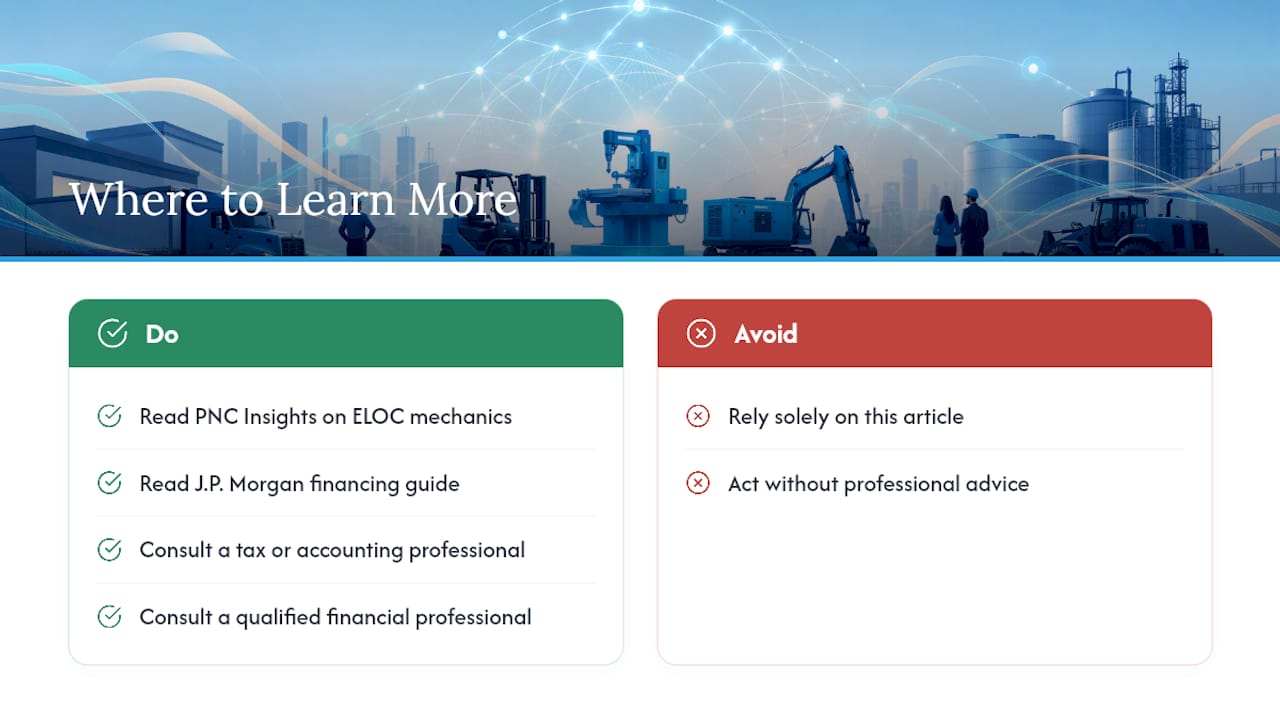
This article is general information, not a substitute for advice from a qualified financial advisor. Consult a qualified financial professional about your own circumstances before acting on anything here.
Sources
- Could an Equipment Line of Credit Make Purchases Easier Today? | PNC Insights
- What Is an Equipment Line of Credit? Rates, Terms … - Nav
- Equipment Loans & Financing: How They Work & Their Benefits — J.P. Morgan