The debt service coverage ratio is your net operating income divided by your total debt service, and it tells a lender whether your business or property throws off enough cash to cover its loan payments. A DSCR above 1.0 means you generate more income than you need to pay your debt; below 1.0, you’re short. The SBA and HUD both build underwriting standards around this ratio, and lenders like CDC New England use it as a first checkpoint before anything else in your file gets a second look.
TL;DR:
- A DSCR of at least 1.25 is typically required for commercial loans, with many lenders demanding a cushion of 1.15 to 1.35 depending on property type.
- Achieving a strong DSCR involves increasing revenue through rent hikes or added income sources or lowering operating expenses and debt payments, such as refinancing or bringing in a guarantor.
- Using a longer amortization, such as 25 years instead of 15, significantly reduces annual debt service, thereby improving the DSCR.
- For SBA 504 loans, a 10% down payment and realistic, normalized NOI based on stable, recurring income are essential for favorable underwriting results.
- Borrowers should verify DSCR standards with official sources like the SBA or HUD and use detailed calculations and early preparation to improve approval chances.
Table of Contents
- What DSCR Measures and the Standard Formula
- How to Calculate Net Operating Income for DSCR
- What Counts as Debt Service and How to Calculate It
- Worked Examples: Calculating DSCR Step by Step
- What Lenders Look For: Typical DSCR Minimums
- How to Improve Your DSCR Before You Apply
- Using DSCR in Commercial Real Estate Lending
- Tools and Calculators to Estimate DSCR
- CDC New England’s View on DSCR in SBA 504 Underwriting
- SBA 504 Loans Built Around a 10% Down Payment
- Where to Verify DSCR Standards and Run the Numbers
- Sources
What DSCR Measures and the Standard Formula
The formula is simple on paper: DSCR equals net operating income divided by total debt service, where debt service includes principal, interest, and any lease payments tied to the deal. Net operating income (NOI) is not the same as EBITDA. NOI strips out financing costs and is calculated specifically from property or business operations before any debt payments enter the picture, while EBITDA can include items a real estate lender would exclude, like non-operating income.
Lenders favor cash-flow measures like DSCR over pure profit metrics because profit can be shaped by accounting choices, but cash paid to service debt is a fixed, contractual obligation. Some lenders use what’s called the Pre-Tax Provision Method, an alternate calculation that adjusts NOI for anticipated taxes before comparing it to debt service. You probably won’t need this method for a standard SBA 504 deal, but it’s worth knowing it exists if you’re working with a lender who calculates things differently than you expect.
How to Calculate Net Operating Income for DSCR
Getting NOI right matters more than almost any other input in the DSCR equation, because a small error here compounds through the entire ratio. Start with gross revenue, then work down to a number that reflects sustainable, recurring cash flow.
Include these items when building NOI:
- Rental income or gross business revenue before financing costs
- Other recurring income (parking fees, laundry income, ancillary service revenue)
- A vacancy and credit-loss allowance, typically 5% to 10% for stabilized commercial property
- Concessions or discounts that reduce effective revenue
Then subtract operating expenses, but only the ones tied to running the property or business day to day: property taxes, insurance, utilities, repairs, management fees, and payroll for operations. Leave out anything related to financing, like interest payments or loan fees, and leave out owner draws, depreciation, and capital expenditures. Those live outside the NOI calculation entirely.
If you had a one-time repair bill or a lawsuit settlement last year, normalize it out and present a stabilized NOI that reflects what a typical year actually looks like. Lenders trust a clean, defensible NOI schedule far more than one padded with one-time noise.
What Counts as Debt Service and How to Calculate It
Total debt service is every dollar you’re contractually obligated to pay on debt in a given year, not just the interest. Here’s how to build that number correctly:
- Start with the loan’s principal and interest payment, calculated from the amortization schedule, not just the interest rate.
- Convert monthly payments to an annual figure by multiplying by 12; lenders always evaluate DSCR on an annual basis.
- Check whether the loan is fixed or adjustable. An adjustable rate can push your debt service higher mid-term, and some lenders stress-test DSCR against a higher rate to confirm you can absorb an increase.
- Add in any other obligations tied to the deal, including a second mortgage, equipment leases, or capital lease payments the lender treats as debt-like.
- Sum every payment stream into one annual total. That total is your denominator.
Amortization length changes this number more than most borrowers expect. Stretching a loan from 15 years to 25 years lowers the annual payment substantially, which is one reason SBA 504 loans with 25-year fixed terms often produce a stronger DSCR than shorter, higher-payment alternatives.
Worked Examples: Calculating DSCR Step by Step
Numbers make this concrete faster than any explanation. Here are two quick scenarios you can check against your own figures.
- Rental property example: NOI of $180,000 and annual debt service of $150,000 produces a DSCR of 1.20. That means the property generates 20% more cash than it needs to cover its loan payments, a ratio many commercial banks would approve without additional conditions.
- Small business example: A business with $500,000 in NOI and $400,000 in total annual debt service also lands at DSCR of 1.25, comfortably inside the range most SBA-backed programs look for.
- Sensitivity check: Drop that same business’s NOI to $420,000, or raise its debt service to $450,000 through a rate increase, and DSCR falls to roughly 0.93 to 1.05. That’s the difference between an easy approval and a file that needs a guarantor or extra collateral.
Small swings in either NOI or debt service move DSCR more than most first-time borrowers expect, which is exactly why lenders stress-test both sides before they commit.
What Lenders Look For: Typical DSCR Minimums
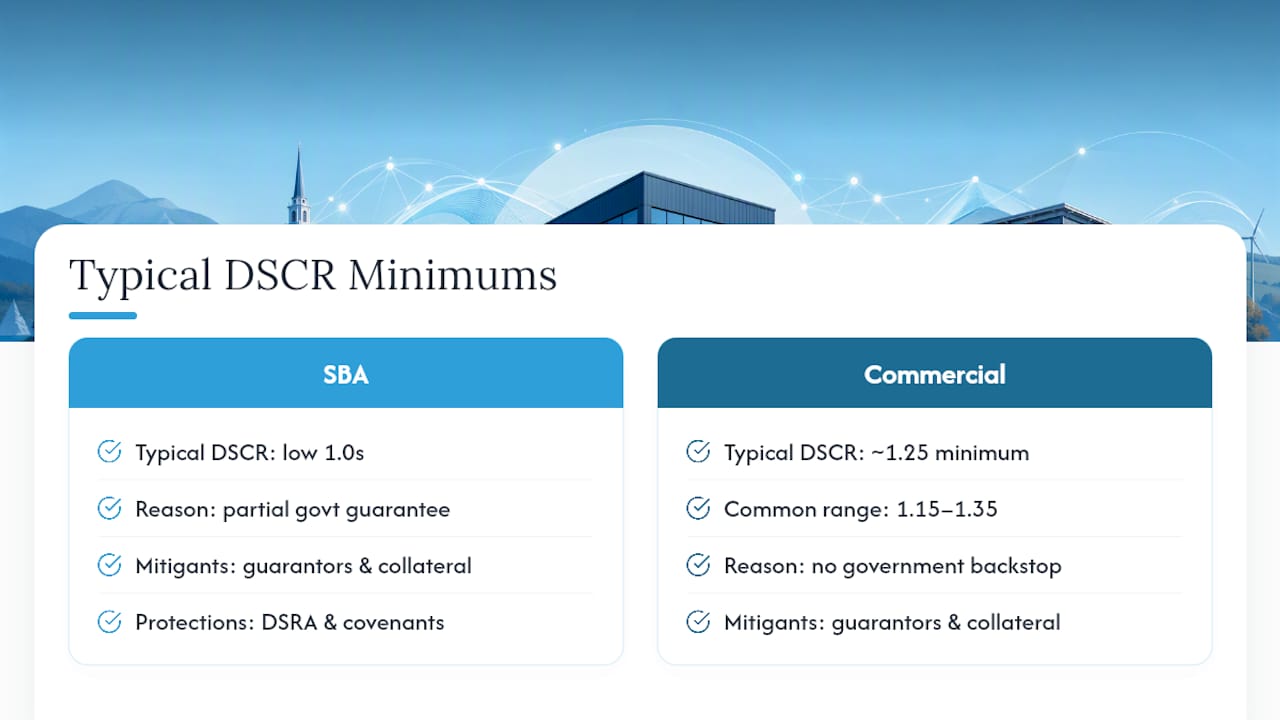
Threshold snapshot: The SBA generally looks for DSCR in the low 1.0s on many programs, thanks to the partial government guarantee behind the loan. Commercial banks typically want more cushion, with minimums around 1.25 and a common range of 1.15 to 1.35 depending on property type and loan structure.
Why the spread? A guaranteed government program can accept a thinner margin because part of the risk sits with the SBA, not the bank alone. An unsecured line of credit or a speculative property type demands a fatter cushion because there’s no backstop if income dips. Guarantors, personal guarantees, and additional collateral can all soften a lender’s DSCR requirement on the margin, though none of them replace the need for real cash flow.
Lenders also build in protections beyond the ratio itself. A debt service reserve account (DSRA) sets aside cash specifically to cover a shortfall, and loan covenants often require you to maintain a minimum DSCR throughout the loan term, not just at closing. Breach a covenant and you may trigger a technical default, even if you’re current on payments, which can force a renegotiation or an unwanted call on the loan.
How to Improve Your DSCR Before You Apply
You have more control over this number than you might think, and most of the levers fall into three categories.
Revenue moves:
- Raise rents or prices where the market supports it, even modestly
- Cut vacancy through better marketing or lease renewal outreach
- Add a secondary income stream, like parking or service fees
Expense moves:
- Trim discretionary operating costs that don’t affect the tenant or customer experience
- Renegotiate service contracts or outsource functions that cost less through a vendor
Debt moves:
- Refinance into a lower rate or a longer amortization to shrink annual payments
- Increase your down payment to reduce the loan amount and the resulting debt service
- Bring in a guarantor with strong outside income to support a thinner ratio
Pro Tip: Work on your NOI six to twelve months before you apply, not the week before. Lenders want to see a trend, not a one-time spike engineered right before underwriting.
Using DSCR in Commercial Real Estate Lending
Property-level DSCR looks at a single asset’s income against its own debt, which works fine for a one-property borrower. Investors holding multiple properties often get evaluated on global DSCR instead, a portfolio-wide view that lets a strong asset offset a weaker one.
DSCR and loan-to-value (LTV) work together to size a loan: a strong DSCR can sometimes support a higher LTV, while a marginal DSCR usually forces a smaller loan or a bigger down payment. Keep in mind what DSCR doesn’t show. It says nothing about deferred capital expenses, roof or HVAC replacement costs, or market-level risks like a major tenant leaving. Pair it with a capital needs assessment before you commit.
Tools and Calculators to Estimate DSCR
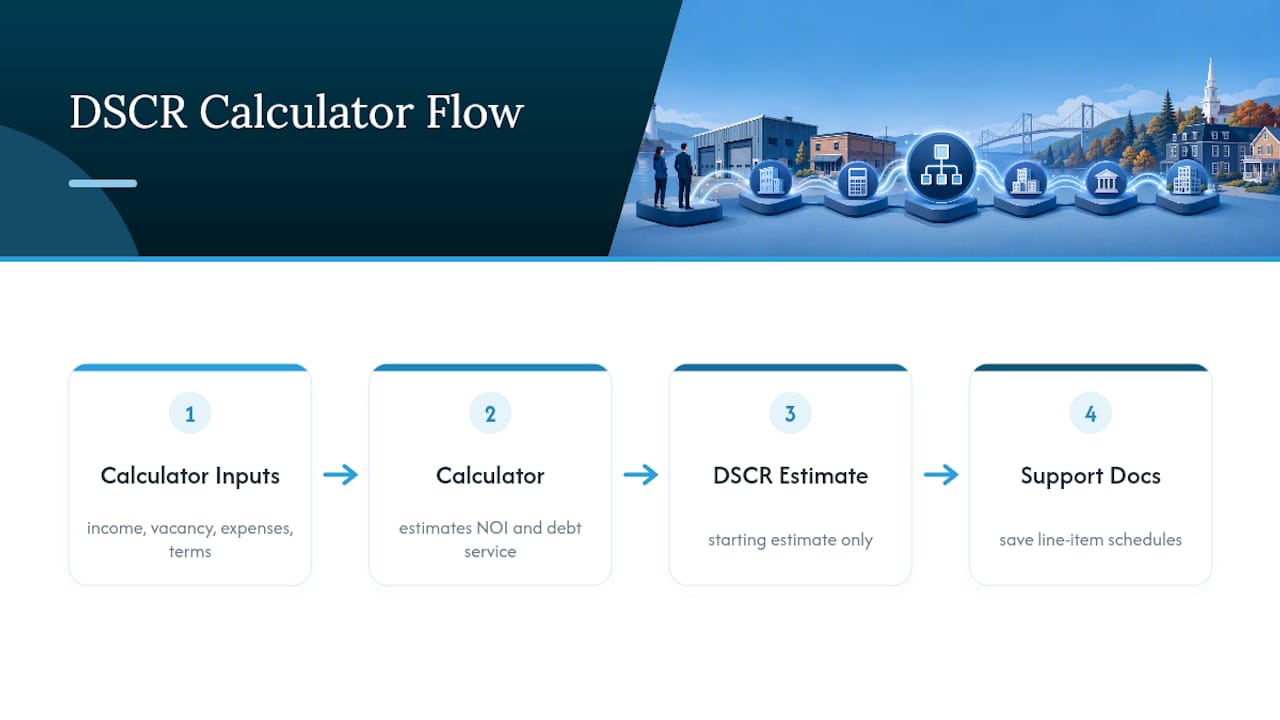
Before you sit down with a calculator, gather your annual income, a realistic vacancy assumption, full operating expenses, and your proposed loan terms. Most online DSCR calculators ask for exactly these inputs to estimate NOI and annual debt service automatically. Calculators vary in how they define NOI and what amortization they assume by default, so treat the output as a starting estimate. Save your own line-item schedules. Lenders want to see the detail behind the number, not just the final ratio.
CDC New England’s View on DSCR in SBA 504 Underwriting
A conservatively built NOI schedule is the fastest path to a 25-year fixed SBA 504 loan, because it gives underwriters confidence your cash flow holds up under stress. We consistently recommend borrowers use realistic vacancy assumptions, document every income and expense line, and start the DSCR conversation with us early, before a purchase contract creates time pressure. Over 70 years and more than $2.3 billion invested in New England businesses, that early preparation is the pattern behind the loans that close smoothly.
— PHENYX
SBA 504 Loans Built Around a 10% Down Payment
If your DSCR numbers are holding up and you’re eyeing owner-occupied real estate or major equipment, an SBA 504 loan gives you a 10% down payment requirement and a fixed rate locked for up to 25 years, which keeps your debt service predictable for the life of the loan. That predictability is exactly what protects your DSCR against the rate swings that can sink a variable-rate deal. SBA 504 financing fits best when you’re buying the building you operate in or financing equipment you’ll use for years, not flipping an asset quickly.
If a bigger down payment would strengthen your ratio but ties up too much cash, CDC New England’s down payment assistance program can help close that gap. Run your own numbers through the SBA 504 loan calculator to see where your DSCR lands, then reach out to start a pre-application conversation before you’re under contract deadline pressure.
Where to Verify DSCR Standards and Run the Numbers
For official underwriting guidance, check the SBA for program-specific DSCR expectations and the HUD site for multifamily and commercial standards. The FDIC outlines how banks assess repayment capacity more broadly. If you track other cash-flow ratios alongside DSCR, this overview of financial ratios small businesses should monitor is worth a read, and CDC New England’s 504 loan calculator lets you test your own scenario before you apply.
This article is general information, not a substitute for advice from a qualified financial advisor. Consult a qualified financial professional about your own circumstances before acting on anything here.
Sources
- U.S. Small Business Administration (SBA)
- U.S. Department of Housing and Urban Development (HUD)
- Federal Deposit Insurance Corporation (FDIC)
Recommended
- How to Buy Commercial Real Estate in New England with Just 10% Down
- SBA 504 Loan Program Explained: How Small Businesses Can Buy Commercial Real Estate With Just 10% Down
- SBA 504 Loan Appraisal Requirements: What New England Business Owners Need to Know
- What Can You Finance with an SBA 504 Loan? A Complete Guide for New England Businesses