Commercial loan-to-value measures how much a lender is financing relative to a property’s appraised worth, expressed as a percentage. For most commercial real estate loans, we’d point you toward a target range of roughly 65% to 75% for the best pricing and flexibility. Lenders rarely stop at LTV alone, though: they weigh it against debt service coverage and the appraisal method before setting final terms.
TL;DR:
- Lenders calculate LTV against appraised value, not purchase price, and include subordinate debt; refinances use current appraised value rather than the original valuation.
- Deals above 75% LTV may face tighter covenants, higher spreads, personal guarantees, mortgage insurance, or extra collateral, especially when they exceed a lender’s policy limit.
- Most lenders seek DSCR of at least 1.20 to 1.25 times; construction and bridge loans instead emphasize sponsor strength and a credible exit strategy.
- A featured SBA 504 program offers 10% down for eligible real estate and equipment purchases; business size, occupancy, and project use affect eligibility.
Table of Contents
- What loan-to-value means and why it drives commercial underwriting
- How to calculate LTV step by step with a worked example
- Typical LTV bands and how they shape pricing and loan terms
- How LTV interacts with DSCR, debt yield, and cap rate
- Practical ways to lower or manage your effective LTV
- How SBA 504 financing addresses LTV-sensitive borrowers
- Strategies for negotiating LTV terms with lenders
- Choosing an LTV that matches your strategy, not just your comfort
- Lower-equity commercial financing through SBA 504 programs
- FAQ
- Sources
What loan-to-value means and why it drives commercial underwriting
The formula is simple: LTV equals the loan amount divided by the property value, multiplied by 100. A $650,000 loan on a $1,000,000 property produces a 65% LTV, calculated according to the standard commercial mortgage formula. The tricky part is what counts as “value.” Lenders use the appraised value, not necessarily the purchase price, and that distinction matters when a deal is priced below or above market.
A few terms shape how lenders apply this ratio:
- Loan commitment is the approved amount; the outstanding balance drops as you pay down principal, so your effective LTV improves over time.
- Appraised value reflects a third-party valuation, while purchase price is simply what you agreed to pay.
- Combined liens (any subordinate debt) get added to the primary loan when lenders calculate total leverage against the property.
Regulators require banks to set prudent LTV limits by property type, and improved commercial property is subject to an 85% supervisory LTV ceiling, though most lenders cap internal policy well below that for nonresidential assets.
How to calculate LTV step by step with a worked example
Calculating LTV takes three inputs: the loan amount, the property value, and any subordinate financing layered on top.
- Confirm the property value. Use the appraised value from a certified appraisal, not the purchase price, since lenders typically anchor underwriting to the former.
- Total the loan amount. Add the primary loan to any secondary or mezzanine debt secured against the same property.
- Divide and multiply by 100. Loan amount divided by property value, times 100, gives your LTV percentage.
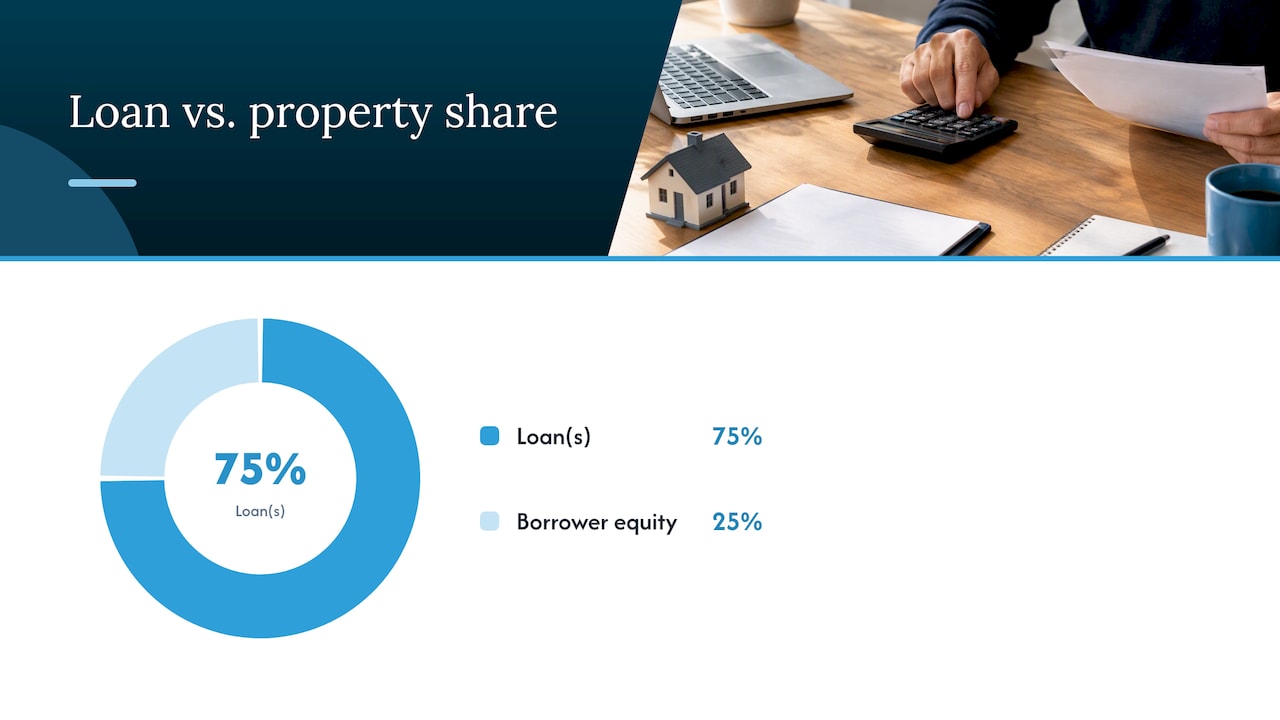
Say you’re buying a property with a loan amount that yields a 75% LTV. Now add a subordinate loan for tenant improvements: combined LTV rises and may push you outside a lender’s comfort zone.
Refinance scenarios work the same way, but you compare the new total debt against current appraised value rather than the original purchase price.
Pro Tip: Always confirm with your lender whether closing costs or fees are included in the loan amount before you run the calculation, since that assumption can shift your LTV by several points.
Typical LTV bands and how they shape pricing and loan terms
Lenders think in bands, and where your deal lands changes the conversation about rate, covenants, and recourse.
- Conservative (60% to 65%): Usually reserved for riskier property types or borrowers with thinner operating history; this band earns the best pricing and the fewest strings attached.
- Common (65% to 75%): The sweet spot for stabilized, income-producing commercial property, where most conventional lenders feel comfortable.
- Stretched (75% to 80%+): Reserved for strong sponsors, stabilized cash flow, or government-backed programs; expect tighter covenants and closer monitoring.
Banks must document written LTV policy limits by property type and report exceptions to their boards, a requirement spelled out in federal examination guidance. When a loan exceeds internal policy, lenders often respond with higher spreads, personal guarantees, mortgage insurance, or additional collateral pledges. Portfolio-level limits on aggregate high-LTV exposure mean your individual exception request competes with every other borrower asking for the same leeway, so documentation matters as much as the number itself.
How LTV interacts with DSCR, debt yield, and cap rate
LTV answers one question: how much equity cushion exists if the lender has to foreclose. It doesn’t tell you whether the property generates enough income to service the debt, which is where debt service coverage ratio (DSCR), debt yield, and cap rate come in.
- DSCR compares net operating income to annual debt payments; most lenders want at least 1.20 to 1.25 times coverage.
- Debt yield divides net operating income by loan amount, giving lenders a leverage-independent view of risk.
- Cap rate reflects the relationship between net operating income and property value, and it drives valuation itself since value often equals NOI divided by cap rate.
For investor-focused financing where DSCR carries more weight than conventional LTV caps, DSCR-based loan programs structure underwriting around income first. Construction and bridge loans flip the priority further still, since stabilized income doesn’t exist yet and lenders lean on sponsor strength and exit strategy instead.
Pro Tip: If your DSCR is strong but your LTV is high, lead your loan application with the income numbers. If LTV is low but DSCR is thin, lead with the equity cushion instead.
Practical ways to lower or manage your effective LTV
Borrowers aren’t stuck with whatever LTV a first offer suggests. A few levers move the number in your favor.
- Increase your down payment or bring in partner capital. More equity upfront directly lowers the ratio, though it ties up cash you might want for operations or other deals.
- Raise the property’s appraised value legitimately. Capital improvements, lease-up of vacant space, and documented stabilized occupancy can lift NOI, which raises value under the income approach and lowers LTV without new cash.
- Time a refinance carefully. Lenders typically want seasoning (time since purchase or last refinance), DSCR minimums met, and stabilized occupancy before approving cash-out that would otherwise push LTV higher.
- Use subordinate financing or guarantees strategically. Mezzanine debt or specific collateral pledges can bridge an equity gap, but they add combined LTV and often trigger closer underwriting scrutiny.
Each tactic trades something: cash, time, or added lender oversight. The right mix depends on how urgently you need the deal to close and how much flexibility you’re willing to give up in the terms.
How SBA 504 financing addresses LTV-sensitive borrowers
For business owners who can’t comfortably hit a 65% to 75% LTV on a conventional loan, the SBA 504 program restructures the equation. A certified development company provides long-term, fixed-rate financing that works alongside a bank loan, which typically lowers the borrower’s required down payment compared to conventional commercial mortgages.
We structure SBA 504 loan offerings around that same principle, including low down payments on qualifying real estate and equipment purchases, fixed-rate programs for long terms, benefits for veterans and their spouses, and assistance programs for borrowers needing help bridging the equity gap.
SBA 504 fits best for owner-occupied commercial real estate or major equipment purchases, and eligibility generally depends on business size, occupancy requirements, and project use, so confirming your specific project against program limits is worth doing early.
Strategies for negotiating LTV terms with lenders
LTV isn’t always a fixed number a lender hands you. It’s often a starting point for negotiation, and a few approaches tend to move it.
Come prepared with documentation that strengthens the rest of your profile, since lenders will trade LTV flexibility for reduced risk elsewhere. A strong DSCR, a clean rent roll, or a personal guarantee from a creditworthy sponsor can all justify a higher LTV than a lender’s standard policy allows.
Shop more than one lender. Internal LTV caps vary by institution, and regulatory guidance sets an outer limit but leaves room for individual bank policy to differ. A community bank with portfolio capacity in your property type might offer better leverage than a larger institution nearing its concentration limits.
Consider staged financing. If a lender balks at your requested LTV, ask whether a lower initial advance with a future draw, tied to a leasing or stabilization milestone, gets you closer to your target without raising the lender’s risk profile today.
Bring a recent appraisal or a credible broker opinion of value to the table rather than relying on the lender’s internal estimate alone. A well-supported valuation can shift the LTV calculation in your favor before negotiations even begin.
Finally, ask about government-backed structures. Programs that blend a conventional loan with a subordinate, fixed-rate second position can reduce your effective cash requirement even when the headline LTV on the primary loan looks conservative.

Choosing an LTV that matches your strategy, not just your comfort
Leverage is a tool, not a goal. A higher LTV frees up capital for other investments but leaves you thinner on downside protection if rents soften or rates climb. We’d lean toward conservative LTV for short holds or volatile property types like hospitality or specialty retail, and we’d accept slightly higher LTV on stabilized, long-term cash-flowing assets like multi-tenant industrial. Before signing anything, stress-test your numbers against a vacancy spike, a rate increase, and cap rate expansion. If the loan still works under all three, your LTV is probably right for your strategy.
— PHENYX
Lower-equity commercial financing through SBA 504 programs
If a 65% to 75% LTV target feels out of reach given your available capital, our SBA 504 structure offers a different path to the same property.
We provide financing across Massachusetts, Rhode Island, Vermont, New Hampshire, and Connecticut through several programs: the 10% down SBA 504 structure for real estate and equipment, our SBA 504 Refinance Program for borrowers looking to restructure existing debt, the VetLoan Advantage Program for veterans and their spouses, and our Down Payment Assistance Program for those who need help closing the equity gap.
Before reaching out, gather your net operating income figures, a current rent roll, a recent appraisal or broker opinion of value, and two to three years of historical financials. Start a conversation through our CDC New England landing page to see which program fits your project.
This article is general information, not a substitute for advice from a qualified financial advisor. Consult a qualified financial professional about your own circumstances before acting on anything here.
FAQ
What is the typical loan-to-value ratio for a commercial property?
Conservative lenders may cap loans closer to 60% for higher-risk property types, while stretched deals with strong sponsors can reach 75% to 80%.
Is a 67% LTV good?
A 67% LTV sits comfortably within the common range lenders prefer for commercial real estate.
What is the payment on a $1,000,000 business loan?
Monthly payment depends on the rate, term, and amortization schedule your lender sets, so there’s no single figure that applies to every $1,000,000 loan. For current fixed-rate SBA 504 options, you can review our Real Estate 25-Year Fixed program details to estimate payments for your specific project.
What does 125% LTV mean?
This situation arises mainly in distressed or specialty financing scenarios and sits well above the supervisory limits regulators expect banks to maintain for improved property.
Sources
- Commercial Mortgage Loans (NAIC/capital markets primer)
- Loan to Value (LTV) — LoopNet CRE Explained
- Commercial real estate lending — FDIC risk management manual
- SBA 504 loans — U.S. Small Business Administration