Unitranche financing suits borrowers who need speed and one set of covenants, typically in competitive sponsor-led auctions, while mezzanine debt fits borrowers willing to trade a higher coupon and an equity kicker for a smaller senior footprint. Mayer Brown’s analysis frames this as a trade-off between execution certainty and engineered cost. We see CDC New England borrowers in equipment and real estate deals weigh both paths before choosing.
TL;DR:
- Unitranche loans offer faster closing with a single credit agreement and internal risk split, while mezzanine debt involves longer, separate documentation with equity features.
- Pricing for unitranche typically ranges from the blended rate of 8% to 15%, with PIK features increasing repayment at maturity; mezzanine often costs more upfront but includes warrants and leverage.
- In distress, unitranche’s internal agreement among lenders can create enforceability questions, whereas mezzanine debt maintains more structural protections and negotiating leverage.
- The choice depends on deal timing, cost sensitivity, asset type, and whether speed or precision is prioritized, with unbundled structures often lowering overall costs.
- Borrowers should rigorously review AAL terms, covenant caps, and redemption clauses to avoid control issues and unexpected costs in future restructurings.
Table of Contents
- Unitranche vs mezzanine at a glance
- How unitranche works: AAL, first-out/last-out, and an example
- How mezzanine debt works: structures, kickers, and returns
- Modeling the all-in cost: unitranche vs layered financing
- Risks and bankruptcy considerations: what AAL terms mean in distress
- Choosing between unitranche and mezzanine: a decision framework
- Negotiation checklist: terms and red flags to watch
- Historical development and market evolution of unitranche and mezzanine financing
- Typical lenders and investors in unitranche vs mezzanine deals
- Impact on financial flexibility and reporting obligations
- Maturity and repayment structures compared
- Publisher perspective: capital strategy over product labels
- FAQ
- Sources
Unitranche vs mezzanine at a glance
Both instruments sit between a senior lender and common equity, but they allocate risk, paperwork, and control very differently. A unitranche loan looks like one facility from the borrower’s seat, even though lenders often split it internally. Mezzanine debt is structured and marketed as a distinct, subordinated layer from day one.
- Capital stack position: unitranche blends senior and subordinated risk into one lien; mezzanine sits as a separate, junior claim behind a true senior lender.
- Documentation: unitranche uses one credit agreement with an internal Agreement Among Lenders (AAL); mezzanine uses its own note purchase agreement, often with warrants.
- Pricing: unitranche carries a single blended rate; mezzanine pricing stacks a cash coupon on top of separate senior debt, frequently with an equity kicker.
- Control: unitranche borrowers negotiate with one lender group; mezzanine borrowers manage two lender relationships with different voting rights and intercreditor terms.
The ABF Journal notes that lenders are increasingly unbundling these stacks, pairing ABL revolvers with cash-flow term loans rather than defaulting to either pure structure.
How unitranche works: AAL, first-out/last-out, and an example
A unitranche facility presents itself to the borrower as a single loan with one interest rate, one maturity, and one set of covenants. Behind that simplicity, the lenders typically divide the economics through a private Agreement Among Lenders that the borrower often never sees in full. Mayer Brown describes this as the defining feature of the product: speed and simpler borrower paperwork, paired with enforceability questions that surface mainly in distress.
Here is how the mechanics typically unfold:
- The borrower signs one credit agreement at a single blended rate.
- Lenders internally split the facility into a first-out tranche (lower risk, lower return) and a last-out tranche (higher risk, higher return).
- In a workout, the first-out tranche recovers before the last-out tranche, even though both sit on the same lien.
- Voting and enforcement rights shift once leverage crosses thresholds set in the AAL, often transferring control to the first-out lender.
Say a $50 million unitranche carries a 9% blended rate.
Pro Tip: Ask the lead lender directly whether an AAL exists, how the facility splits, and what leverage trigger shifts control, before signing a term sheet.

How mezzanine debt works: structures, kickers, and returns
Mezzanine debt is built as a visibly separate layer, which is part of why it takes longer to document than unitranche. Lenders accept subordination to senior debt, so they price in both a higher cash coupon and often an equity-linked sweetener.
- Forms: subordinated notes, second-lien term loans, and payment-in-kind (PIK) notes are the most common structures.
- Lender protections: board observation rights, information covenants, and negative covenants substitute for the collateral position senior lenders hold.
- Equity features: warrants or conversion rights let mezzanine lenders participate in upside, which lowers the cash coupon they need to hit target returns.
- Return drivers: Oaktree Capital’s mezzanine primer describes investors targeting mid-teen blended gross annualized returns, achieved through a mix of cash coupon and modest equity participation.
Because mezzanine lenders carry more risk without a direct security interest, they typically run extended private-side diligence, often stretching several weeks, which slows execution compared with a single-lender unitranche process.
Modeling the all-in cost: unitranche vs layered financing
Pricing is where the two instruments diverge most visibly. According to Arc’s mezzanine financing guide, mezzanine pricing commonly falls in the 8% to 15% range, with many deals layering an equity kicker on top of that cash coupon. A unitranche facility, by contrast, blends senior and junior risk into one rate that usually lands between the pure senior rate and the pure mezzanine rate.
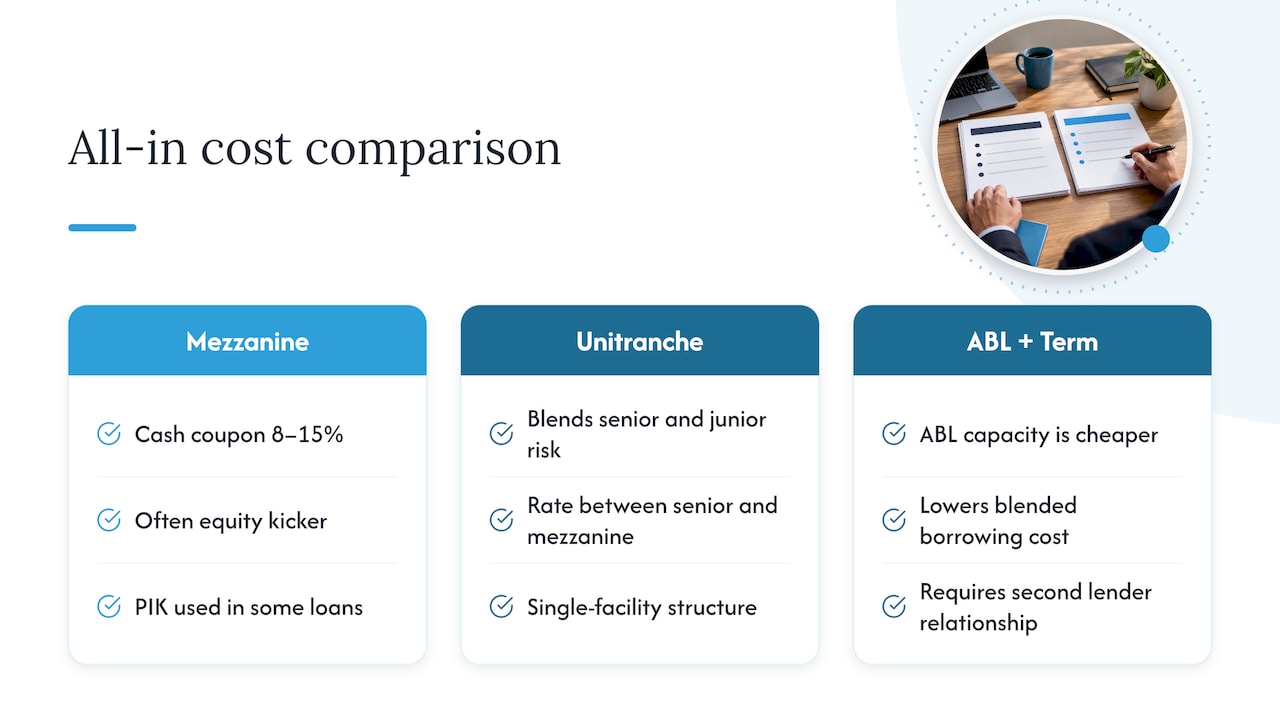
PIK features complicate the comparison further. Arc’s data shows that a notable minority of private market loans included some PIK component in late 2025 datasets, a structure that preserves near-term cash for the borrower while increasing the principal balance due at maturity. A borrower choosing PIK mezzanine trades current cash flow relief for a larger repayment obligation later.
The ABF Journal points to a third option reshaping this math: pairing an ABL revolver with a separate cash-flow term loan. Because ABL capacity is typically cheaper than either unitranche or mezzanine pricing, unbundling the stack this way can lower blended borrowing cost for asset-heavy borrowers, even though it adds a second lender relationship to manage.
Risks and bankruptcy considerations: what AAL terms mean in distress
The simplicity that makes unitranche attractive during origination can become a liability during a workout. Mayer Brown flags unresolved questions about how courts treat a single lien that is internally split by a private AAL, particularly around enforceability and whether last-out lenders can challenge first-out recovery priority.
- First-out lenders generally recover before last-out lenders, even though both hold the same nominal lien position.
- Leverage triggers in the AAL can shift voting and enforcement control away from the borrower’s preferred lender contact.
- Post-petition interest treatment for last-out tranches is an unsettled area that varies by case and jurisdiction.
- Mezzanine lenders lose their coupon and equity upside first in a true liquidation, but they typically retain negotiating leverage through consent rights that unitranche last-out lenders may lack.
Pro Tip: Request the AAL’s leverage-trigger language in writing during diligence, not after a covenant breach, since that single clause often determines who controls a restructuring.
Choosing between unitranche and mezzanine: a decision framework
The right instrument depends less on theory and more on deal size, timeline, and how much the sponsor values precision over speed.
- If the deal needs to close in under 45 days with one signature block, unitranche is usually the faster path.
- If the sponsor wants to minimize blended cost and has time for separate negotiations, senior debt paired with mezzanine often wins on price.
- If the borrower has strong asset coverage, an ABL revolver layered with a term loan can undercut both options on cost.
- If equity dilution is the primary concern, mezzanine’s warrant structure is usually more flexible than giving up additional equity outright.
- If the business is asset-light and cash-flow driven, mezzanine lenders are generally more comfortable underwriting that profile than ABL lenders are.
A sponsor running a competitive auction for a mid-market target often defaults to unitranche for certainty of close. A founder-led recapitalization with more negotiating time may prefer mezzanine to avoid handing over board control. An asset-heavy acquisition, by contrast, frequently fits better with a layered ABL and term loan structure than either single product.
Negotiation checklist: terms and red flags to watch
Borrower counsel should treat these items as non-negotiable review points before signing any unitranche or mezzanine term sheet.
- Request the AAL waterfall in full, not a summary, including exact first-out/last-out splits.
- Set a hard cap on PIK accrual as a percentage of total coupon, not an open-ended toggle.
- Review warrant strike price and anti-dilution mechanics line by line before accepting a mezzanine kicker.
- Confirm consent thresholds for amendments, since a low bar can let one lender block a future refinancing.
- Push for DIP financing access carve-outs so a future restructuring does not get blocked by senior consent requirements.
Pro Tip: Ask for a side letter confirming transparency into AAL triggers even when the main credit agreement keeps those terms confidential.
For borrowers evaluating whether the deal itself is ready for outside capital, the M&A readiness white paper from C3 Dynamic Solutions covers deal structuring and buyer diligence questions that often surface before a financing conversation even starts.
Historical development and market evolution of unitranche and mezzanine financing
Mezzanine debt predates unitranche by decades, emerging from leveraged buyout financing in the 1980s as a way to bridge the gap between senior bank debt and sponsor equity without diluting ownership further. It became a standard middle-market tool through the 1990s and 2000s, largely provided by dedicated mezzanine funds and insurance company balance sheets looking for yield above investment-grade fixed income.
Unitranche emerged later, gaining traction after the 2008 financial crisis as direct lenders and business development companies stepped into a gap left by retreating bank balance sheets. The product’s appeal was speed: a single lender group could underwrite and close a deal that previously required separate senior and mezzanine negotiations. Through the 2010s, unitranche became the default middle-market financing structure for sponsor-backed transactions, prized for certainty of execution in competitive auctions.
More recently, the ABF Journal documents a reversal of sorts: insurance capital flowing into rated senior private credit, combined with rising PIK accommodation, is encouraging sponsors to unbundle the unitranche back into component parts. The market is not abandoning unitranche, but it is no longer treating it as the automatic default it was a decade ago, and mezzanine is finding renewed relevance as a precision tool rather than a fallback.
Typical lenders and investors in unitranche vs mezzanine deals
Unitranche lending is dominated by direct lending funds and business development companies that can underwrite the full facility size internally, then syndicate first-out and last-out pieces to other institutional investors without the borrower needing to manage multiple relationships. These lenders typically prioritize speed and certainty, which is why unitranche has generally become a favored instrument for sponsor-led auctions with tight timelines.
Mezzanine capital tends to come from dedicated mezzanine funds, insurance company general accounts, and specialty finance lenders willing to accept subordinated risk in exchange for a cash coupon plus equity participation. Oaktree’s mezzanine primer describes these investors as running extended private-side underwriting processes and demanding governance protections like board observation rights in place of collateral.
Regional lenders also play a role in supplemental financing, particularly for middle-market and smaller business borrowers who need mezzanine capital alongside more conventional real estate or equipment loans. Mezzanine financing and asset-based lines of credit can serve as supplemental options for borrowers seeking layered capital solutions alongside core SBA 504 lending.
Before finalizing a lender relationship of either type, reviewing a firm’s regulatory standing through resources like FINRA’s BrokerCheck is a reasonable diligence step for intermediaries involved in structuring or placing the debt.
Impact on financial flexibility and reporting obligations
Unitranche financing typically imposes a single set of financial covenants tied to leverage and coverage ratios, which simplifies compliance reporting since the borrower answers to one lender group rather than two. That simplicity has a tradeoff: because the AAL concentrates control with the first-out lender once leverage triggers are crossed, a borrower can lose negotiating flexibility quickly if performance slips, even without a formal default.
Mezzanine debt generally carries fewer maintenance covenants than senior debt, since mezzanine lenders rely more on structural protections like board observation rights and information covenants than on tight financial ratios. This can give borrowers more day-to-day operating flexibility, but it comes with separate reporting obligations to a second lender group, including periodic financial statements and covenant compliance certificates distinct from the senior facility’s requirements.
Both structures affect a borrower’s ability to raise additional capital later. A unitranche AAL’s leverage triggers can restrict further borrowing more abruptly than a mezzanine intercreditor agreement typically does, since mezzanine lenders negotiating from a visibly subordinated position are often more amenable to permitting additional senior debt if it does not impair their junior claim. Borrowers weighing either option should map out how each structure’s covenant package interacts with future financing needs, not just the immediate transaction.
Maturity and repayment structures compared
Unitranche facilities typically carry a single maturity date, often five to seven years, with amortization schedules that blend the first-out and last-out tranches into one borrower-facing repayment schedule even though the underlying AAL may allocate principal payments differently between the two tranches.
Mezzanine debt usually carries a longer effective maturity than the senior debt it sits behind, often extending six months to a year past the senior facility’s term, precisely so mezzanine lenders are not forced to refinance alongside the senior lender. Repayment is frequently interest-only during the term, with principal due at maturity as a bullet payment, a structure that preserves the borrower’s cash flow during the life of the loan but concentrates repayment risk at the back end.
PIK features, common in mezzanine structures, further separate the two instruments’ repayment profiles. A PIK toggle lets the borrower defer cash interest payments by adding them to principal, which increases the amount due at maturity rather than smoothing it across the term the way a typical unitranche amortization schedule does. Borrowers modeling either structure should map the full repayment curve, not just the headline rate, since a lower coupon with PIK accrual can produce a larger final payment than a higher coupon with steady amortization.
Publisher perspective: capital strategy over product labels
Our take: the instrument matters less than the structure behind it. Borrowers who ask about AAL triggers and PIK caps before signing usually negotiate better terms than those who shop purely on headline rate. Layered ABL and term loan structures often reclaim cheaper capacity that a single unitranche facility leaves on the table. Have counsel review the full intercreditor package before closing.
— PHENYX
FAQ
What are the key differences between mezzanine debt and subordinated debt?
Mezzanine debt is a specific type of subordinated debt that typically includes equity-linked features like warrants or conversion rights, while general subordinated debt may carry none of those equity features. Mezzanine also tends to carry a higher coupon and more structural protections, such as board observation rights, than a plain subordinated loan.
What is a B note?
A B note generally refers to the junior or last-out piece of a split senior loan, often used in commercial real estate financing where a single mortgage is divided into an A note (senior) and a B note (subordinated) for risk allocation purposes. It functions similarly to the last-out tranche in a unitranche AAL structure, absorbing losses before the senior piece.
What is a stretch loan?
A stretch loan is a senior loan that extends beyond typical loan-to-value limits, effectively stretching the senior lender’s advance rate to cover some of the risk a mezzanine lender would otherwise take. It serves a similar purpose to mezzanine debt, filling the gap between conventional senior financing and equity, but it stays on the senior lender’s balance sheet rather than creating a separate subordinated layer.
Can you provide an example of mezzanine financing?
A common illustrative example is a $10 million mezzanine note layered behind a senior loan to fund a leveraged buyout, carrying a cash coupon plus warrants that let the mezzanine lender purchase a small equity stake later. This structure lets the sponsor limit upfront equity dilution while still closing the acquisition, a tradeoff Oaktree’s mezzanine primer describes as central to mezzanine’s role in buyout financing.
How can borrowers explore alternative capital solutions?
Borrowers looking to reduce upfront equity needs or refinance existing debt alongside a unitranche or mezzanine decision can review financing options like the SBA 504 Refinance Program or the Down Payment Assistance Program, both of which lower the capital a business needs to bring to closing.