Cost segregation and bonus depreciation are not competing strategies. Cost segregation is the engineering-based process that identifies which parts of a building qualify for shorter depreciation lives, and bonus depreciation is the 100% first-year deduction rate that lets you expense those reclassified components immediately.
Cdcnewengland
cdcnewengland.com
Finance Your Next Commercial Property
CDC New England provides SBA 504 financing for commercial real estate and equipment, with fixed rates and a 10% down payment requirement.
Table of Contents
How cost segregation and bonus depreciation work, and how they differ
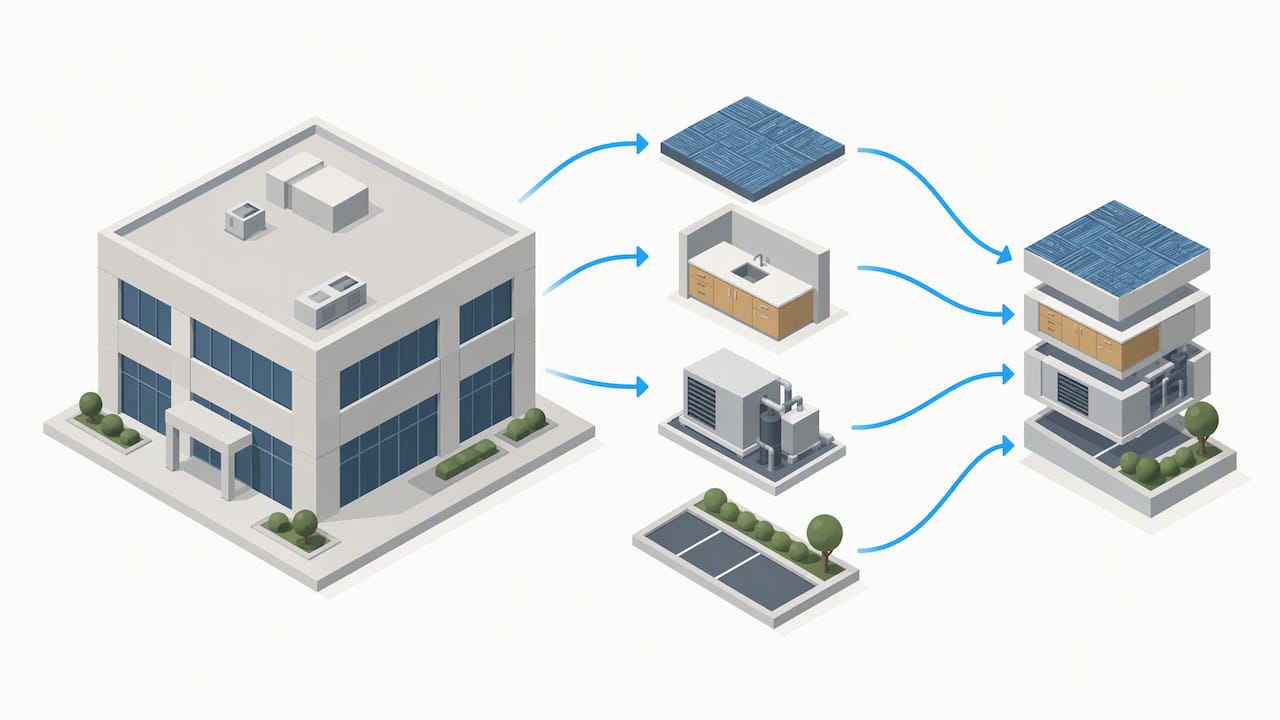
Cost segregation is a study, usually performed by engineers or cost estimators, that breaks a building purchase or construction cost into its component parts and reassigns many of them from standard 27.5-year or 39-year real property depreciation into 5-year, 7-year, or 15-year classes under the Modified Accelerated Cost Recovery System. Carpeting, certain electrical and plumbing work tied to equipment, decorative millwork, parking lot paving, and landscaping are common examples of assets that move into these shorter classes. The rules governing which asset belongs in which recovery period are laid out in IRS Publication 946, which remains the primary federal reference for depreciation mechanics.
Bonus depreciation, created under Internal Revenue Code Section 168(k), is a separate mechanism entirely. It does not reclassify anything. The catch is that bonus depreciation only applies to property with a recovery period of 20 years or less. A building’s structural shell, with its 27.5-year or 39-year life, does not qualify. The components a cost segregation study pulls out of that shell, because they carry 5-year, 7-year, or 15-year lives, do qualify.
This is where the §1245 versus §1250 distinction matters. Section 1245 property covers tangible personal property and certain land improvements, the carpeting, fixtures, and specialty equipment that cost segregation typically reclassifies. Section 1250 property is the real property itself, the building structure and its core systems. A cost segregation study’s real function is reallocating basis from §1250 into §1245 wherever the engineering and tax law support it, since only the §1245 portion becomes bonus-eligible. The Cost Segregation Audit Technique Guide walks through acceptable allocation methods for making that distinction defensible.
What qualifies for 100% bonus depreciation now
The IRS newsroom guidance confirms this restoration and notes that taxpayers may rely on existing additional first-year depreciation regulations while the agency finalizes proposed rules.
A separate category, qualified production property, carries its own placed-in-service threshold. Property used in manufacturing, production, or refining activities that is placed in service after July 4, 2025 can qualify for the 100% allowance under rules clarified in Notice 2026-16, which provides interim guidance on how that unadjusted depreciable basis is treated until formal regulations arrive.
A few planning details are easy to miss. Taxpayers can elect a reduced bonus percentage instead of the full 100% in certain circumstances, which sometimes makes sense when preserving future deductions matters more than maximizing the current year. Used property generally still qualifies for bonus depreciation as long as the taxpayer did not previously use the asset and the acquisition meets the law’s arm’s-length requirements. None of this guarantees a state tax benefit. Many states decouple from federal bonus depreciation entirely, which means a deduction that wipes out federal taxable income can still leave a state tax bill behind. Any projection you run should model state addbacks separately rather than assuming the federal result carries through.
What a cost segregation study does in practice
A cost segregation study generally takes one of two forms. An onsite engineering study involves a site visit, detailed cost estimating, and a full engineering breakdown of every building component, typically running from several thousand dollars up into the tens of thousands depending on property size and complexity. A desktop or automated study relies on blueprints, photographs, and comparable cost data rather than a physical site visit, and it costs less but may carry less documentation weight if the IRS ever asks questions.
A credible study’s final report includes a detailed allocation schedule showing how total project cost splits across asset classes, a reconciliation tying that allocation back to the actual purchase price or construction contract, and supporting photos, diagrams, or engineering take-offs that justify each classification. The Cost Segregation ATG specifically flags studies that apply a flat percentage to total cost without this kind of backup as a weak point under examination.
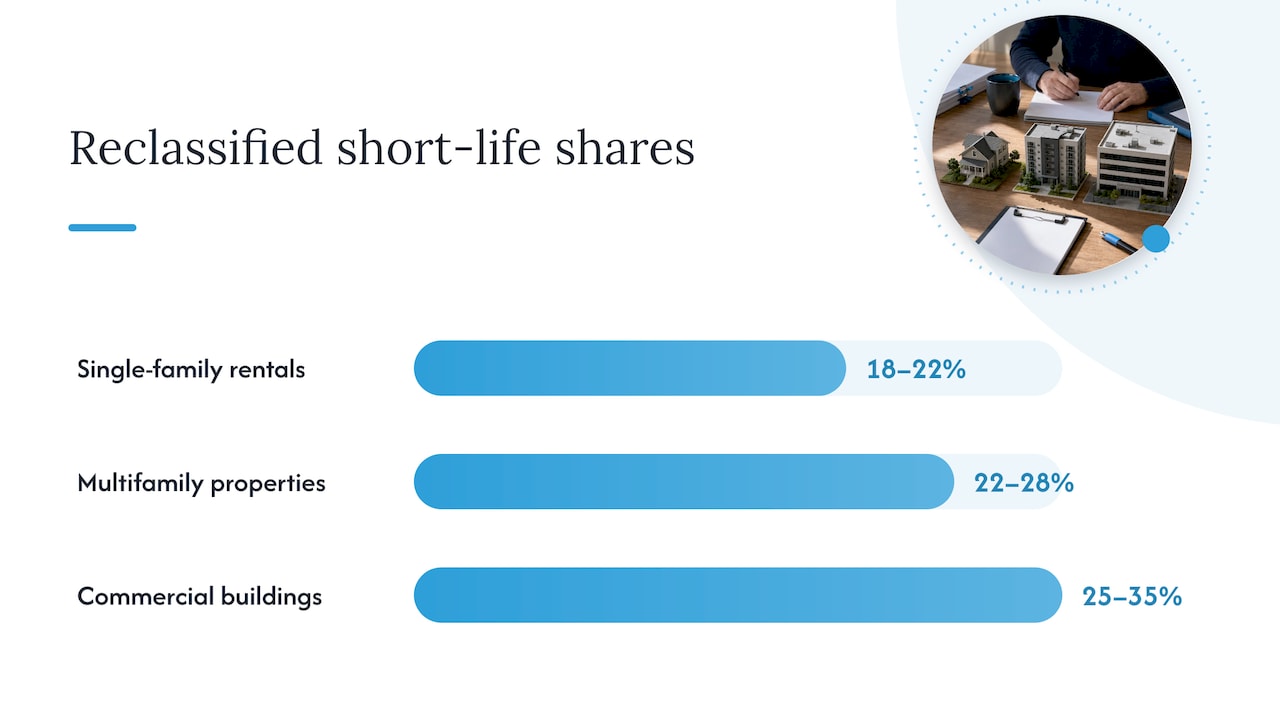
Reclassification outcomes vary by property type. Industry modeling shows single-family rentals commonly see 18% to 22% of depreciable basis reclassified into short-life property, multifamily properties often land between 22% and 28%, and commercial buildings can reach 25% to 35% depending on finish-out and specialty systems. That gap between the small share automatically bonus-eligible and the larger share after cost segregation is the entire reason cost segregation exists as a strategy: it is what makes the bulk of a building’s cost bonus-eligible in the first place.
Practical Year-1 math: example scenarios
Numbers make the relationship concrete. Say an investor buys a $1,000,000 residential rental property, with $800,000 allocated to the depreciable building and $200,000 to land. Without a cost segregation study, maybe $40,000 of that $800,000 basis, items like appliances already broken out on the closing statement, is clearly bonus-eligible.
Now say that same investor orders a cost segregation study and it reclassifies a significant portion of the $800,000 building basis, a figure consistent with commonly observed ranges for single-family rentals, into 5-year, 7-year, and 15-year property. That is $160,000 of newly bonus-eligible basis. Combined with the original $40,000, the Year-1 deduction jumps to $200,000, five times larger than the no-study scenario.
At a 32% marginal federal rate, the $160,000 incremental deduction from the study translates to roughly $51,200 in additional tax savings in Year 1 alone, well above the typical cost of an engineering study on a property this size.
That math is sensitive to three variables, especially when considering capital gains on a home sale and its impact on overall tax planning. The study’s own cost eats into the net benefit, so a $1,500 desktop study on a small property returns differently than a $15,000 onsite study on a large commercial building. A short holding period compresses the window before depreciation recapture claws some of that benefit back at sale. And a lower marginal tax rate in the year of the deduction shrinks the dollar value of the same percentage reclassification.
When cost segregation plus bonus depreciation is worth it
Not every property justifies the cost of a formal study. A few decision rules help filter candidates quickly.
Pro Tip: Pair a large Year-1 deduction with fixed-rate, long-term financing so the cash flow freed up by lower taxes isn’t immediately absorbed by a variable-rate loan payment that climbs over time.
Filing, elections, documentation, and audit considerations
If you missed claiming accelerated depreciation on a property you already own, you generally do not need to amend prior-year returns. Form 3115, the application for change in accounting method, lets you capture a catch-up adjustment for all the depreciation you should have claimed in prior years as a single adjustment in the current year’s return. This is the standard practitioner workflow when a cost segregation study is performed on a property that has been in service for a while.
Your tax file should hold the complete cost segregation report, including the allocation schedule and engineering backup, along with the original purchase invoices or construction contracts, a reconciliation showing the allocation ties back to total project cost, and any Form 3115 filed to implement the change. The Cost Segregation ATG explicitly tells IRS examiners to look for this kind of documentation, and a study lacking it is a common audit trigger.
Some taxpayers elect out of bonus depreciation entirely for a given asset class in a given year, usually because they expect higher tax rates in future years and prefer to spread deductions forward, or because they want to preserve net operating losses for a year when they will carry more value. That election is made on a timely filed return and applies by MACRS class, not asset by asset.
Integrating tax acceleration into a longer-term financing and growth plan
Accelerated depreciation is a timing benefit, not free money. It shifts deductions into Year 1 that you would otherwise claim over decades, which means the cash flow it frees up is most valuable when matched against a deliberate plan rather than spent as a windfall.
The properties and equipment purchases most likely to benefit from a large cost segregation reclassification tend to be the same ones financed with long-term, fixed-rate debt, since both strategies work best over a multi-year holding horizon. We work with business owners across New England financing commercial real estate and equipment acquisitions, and we consistently see the strongest outcomes when a large Year-1 tax deduction gets paired with a financing structure that locks in predictable payments rather than one that leaves the investor exposed to rate swings down the road.
CDC New England: turning tax savings into growth capital
A large Year-1 deduction from cost segregation and bonus depreciation is most useful when it funds something, a down payment on the next property, an equipment upgrade, or breathing room during a refinance. We provide SBA 504 loans with fixed rates for up to 25 years and a 10% down payment requirement well below conventional commercial financing, which pairs naturally with the cash flow a cost segregation study frees up.
Our SBA 504 Refinance Program also helps restructure existing debt once tax-driven savings give you more flexibility to act. If you are planning a property acquisition or equipment purchase and want to see how fixed, long-term financing fits alongside your depreciation strategy, reach out to our team for a financing scenario built around your numbers.
This article is general information, not a substitute for advice from a qualified financial advisor. Consult a qualified financial professional about your own circumstances before acting on anything here.
FAQ
What qualifies for 100% bonus depreciation?
Property with a MACRS recovery period of 20 years or less, including the components a cost segregation study reclassifies out of a building’s structure, generally qualifies for the full 100% rate when acquired and placed in service after January 19, 2025, under the One Big Beautiful Bill Act restoration. Qualified production property placed in service after July 4, 2025 follows its own rules under Notice 2026-16.
Is it worth it to do a cost segregation study?
A study tends to pay for itself when the depreciable basis is large enough, generally above roughly $300,000, and when you plan to hold the property long enough to use the resulting deduction without an immediate recapture event at sale. Smaller properties can still benefit from a lower-cost desktop study rather than a full engineering analysis.
How much can you write off with cost segregation?
The amount depends on how much basis gets reclassified into short-life property, and industry modeling shows that share commonly runs from 18% for single-family rentals up to 35% for commercial buildings, compared with only about 3% to 6% of basis being bonus-eligible without a study.
Can you write off 100% of a heavy vehicle’s cost?
The specific depreciation limits that apply to vehicles depend on gross vehicle weight rating and business use percentage, so confirming the exact figures for your situation against Publication 946 or a tax professional is worthwhile before filing.