To get approved for a commercial real estate loan in Rhode Island, you need to show a lender three things: the property’s cash flow (or your business’s) can cover the debt, you have real equity in the deal, and you and your team can run what you are buying. If you plan to occupy the building yourself, the SBA 504 program is built for that situation. It lets you put as little as 10% down and lock a fixed rate for up to 25 years.
This guide walks through what underwriters look at, how a 504 deal is structured, which documents to gather, and how to move from first call to closing.
TL;DR
- Lenders approve on repayment ability first, collateral second. Expect to prove cash flow, equity, management experience and a believable plan.
- For owner-occupied property, an SBA 504 loan typically splits financing three ways: a bank at up to 50%, a Certified Development Company (CDC) at up to 40%, and you at 10% or more.
- You must occupy at least 51% of an existing building, so 504 is not a vehicle for pure investment property.
- Call a CDC before you sign a purchase agreement, not after. Structure decisions made early prevent most delays.
- Rhode Island also has local capital layers, such as tax increment financing and the Small Business Loan Fund, that can sit alongside a primary loan.
Table of Contents
- What lenders actually evaluate
- Why SBA 504 fits many Rhode Island owner-users
- Documents to gather before you apply
- Step-by-step: from first call to approval
- Rhode Island capital that can sit beside your loan
- Our perspective: approval is mostly preparation
- Programs that help you clear common hurdles
- Common reasons applications stall
- FAQ
- Sources
What lenders actually evaluate
Banking regulators describe sound commercial real estate lending as resting on clear, measurable underwriting standards. Federal interagency guidance points institutions to loan-to-value limits, property cash flow and borrower net worth. In practice, that becomes five questions on the loan officer’s desk.
1. Can the cash flow carry the debt?
The debt-service coverage (DSC) ratio compares annual net operating income to annual loan payments. The same guidance cites a ratio of 1.5 or greater as one example benchmark in some regulated settings. Individual lenders set their own thresholds, so ask each one for theirs. If your ratio is thin, a longer amortization or a lower down-payment structure can change the math, which is one reason fixed 20- and 25-year terms matter.
2. How much equity are you putting in?
Conventional commercial loans commonly ask for a larger down payment than residential ones. Lenders want to see hard equity because it keeps you invested in the outcome. Under the SBA 504 program, the minimum is 10% from the borrower, and we cover how that works below.
3. What is the property worth?
Expect an appraisal, usually an environmental review for certain property types, and a title search. The lender’s loan-to-value limit caps how much it will advance against the appraised number, not against your purchase price.
4. Who is behind the business?
Underwriters read your management experience, your industry track record and your personal credit. Expect a personal guarantee from owners of meaningful stakes. Lenders look past collateral value to your grasp of the market, which is why a one-page business plan will not carry a loan request.
5. Does your business compare well with its peers?
Lenders benchmark your margins, leverage and growth against similar companies. You can do the same homework before you apply. Industry financial benchmark data, such as the industry and geography benchmarks that credit analysts use for loan underwriting, helps you spot ratios that will raise questions and prepare an explanation before the lender asks.
Why SBA 504 fits many Rhode Island owner-users
The SBA describes the 504 program as long-term, fixed-rate financing for major fixed assets such as owner-occupied commercial real estate and machinery with a useful life of at least 10 years. The maximum SBA-backed portion is $5.5 million. To qualify, your business must be a for-profit small business with tangible net worth under $15 million and average after-tax net income under $5 million for the prior two years.

How the three-part structure works
The SBA’s Office of Inspector General summarizes the standard 504 structure: a third-party lender provides at least 50% of project financing, the CDC provides up to 40% through a 100% SBA-guaranteed debenture, and the applicant provides at least 10%.
Here is what that looks like on a hypothetical $2,000,000 building purchase, with illustrative numbers only:
| Source | Share | Amount |
|---|---|---|
| Bank (first lien) | 50% | $1,000,000 |
| CDC debenture (second lien) | 40% | $800,000 |
| Your equity | 10% | $200,000 |
Because the CDC portion carries a fixed rate for the full term, a large part of your financing stays predictable for decades. Our current published rates are 6.73% on a Real Estate 20-Year Fixed and 6.77% on a Real Estate 25-Year Fixed, and 6.58% on an Equipment 10-Year Fixed. The bank portion is priced separately by the bank. You can read more about how 10, 20 and 25 year terms compare.
The occupancy rule you cannot skip
The SBA requires you to occupy at least 51% of an existing building. For new construction, the figure is 60% immediately, with a plan to reach 80% of the rentable space within 10 years. A project that fails these thresholds can be disqualified, because the program funds owner-occupied assets, not speculative investment. Our guide to 504 eligibility for New England borrowers goes through the details.
Using 504 to refinance
If you already own your building and carry expensive or short-term debt, refinancing may be possible. Qualified debt generally must have been incurred at least two years before you apply and must relate to your business’s fixed assets or expansion. The SBA finalized a 2024 rule that changed how refinancing with expansion works. Be ready to document the original business purpose of the debt. Our SBA 504 Refinance Program is the place to start.
Documents to gather before you apply
A complete package shortens underwriting more than almost anything else. Start with this list:
- Three years of business tax returns and year-to-date financial statements.
- Personal tax returns and a personal financial statement for each owner of 20% or more.
- A debt schedule listing every current obligation, with balances, rates and maturities.
- The purchase contract or letter of intent, plus any lease you will terminate.
- A description of the project and how you will use the space, including the percentage you will occupy.
- Resumes for the principals and a short summary of management experience.
- Business formation documents, licenses and a current organizational chart.
- For refinancing: original loan documents and proof of how the proceeds were spent.
If your business is young, ask about options in our guide to SBA 504 for startups, which covers pairing 504 with a 7(a) loan.
Step-by-step: from first call to approval
- Define the project. Decide whether you are buying, building, renovating or refinancing, and what you can afford in monthly payments, not only in price.
- Talk to a CDC early. The SBA’s own guidance says that CDCs originate 504 loans together with a senior lender. A CDC can help you set the structure before you commit to a property.
- Get a bank partner. The senior lender funds the first-lien portion. Your CDC can help you present the project to a bank at the same time.
- Run the numbers. Build a DSC projection under the new payment, using your actual trailing financials and conservative revenue assumptions.
- Submit the application and package. Respond to underwriter questions the same day when you can.
- Order third-party reports. Appraisal, environmental review and survey are common, and their timing often sets your closing date.
- Receive approvals. The bank issues its commitment and the SBA authorizes the CDC debenture.
- Close and fund. The bank portion closes at the start, and the CDC debenture is funded after it, replacing the interim financing on the CDC share.
If your timeline is tight, ask whether your CDC has Premier Certified status. At CDC New England, that status is how we aim for faster approvals.
Rhode Island capital that can sit beside your loan
A main loan is not the only layer. Rhode Island has programs worth asking about:
- Tax Increment Financing (TIF). The Executive Office of Commerce administers TIF, which rebates a portion of new state tax revenue for qualified projects, up to 30% of total project costs.
- Small Business Loan Fund. For smaller projects, the state’s Small Business Loan Fund offers direct, fully secured loans from $50,000 to $250,000 for land, buildings, improvements and equipment, with terms up to 10 years on fixed assets. That scale suits small purchases or add-on improvements rather than a full building acquisition.
- C-PACE. Commercial Property Assessed Clean Energy financing covers energy and environmental health upgrades, but your host municipality must opt in. Check with your town before counting on it.
Rules and funding levels change, so confirm current terms with each agency before you build them into your budget.
Our perspective: approval is mostly preparation
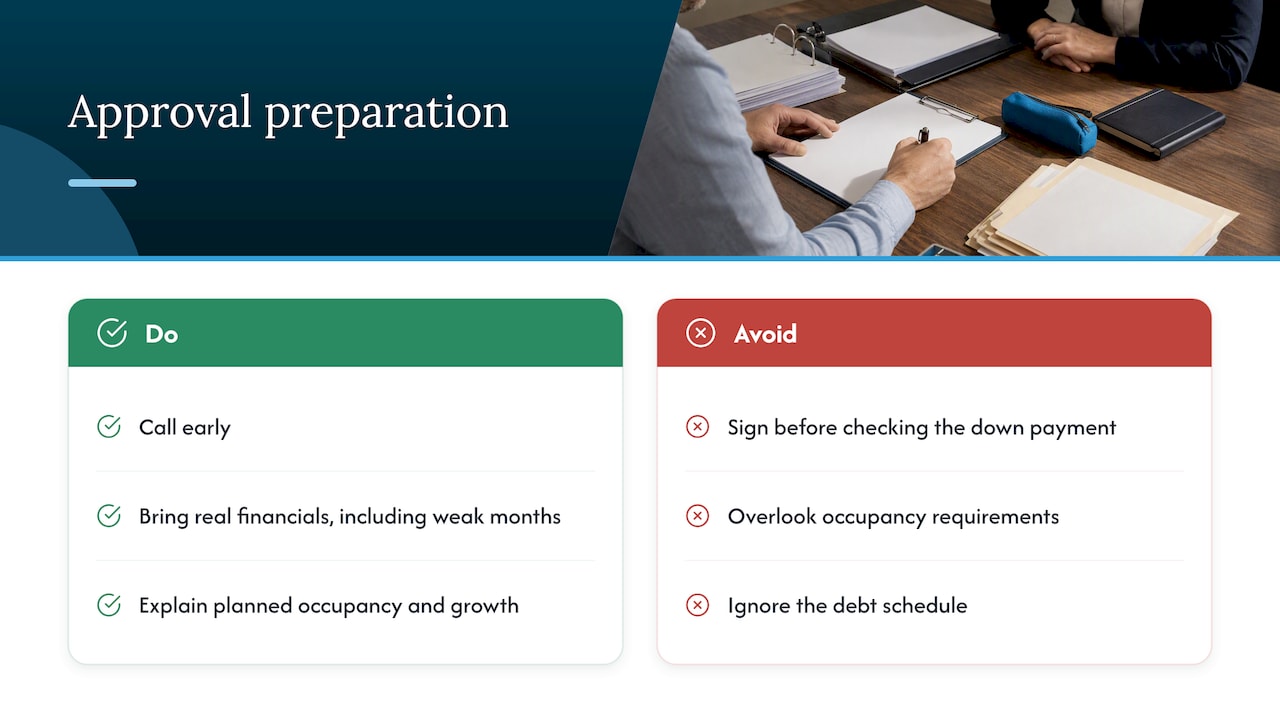
We have worked with New England owner-occupants for more than 70 years and have invested over $2.3 billion in regional businesses. What we see repeatedly is that approvals are rarely lost on the property. They are lost on timing and structure: a borrower signs a purchase agreement with a 30-day clock before learning that the down payment is short, or the occupancy percentage does not meet the rule, or the debt schedule has a surprise.
So our advice is plain. Call early. Bring your real financials, including the weak months. Tell us what you plan to occupy and how fast you plan to grow into the rest. A fixed rate over 20 or 25 years, with 10% down, often keeps working capital in your business for hiring and inventory instead of tying it up in the building. For veterans and spouses, and for owners who need help with the down payment, we have dedicated programs, described below.
— PHENYX
Programs that help you clear common hurdles
If the 10% equity is your obstacle, our Down Payment Assistance Program is designed for commercial property acquisition. If you or your spouse served, the VetLoan Advantage Program offers special terms, with a 1.0% processing fee. For a view of what our standard financing looks like, see our real estate and equipment loan rates. Talk to us before you make an offer on a building, and we will help you test whether the structure works.
Common reasons applications stall
- Not enough owner occupancy. Count square feet honestly, including any space you plan to lease to others.
- Unclear use of funds. Refinance requests need records tying old debt to business assets.
- Thin coverage. Recheck your DSC with the new payment, property taxes and insurance included.
- Late documents. Missing tax returns and unsigned statements add days to the timeline.
- Choosing the wrong product. Equipment with a useful life under 10 years generally does not fit 504. Our comparison of 504 versus equipment financing explains the distinction.
FAQ
What credit score do I need for a commercial real estate loan in Rhode Island?
There is no single statewide minimum. Lenders set their own standards, and the review covers your personal credit, business credit and cash flow together. A stronger score helps, but a documented history of paying obligations on time and solid coverage can offset a modest score. Ask your lender for its specific cutoff before you apply.
How much down payment do I need?
It depends on the loan type. Under the SBA 504 program, the borrower provides at least 10% of project costs. Some projects, such as special-purpose properties or startups, may require more. Down payment assistance may be available for qualifying acquisitions.
Can I use a commercial real estate loan to buy an investment property?
Not with SBA 504. The program is for owner-occupied property, and you must occupy at least 51% of an existing building. Pure investment properties are financed through conventional commercial or other investor loans.
How long does approval take?
It varies with the complexity of the project and how fast you return documents. Appraisals and environmental reports often set the pace. Starting with a complete package and a CDC with Premier Certified status can help avoid delays.
Sources
- 504 loans, U.S. Small Business Administration
- Verification Inspection of SBA’s 504 Loan Liquidation Process
- SBA final rule on 504 debt refinancing, September 30, 2024
- Federal interagency guidance on commercial real estate lending
- Tax Increment Financing, Rhode Island Executive Office of Commerce
- Small Business Loan Fund, RI.gov