

If you run a medical, dental or specialty practice in New England and want to own your building, the SBA 504 loan is usually the strongest place to start. It pairs a bank first mortgage with a long-term, fixed-rate second loan from a Certified Development Company (CDC), so you can buy with as little as 10% down. This guide compares 504 with the other common ways to buy, then walks through occupancy rules, a worked example and the steps to apply.
TL;DR
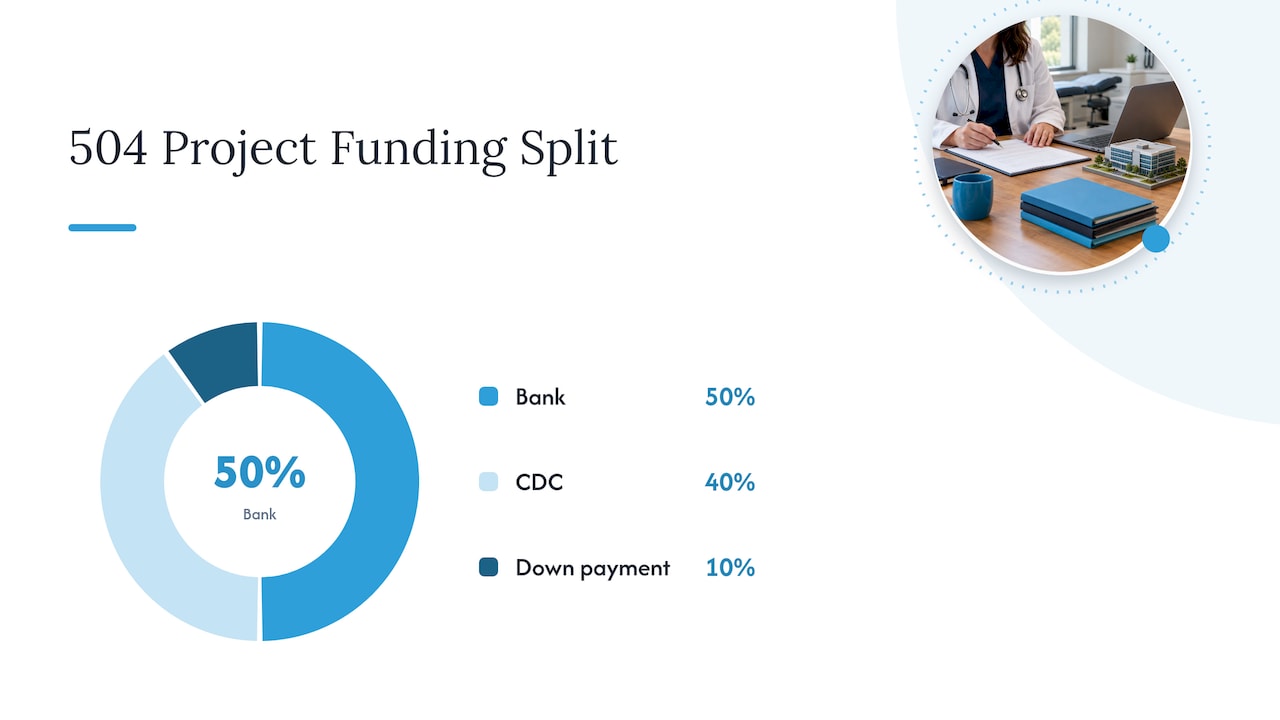
- The standard 504 structure is 50% bank, up to 40% CDC and 10% borrower, which keeps your cash outlay low compared with many conventional deals.
- Your practice must occupy at least 51% of an existing building. New construction requires 60% at first, rising to 80% within 10 years.
- The CDC portion carries a fixed rate for 10, 20 or 25 years. Our published real estate rates are 6.73% (20-year) and 6.77% (25-year) as of September 2026, and they change.
- SBA 7(a) and a conventional bank loan are the main alternatives. 504 tends to win on down payment and rate stability. 7(a) wins when you also need working capital in the same loan.
Table of Contents
- Why medical practices buy instead of lease
- How the SBA 504 structure works for an office purchase
- Occupancy rules every practice should check first
- What the 504 loan can pay for
- Comparing your options
- Refinancing a practice’s existing building
- Our perspective: where practices gain most from 504
- Steps to apply
- Finance your practice’s building with CDC New England
- FAQ
- Sources
Why medical practices buy instead of lease
Rent is a cost you never recover. A mortgage payment builds equity in a building that, for a practice, is often its most valuable fixed asset. Ownership also gives you control over the build-out: plumbing for operatories, imaging rooms, shielding, accessible entrances, and the layout your workflow actually needs.
The obstacle has always been cash. A conventional commercial mortgage commonly asks for 20% to 30% down, and the practice owner is also funding equipment, staff and renovations. The 504 program was built for this problem. It finances major fixed assets that promote business growth and job creation, and medical and dental offices fit comfortably within it as owner-occupied commercial real estate.
How the SBA 504 structure works for an office purchase
A 504 project has three pieces:
- A bank first mortgage, about 50% of the project. A private lender makes and services this loan, at its own rate and term.
- A CDC debenture, up to 40%. The CDC, a nonprofit certified and regulated by the SBA, funds this second lien through an SBA-guaranteed debenture. The rate is fixed for the life of the loan.
- Your equity, at least 10%. This is your down payment.
The SBA states that the maximum debenture is $5 million for standard projects and $5.5 million for manufacturing or energy projects. Most single-practice office purchases sit well under that ceiling.
A worked example
Suppose a group practice buys a building and funds the renovation as one $3,000,000 project. On the standard 50/40/10 split:
| Piece | Share | Amount |
|---|---|---|
| Bank first mortgage | 50% | $1,500,000 |
| CDC debenture | 40% | $1,200,000 |
| Your down payment | 10% | $300,000 |
The same project at 25% down on a conventional loan would call for $750,000 of your cash. The difference of $450,000 stays in the practice for equipment, hiring and the months it takes a new location to fill its schedule. That is what “preserving working capital” means in practice.
The equity requirement can be higher in some situations, for example when the practice is a startup or the building is considered special-use. Ask your CDC to classify your property before you sign a purchase contract.
Occupancy rules every practice should check first
The 504 program is for owner-occupied property, and the occupancy test is where medical deals most often stumble. According to a regulatory reference on SBA SOP 50 10 8, the thresholds are:
- Existing building: your practice occupies at least 51% of the rentable square footage.
- New construction: at least 60% at the start, with a plan to reach 80% within 10 years.
The remaining space in an existing building can be leased to others, up to the 49% limit. For a practice, that is a useful feature. A two-story building might house your clinic on the first floor, with the second floor leased to a physical therapist or lab tenant, whose rent helps cover the mortgage.
If you are planning new construction, write your growth plan into the application. Show how you will fill the additional space, whether through added providers, a new service line or a related entity. Our guide on 51% occupancy and SBA 504 eligibility covers how New England borrowers document this.
Real estate holding company and practice entity
Many physicians hold property in a separate LLC and lease it to the practice. This is a common structure, and the 504 program can accommodate it when the operating practice meets the occupancy and eligibility conditions. Because ownership details affect eligibility, share your entity chart with a CDC early, before you form or retitle anything.

What the 504 loan can pay for
For a medical practice, eligible costs typically include:
- Purchase of an existing office building or condominium unit
- Land and new construction
- Major renovations and tenant build-out of the space you occupy
- Long-lived equipment with a useful life of at least 10 years
- Certain soft costs tied to the project
Working capital, inventory and routine supplies are not eligible under 504. If you want those in the same transaction, you may be looking at a 7(a) loan, covered below.
Comparing your options
Practice owners usually weigh three paths. Here is how they compare on the criteria that matter most.
| Criteria | SBA 504 (bank + CDC) | SBA 7(a) | Conventional bank mortgage |
|---|---|---|---|
| Typical down payment | 10% minimum | Often around 10%, set by the lender | Frequently 20% to 30% |
| Rate structure | Fixed on the CDC portion for up to 25 years | Often variable, fixed options vary by lender | Often fixed for 5 to 10 years, then reset |
| Best for | Buying, building or renovating owner-occupied real estate and long-lived equipment | Real estate plus working capital, or an acquisition of another practice | Borrowers with large equity and a strong banking relationship |
| Working capital in the loan | No | Yes | Usually no |
| Occupancy requirement | 51% existing, 60% new construction | Owner-occupancy rules also apply | Set by lender |
Treat the down payment and rate cells as general patterns. Individual lenders set their own terms, and rates move.
When 504 is the better fit
Choose 504 when the main goal is the building. You get a lower down payment, a long amortization that keeps the monthly payment manageable, and a fixed rate on 40% of the project, so a large share of your debt cost cannot rise. Our overview of 10, 20 and 25 year 504 terms explains how to match term to purpose: the 10-year option for equipment, 20 or 25 years for real estate.
When 7(a) or a conventional loan may fit
If you are buying another practice, need to cover payroll during a ramp-up, or want one loan to do everything, a 7(a) may be simpler. If you have substantial cash and a bank that will give you a good rate and a short approval timeline, a conventional mortgage can work. In both cases, ask what the down payment, rate reset and prepayment terms would be over the full ownership period, not just year one.
Refinancing a practice’s existing building
If you already own your office building, 504 can also lower your cost of capital. The SBA finalized a rule that expanded debt refinancing eligibility under the program, including projects without a business expansion and without a minimum payment reduction requirement.
For a practice that bought with a balloon or adjustable-rate loan, a fixed 25-year term can replace payment uncertainty with a schedule you can forecast. Comparing your current loan with market norms helps here, and industry financial benchmarks give a useful reference for how debt service coverage looks for businesses like yours. We explain the process in commercial mortgage refinance options and on our SBA 504 Refinance Program page.
Our perspective: where practices gain most from 504
We have worked with New England businesses for more than 70 years and have invested over $2.3 billion in regional projects. A few patterns stand out when the borrower is a practice.
Cash timing matters more than the rate. A practice owner is often buying a building in the same year as new equipment and a staffing increase. A 10% down payment protects liquidity during the months when revenue at the new location has not caught up.
Occupancy is a planning exercise, not an obstacle. Most buildings that suit a practice have extra space. We would rather help you structure the 49% you do not occupy as a leasing plan than watch you pass on a good building.
Start with the CDC before the purchase contract. Eligibility, equity and property type are easier to settle before you are under a deadline. Our Premier Certified status is designed to support faster approvals, and our regional focus means we know the five-state market: Massachusetts, Rhode Island, Vermont, New Hampshire and Connecticut.
Cash for the down payment can be a bridge, too. If the 10% is the sticking point, our Down Payment Assistance Program is built for that gap. Veterans who own practices should also look at the VetLoan Advantage Program, which lists a 1.0% processing fee.
— PHENYX
Steps to apply
- Define the project. Purchase price, renovation budget, equipment and expected square footage you will occupy.
- Run the occupancy math. Confirm 51% (existing) or 60% (new construction) and note your plan for any leased space.
- Talk to a CDC and a bank together. The bank handles the first mortgage, the CDC the debenture, so they need to be aligned on the project.
- Gather documents. Business and personal financial statements, tax returns, a practice description and a project budget. The SBA’s Form 1244 application for 504 loans shows what the applicant must supply.
- Move through approval and closing. The SBA guarantees the debenture, and the CDC closes the loan with the bank’s first mortgage.
Lenders in New Hampshire and across the region also publish local guidance, such as our commercial building loans for New Hampshire business owners.
Finance your practice’s building with CDC New England
We offer SBA 504 financing for owner-occupied real estate and equipment across New England. Our published rates, as read on September 16, 2026, are 6.73% for a 20-year fixed real estate loan, 6.77% for a 25-year fixed real estate loan and 6.58% for a 10-year fixed equipment loan. Rates move, so confirm the current figure with us. See the options on the CDC New England home page and tell us about your building.
FAQ
Can a medical practice use an SBA loan to buy a commercial building?
Yes. Medical and dental offices are eligible as owner-occupied commercial real estate under the 504 program, as long as the practice meets the occupancy requirement, which is 51% for existing buildings. The practice can also finance renovation and long-lived equipment in the project.
How much down payment does a 504 loan require?
The minimum is 10% of the project cost, with the bank financing 50% and the CDC up to 40%. Certain situations, such as startups or special-use property, can raise the equity requirement, so ask your CDC to review your specific building.
Can I lease part of the building to other tenants?
Yes, for an existing building you can lease the space your practice does not occupy, up to the 49% limit. For new construction, you must plan to grow into more of the building, reaching 80% within 10 years.
What is the maximum 504 loan amount?
The SBA sets the maximum debenture at $5 million for standard projects and $5.5 million for manufacturing or energy projects. The total project can be larger because the bank’s first mortgage and your equity are added to the debenture.
Sources
- 504 loans, U.S. Small Business Administration
- SBA lender resources: partnering with SBA loan programs
- SBA SOP 50 10 8.1 regulatory reference
- SBA rule expanding 504 debt refinancing, September 30, 2024
- SBA Form 1244, Application for Section 504 Loans


