

An SBA 504 loan can help you buy, build, expand or refinance the building your childcare center operates in, with a 10% down payment and a fixed rate on the portion funded through a Certified Development Company (CDC). If you run a licensed daycare, preschool or early learning center in Massachusetts, Rhode Island, Vermont, New Hampshire or Connecticut, and you plan to occupy the property yourself, the program is built for the way your business uses real estate.
Below, we explain how the structure works, what a childcare project has to prove, which costs qualify, and how to prepare before you apply.
Cdcnewengland
Finance a Building for Your Childcare Center
CDC New England provides SBA 504 financing for businesses acquiring commercial real estate, with a 10% down payment requirement and fixed rates up to 25 years.
TL;DR
Table of Contents
Why the 504 program suits childcare operators
Childcare is a real estate heavy business. Space drives your licensed capacity, and licensed capacity drives revenue. Classrooms, outdoor play areas, kitchens, restrooms and safe entry points are fixed features, and a lease gives you little control over any of them. Many operators spend years improving a leased building, then face a rent increase or a landlord who decides to sell.
Owning the property changes that. Your occupancy cost becomes a predictable payment instead of a rent schedule you do not control. The 504 program is designed for this move. SBA describes it as long-term, fixed-rate financing for major fixed assets that promote business growth and job creation, delivered through CDCs, which are nonprofit, community-based lenders.
Three features matter most to a center owner:
For a deeper look at how the pieces fit, see our guide to the 50/40/10 SBA 504 structure.
How the 50/40/10 structure works for a daycare purchase

A 504 project has three layers. A bank or other private lender provides the first mortgage, usually 50% of the project cost. The CDC provides a second loan, funded through an SBA-backed debenture, for up to 40%. You contribute the remaining 10% as equity. The SBA’s own page describes the 50% senior lender, up to 40% CDC and 10% borrower split.
Here is a simple illustration with round numbers, not a quote or a promise of terms:
Project itemAmountBuilding purchase$1,300,000Renovation and playground work$200,000Soft costs and closing costs$100,000Total project cost$1,600,000Private lender first mortgage (50%)$800,000CDC second loan (up to 40%)$640,000Your equity (10%)$160,000
The equity requirement can rise in some situations, for example when the business is a startup or the property is a special-purpose building. Childcare facilities can fall into these categories, so ask your CDC early how your specific project will be classified. Our post on 504 loans for startups covers how new businesses are treated.
Current published rates
The CDC portion of a 504 loan is fixed. As published on our website as of September 2026, our rates are:
ProductTermPublished rateEquipment10-year fixed6.58%Real estate20-year fixed6.73%Real estate25-year fixed6.77%
These are the rates on our main rates page, and they change with the market, so confirm the current figure before you build a budget around it. The bank’s first mortgage is priced separately by that lender. If you want to compare the three term options, read our explainer on 10, 20 or 25 year 504 terms.
What a childcare project can finance
The 504 program is a fixed-asset program. For a childcare or preschool operator, the eligible uses typically include:
What it does not cover is just as important. Payroll, curriculum materials, marketing, licensing fees and the cash cushion you need during the first months of low enrollment are working capital needs. Plan for a separate source, such as an operating line of credit or your own reserves. Our asset-based lines of credit are one option for that side of the business.
For equipment-only purchases, it helps to weigh the 504 against a conventional equipment loan. Our comparison of 504 versus equipment financing walks through the trade-offs.
Eligibility: what a CDC will look at
Every project is reviewed on its own facts, but childcare operators should be ready to show the following.
Owner occupancy
The 504 program is for businesses that use the property for their own operations. A center that will fill the building with its own classrooms qualifies naturally. An investor who buys a building and leases it to a daycare operator is a different structure. Our article on 51% occupancy requirements explains how the rule works for New England borrowers.
A licensed, operating business or a credible plan
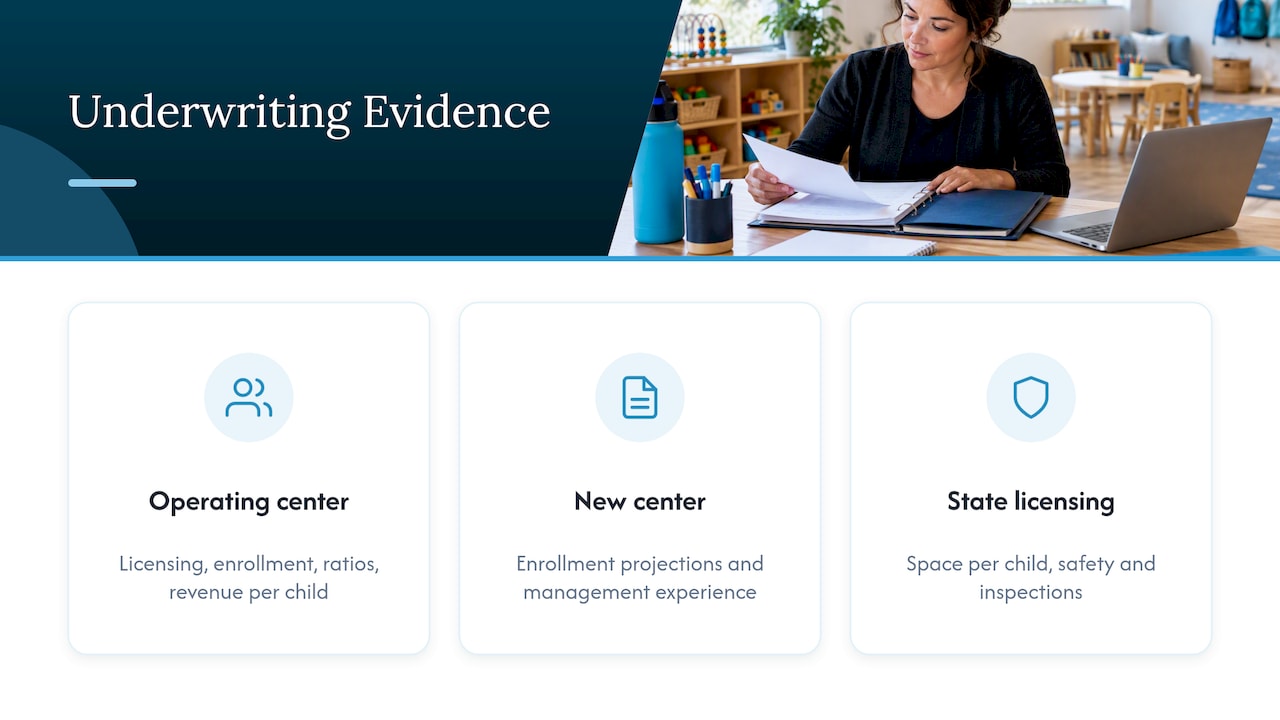
CDC underwriters want to see licensing status, enrollment history, staffing ratios and revenue per child. If you are opening a new center, expect to provide a business plan with enrollment projections and evidence of your management experience. State licensing agencies in each New England state set their own rules for space per child, safety and inspections, so build time into your schedule to meet them. Contact your state’s early education and care licensing office before you sign a purchase agreement for a building that will need changes to pass inspection.
Repayment ability
Lenders want to see that the center’s income supports the debt service. For existing operators, that means tax returns, financial statements and a current enrollment roster. For new centers, it means realistic projections and, ideally, a strong personal financial profile from the owners.
A project that stays within program limits
SBA’s 504 page describes financing of up to $5 million for major fixed assets, and the CDC share of a project is capped. Most single-site childcare projects fall well inside those limits. If you are planning a multi-site expansion, talk with us about how to sequence the projects.
Refinancing a daycare building you already own
Many childcare owners bought their building with a short-term balloon loan or a higher rate loan and now want long-term fixed financing. SBA updated the 504 refinance rules in 2024. Under the final rule effective November 15, 2024, qualifying commercial debt can be refinanced up to 90% of the appraised value of the property, and the earlier requirement to show a minimum reduction in payments was removed.
SBA framed the change as a way for small service businesses to use the value of their fixed assets to free up monthly cash flow. For a childcare center, that freed cash flow might go toward teacher compensation or classroom improvements. Details such as the age of the debt and how the proceeds are used still matter, so review the specifics on our SBA 504 refinance page. If you are also deciding between a refinance and a simple loan recast, our refinance versus recast comparison can help.
Veterans and down payment help
Two programs from our side can make the 10% easier to reach.
If a veteran-owned childcare center is your goal, or you are a new owner short on equity, start with these before assuming the project is out of reach.
A step-by-step path from idea to closing
Other funding that works alongside a 504 loan
A 504 loan finances the building. It does not replace the other funding streams childcare operators depend on. Nonprofit centers that do not need or qualify for 504 financing may use the SBA Microloan program, which provides loans of up to $50,000 through nonprofit intermediaries to small businesses and nonprofit child care centers.
State programs also matter. Massachusetts, for example, publishes its Child Care and Development Fund state plans, which show how federal child care funds are administered in the Commonwealth. Check your own state’s early education agency for facility grants and operating support, since lower operating costs improve the repayment picture a lender sees.
Our perspective
We have watched childcare operators wait years to buy because they assumed a bank would want 20% or 25% down. The 504 structure exists to change that math. With 10% down and a long fixed rate on the CDC loan, a center owner can trade rent for equity without draining the cash the program needs to run.
What we look for first is a clear link between the building and the business plan. How many children will the space license? What do the classrooms cost to bring up to standard? Does enrollment support the payment? When the answers are solid, the structure usually works. When they are not, we would rather tell you early and help you adjust the project than send you down a long application path.
We are a regional lender with more than 70 years of experience, and we have invested more than $2.3 billion in New England businesses. That regional focus means we know the local banks, appraisers and licensing realities your project will meet. Our advice for first-time buyers: talk to a CDC before you make an offer, not after.
Talk with us about your center
If you are planning to buy, build, renovate or refinance a childcare facility in New England, we can walk you through the numbers and the timeline. Review our current fixed rates and loan options at CDC New England, or start with the Down Payment Assistance Program if equity is your main hurdle.
FAQ
Can I use an SBA 504 loan to start a daycare?
Yes, if the project involves buying or building a facility you will occupy or buying major equipment. Startups face closer scrutiny and may need more equity than an established operator. The loan cannot fund working capital, so you will need a separate source for payroll and early operating costs.
How much down payment do I need?
A standard 504 project requires 10% borrower equity, with a private lender covering 50% and the CDC up to 40%, per the SBA. Startups or special-purpose properties can require more. Down payment assistance may help some borrowers cover part of the equity.
Can I refinance my existing daycare building with a 504 loan?
Often, yes. Since November 15, 2024, qualifying commercial debt can be refinanced up to 90% of appraised value without proving a minimum reduction in payments. Eligibility depends on the debt and the property, so a CDC should review the details.
Is a nonprofit childcare center eligible?
Nonprofit centers are typically directed to different SBA products. The SBA Microloan program can provide up to $50,000 for working capital, equipment or supplies through nonprofit intermediaries. Ask a CDC whether your organization and project fit the 504 rules.


