

If you own or want to buy a hotel, motel or inn in New England, an SBA 504 loan can finance the property with a low down payment and a fixed rate for up to 25 years. The catch is eligibility: SBA treats your property as an operating business only if most of its revenue comes from short stays. This guide explains that test, how the 504 structure works, what the numbers look like, and how to prepare a package that two lenders will approve.
TL;DR
- The 504 program finances owner-occupied fixed assets, and hotels and motels qualify as operating businesses when 50% or more of gross annual income comes from guests staying 30 days or less.
- A 504 project pairs a bank loan (usually about 50%) with a Certified Development Company (CDC) loan (typically about 40%), so you meet two underwriting standards at once.
- The standard down payment is about 10%, though special-purpose properties such as hotels may be asked for more, so confirm your structure early.
- Our published fixed rates are 6.77% for 25-year real estate, 6.73% for 20-year real estate and 6.58% for 10-year equipment, as listed on our site.
- Existing hotel owners can also refinance debt into long-term fixed financing under updated SBA rules.
Table of Contents
- Why 504 financing fits hospitality owners
- The eligibility test: operating business, not passive real estate
- How a hotel 504 project is structured
- Presenting your revenue story in 2026
- What you can finance
- Rates and terms
- Refinancing an existing hotel loan
- Insurance: line it up before closing
- Our perspective: where hotel deals succeed or stall
- Working with CDC New England
- A step-by-step path to closing
- FAQ
- Sources
Why 504 financing fits hospitality owners
Hotels are capital-heavy. A property, its furniture, fixtures and equipment, and any renovation can add up to a large check long before the first guest arrives. The SBA 504 program is built for exactly that kind of spend: long-term, fixed-rate financing for major fixed assets, including buying, building or renovating existing buildings and land, plus long-term machinery and equipment with a useful life of at least 10 years. Loans come in 10-, 20- and 25-year maturities, and the SBA lists a ceiling of up to $5.5 million for the SBA-backed portion.
Two features matter most to an owner-operator:
- Fixed rate for the life of the SBA portion. Hotel revenue moves with seasons, events and travel demand. A payment that does not reset gives you something stable to budget against.
- Low equity requirement. Roughly 10% down, compared with the larger down payments many conventional commercial mortgages ask for, leaves more cash for working capital, renovations and the slow weeks of the off-season.
The New England market gives a reason to plan carefully rather than rush. Through June 2026, Connecticut hotel occupancy rose 4.3%, against 1.3% nationally and a 0.8% decline across New England as a whole. Performance varies a great deal by state and submarket, which is why lenders will want to see your own numbers, not regional averages.
The eligibility test: operating business, not passive real estate
The 504 program is for owner-occupied properties. A building you simply rent out to tenants does not qualify. Hotels sit in a special category because they are real estate and an operating business at once, so SBA applies a specific income test.
The 30-day transient rule
Per the SBA eligibility form used for 504 submissions, hotel and motel owners must show that 50% or more of gross annual income comes from transients who stay no more than 30 days. This is what separates a hotel from a building full of long-term residents.
In practice that means:
- An extended-stay property where most guests book for more than 30 days will have trouble qualifying.
- A hotel that rents many rooms monthly to workers or residents needs to document the split between short and long stays.
- A seller’s historical records matter if you are buying: your lender will look at the prior year’s revenue mix, not the one you hope to build.
Occupancy rules for new construction
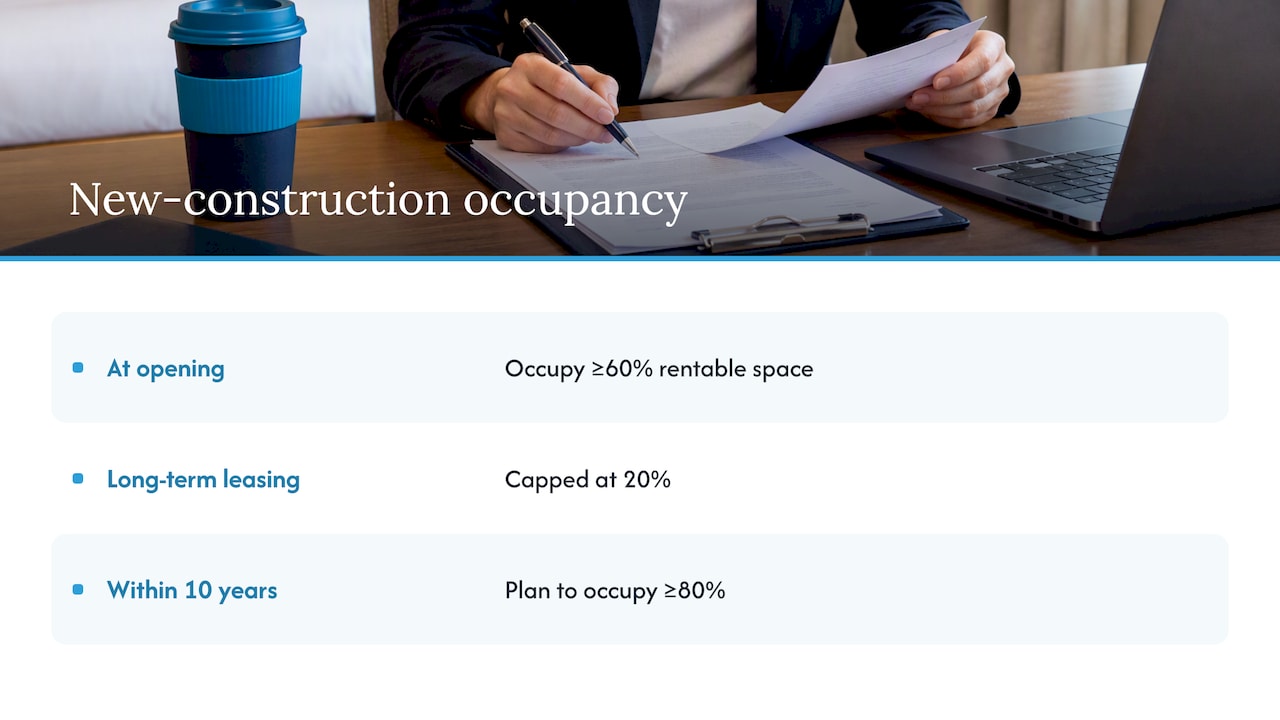
If you are building a new hotel and any part of it will be rentable space, the same SBA form sets occupancy thresholds. You must occupy at least 60% of the rentable space immediately, long-term leasing is capped at 20%, and you need a plan to occupy at least 80% within 10 years. A conference center, restaurant or retail suite in the ground floor can trigger these rules, so sketch your space plan with your lender before you finalize drawings.
For more on how owner-occupancy is measured on other property types, see our guide to SBA 504 eligibility for New England borrowers.
How a hotel 504 project is structured
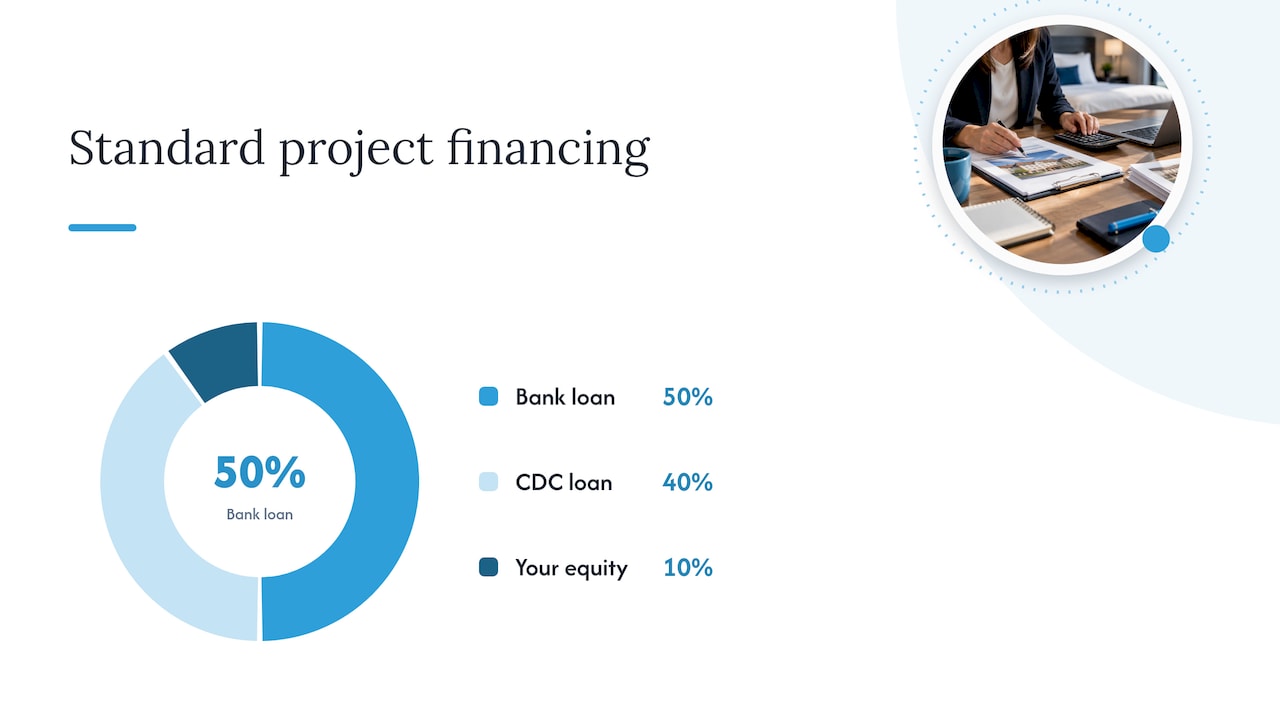
A 504 loan is not one loan. It is a project with two lenders, as the SBA explains: a private-sector senior lender, usually covering about 50% of the financing, and a CDC covering the SBA-backed portion, typically about 40%. You contribute the remainder.
Here is a simple illustration for a hypothetical $4,000,000 hotel acquisition, using the standard 50/40/10 split:
| Piece | Share | Amount |
|---|---|---|
| Bank first-lien loan | 50% | $2,000,000 |
| CDC (SBA 504) loan | 40% | $1,600,000 |
| Your equity | 10% | $400,000 |
This is an example of the standard structure, not a quote. Hotels are often treated as special-purpose properties, and lenders commonly ask for additional equity on those, so your real split may differ. Ask about it at the first conversation rather than the last.
What two underwriters mean for you
Because the bank and the CDC each underwrite the deal, expect a thorough documentation package. Typical items include:
- Three years of business tax returns and year-to-date financials.
- Monthly occupancy, ADR (average daily rate) and RevPAR history, with the transient versus long-stay split.
- Franchise agreement and any property improvement plan (PIP), if the hotel is flagged.
- A purchase contract, appraisal and environmental review for the property.
- Personal financial statements for owners.
- A realistic projection for the next two to three years.
A strong package shortens the process. Our role as a CDC is to coordinate the SBA side and work with your bank so that the two approvals move together.
Presenting your revenue story in 2026
Lenders do not underwrite a hotel on optimism. They look for stable, defensible cash flow. Industry forecasters expect modest growth: HVS projected only modest RevPAR growth for 2026, with operators holding revenue steady through careful ADR management. That is a cue to build your projections conservatively and explain how you will protect rate, not just fill rooms.
Positioning also matters. Colliers’ 2026 outlook describes a market segmenting by income: top earners support luxury and upper-upscale hotels, while middle-income travelers drive demand for midscale and economy properties that offer value. If you run a midscale or economy property, say so plainly in your business plan and show how your rate, location and amenities serve that guest. If you run an upscale boutique inn, show who the guest is and why they return.
Useful items to include:
- Trailing 12-month and three-year performance against your competitive set.
- Seasonality charts. Many New England properties earn a large share of revenue in foliage, summer or ski months, and lenders prefer to see that you understand the off-season.
- Booking channel mix, including direct bookings versus online travel agencies.
- Planned capital improvements and how they lift rate or occupancy.
What you can finance
Hospitality owners use 504 financing in several ways:
- Buying an existing hotel, motel or inn that you will operate yourself.
- Constructing a new property, subject to the occupancy rules above.
- Renovating or expanding an existing owner-occupied building.
- Purchasing long-life equipment, where the useful life is at least 10 years. Our equipment option carries a 10-year fixed term; see how that compares in our piece on 504 versus equipment financing.
Working capital for payroll, supplies or marketing is generally not a 504 use. If you need it, plan for a separate facility. We also offer asset-based lines of credit for New England businesses.
Rates and terms
Our current published fixed rates, as read from our site in September 2026, are:
| Program | Term | Rate |
|---|---|---|
| Real estate | 25-year fixed | 6.77% |
| Real estate | 20-year fixed | 6.73% |
| Equipment | 10-year fixed | 6.58% |
Rates change, so confirm the current figure before you commit. For a building, the 25-year term gives the lowest payment, while the 20-year term builds equity faster at a slightly lower rate. Our breakdown of 10-, 20- and 25-year 504 terms walks through the trade-off with payment examples.
Refinancing an existing hotel loan
Many owners come to us not for a purchase but because a bank loan is maturing, resetting or carrying a rate that no longer works. The SBA finalized rule changes aimed at simplifying 504 debt refinancing with and without expansion, which opens a path for established owners to move short-term or variable debt into long-term fixed financing.
If you are considering this, gather your current note, payment history and the last three years of financials, then review our SBA 504 refinance program. Our guide to commercial mortgage refinance options explains how 504 compares with conventional refinancing.
Insurance: line it up before closing
Your lenders will require adequate property coverage, and hotels carry more exposure than most commercial buildings: guests, kitchens, pools, seasonal storms. Ask your broker early about SBA loan hazard insurance requirements so a missing endorsement does not hold up your closing date. Get quotes before the appraisal comes back, not after.
Our perspective: where hotel deals succeed or stall
We have spent more than 70 years financing New England businesses and have invested more than $2.3 billion in the region. Hotels are some of the most rewarding projects we see, and also some of the ones that benefit most from early planning.
Here is what we tell owners:
- Document the 30-day split before anything else. It is the first question that decides whether the project fits the program. If the numbers are close to 50%, solve that before spending on appraisals.
- Talk to us before you pick a bank. The senior lender and the CDC must agree on the structure. Bringing us in early lets us line up both sides.
- Treat the equity question honestly. The 10% headline is the starting point. Special-purpose property can mean more, and we would rather you know in week one.
- Use our Premier Certified status. It supports faster approvals on the SBA side of your project.
- Ask about support for the down payment. Our down payment assistance program exists because equity is the barrier we see most often.
- Veterans and spouses: ask about VetLoan Advantage. It carries a 1.0% processing fee.
The owners who close smoothly tend to show up with clean financials, a clear story about their guest, and realistic projections. The ones who stall usually discover an eligibility or equity problem late.
— PHENYX
Working with CDC New England
We finance hotel, motel and inn projects across Massachusetts, Rhode Island, Vermont, New Hampshire and Connecticut. If you are weighing a purchase, a renovation or a refinance, start with our team and we will review your property, your revenue mix and your equity position. If you are short on cash for the down payment, our down payment assistance program may help close that gap. Veterans and their spouses can look at the VetLoan Advantage program.
A step-by-step path to closing
- Confirm eligibility. Calculate your prior-year share of income from stays of 30 days or less.
- Gather financials. Tax returns, year-to-date statements and a revenue report by stay length.
- Choose your senior lender. Talk to banks about the 50% first-lien position.
- Contact the CDC. We review the project and outline the SBA portion.
- Order third-party reports. Appraisal and environmental review for the property.
- Underwriting and approval. Both institutions approve their pieces.
- Closing and funding. The bank and CDC loans close together, and the SBA debenture is funded after closing.
FAQ
Can I use an SBA 504 loan to buy a hotel as an investment?
No. The program is for owner-occupied operating businesses, and passive rental real estate is not eligible. A hotel qualifies when you operate it and 50% or more of gross income comes from stays of 30 days or less.
How much down payment does a hotel need?
The program typically requires about 10% down, according to the SBA. Hotels are often treated as special-purpose properties, so some lenders ask for more. We review the structure with you before you make an offer.
Can I finance renovations with a 504 loan?
Yes. The program covers purchasing, constructing or renovating existing buildings and land, as well as long-term equipment. Ordinary operating expenses are not covered.
Can I refinance my hotel’s existing loan?
Often, yes. SBA’s updated rules simplify refinancing with and without expansion. Eligibility depends on your loan history and the property, so share your note and financials with us for a review.
Sources
- SBA: 504 loans
- SBA: Eligibility information required for 504 submission (PCLP)
- Connecticut Governor’s office: tourism growth announcement
- HVS U.S. Market Pulse, February 2026
- Colliers 2026 U.S. hospitality outlook
- SBA: final rule on 504 refinancing


