For most owner-occupied warehouse purchases, construction projects, or refinances in New England, an SBA 504 loan is the financing path to pursue first. It pairs a low 10% down payment with a fixed rate on the CDC portion for up to 25 years. The main exception: businesses that need working capital, fast closings, or don’t yet meet occupancy rules, which usually point toward an SBA 7(a) loan or conventional commercial financing instead. Confirm your occupancy percentage, then contact a Certified Development Company like Cdcnewengland.
TL;DR:
- SBA 504 loans are ideal for owner-occupied warehouses in New England, offering a low 10% down payment and fixed rates for projects under $12.5 million.
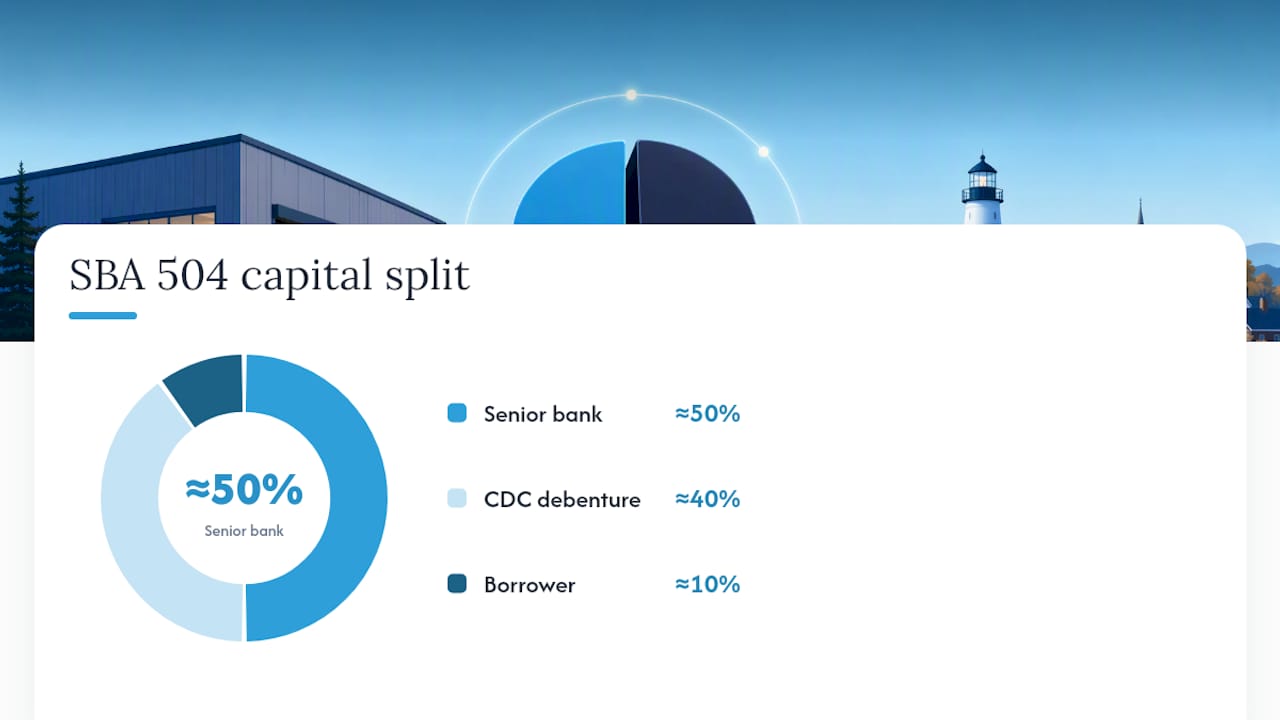
- The financing structure involves about 50% from a bank, 40% from a CDC debenture, and 10% from the borrower, with a typical 60-90 day closing timeline.
- Eligibility requires the business to occupy at least 51% of the space (or 60% for new builds), with a down payment based on business maturity and project scope.
- For projects needing quick closing or working capital, a 7(a) loan or conventional financing is preferable, as 504 takes longer and cannot fund inventory or working capital.
- Regional lenders like Cdcnewengland offer tailored support for New England warehouse deals, structuring loans with benefits like down payment assistance and veteran programs.
Table of Contents
- How SBA 504 Warehouse Financing Compares to Other Options
- Who Qualifies for an SBA 504 Warehouse Loan?
- What Numbers Should You Budget For?
- How Do You Prepare a Strong 504 Application?
- What Do Real Warehouse Financing Mixes Look Like?
- Why Regional Lending Knowledge Matters for Warehouse Deals
- Get an Indicative Structure for Your Warehouse Project
- Sources
How SBA 504 Warehouse Financing Compares to Other Options
The SBA 504 program builds a capital stack in three pieces: roughly 50% from a conventional bank as a senior first mortgage, 40% from a Certified Development Company (CDC) as a fixed-rate debenture backed by the Small Business Administration, and 10% from you as the borrower. That structure is the whole reason 504 dominates owner-occupied warehouse financing: no other commercial loan product routinely gets a small business into an industrial building with a relatively low down payment while locking a large chunk of the debt at a fixed rate.
The tradeoffs are real, though. A 504 project typically takes 60 to 90 days to close, longer than a conventional loan, because you’re coordinating two lenders and two sets of underwriting. The program also won’t touch working capital or inventory financing. If you need cash to stock the warehouse once you own it, that’s a separate conversation with your bank or a line of credit.
Here’s a quick way to sort your project into the right lane:
- Buying or building a warehouse you’ll occupy? Start with 504.
- Need working capital or inventory financing alongside the real estate? Pair 504 with a 7(a) loan or business line of credit.
- Need to close in under 30 days? Conventional or bridge financing will move faster than 504, usually at a variable or higher rate.
- Project cost near or above $12.5 million? Check CDC debenture caps before assuming 504 covers the full 40%.
Who Qualifies for an SBA 504 Warehouse Loan?
Before you spend weeks assembling a file, run through these four eligibility tests:
- You have to run an operating business, not hold the property as a passive investor. SBA size standards apply, and most small to mid-sized warehouse operators in Massachusetts, Rhode Island, or Connecticut fall well within them.
- Your business has to occupy the majority of the space. For existing buildings, that means 51% of the rentable area; for new construction, the threshold rises to 60%, measured against total square footage.
- You need a borrower injection, and the amount depends on your business history. Established businesses operating more than two years typically qualify for the standard 10% down payment. Startups or special-use properties often land at 15%, and some combinations of new business plus special-use property push to 20%.
- Your use of funds has to fit the program’s rules. Purchase, construction, renovation, and eligible long-life equipment all qualify. Working capital, inventory, speculative holding, and pure rental investments do not.
What Numbers Should You Budget For?
Run the math on a representative project before you talk to a lender, not after. Say you’re buying a $4 million warehouse. The bank funds roughly half, the CDC debenture covers around 40%, and you provide approximately 10% as a down payment. That percentage isn’t fixed to the building’s appraised value alone. The 504 program sizes on total project cost, which includes soft costs and eligible fixed equipment, so adding racking or other qualifying equipment to the project can actually lower your cash injection as a percentage of the total.
Pro Tip: Ask your CDC to model the capital stack twice, once with equipment rolled into the project cost and once without. The difference in your out-of-pocket cash can be substantial enough to change your timeline.
CDC debentures are capped per loan, generally at about $5 million to $5.5 million (https://www.sba.gov/funding-programs/loans/504-loans), which caps the 40% CDC piece on very large projects even when the bank portion can flex higher.
Plan for these closing costs on top of your down payment:
- Third-party appraisal on the property
- Phase I environmental report (mandatory for most warehouse and industrial parcels)
- Legal and professional fees on both the bank and CDC side
- SBA guarantee and processing fees, typically rolled into the debenture
Occupancy verification is the first thing underwriters check, before they dig into financials. If your occupancy math doesn’t clear 51% (or 60% for new builds), the file stalls before it starts.
How Do You Prepare a Strong 504 Application?
Start assembling your file 90 to 120 days before your target closing date. Once your file is complete, expect 60 to 90 days to close, but incomplete files or environmental surprises push that timeline out fast.
- Pre-check occupancy and scope the project. Confirm your rentable-area percentage and decide exactly what’s included in project cost, building, renovation, equipment.
- Engage your bank and CDC in parallel, not sequentially. Sending your file to both at once, rather than waiting on one before starting the other, is one of the more reliable ways to keep the timeline near the 60-day end.
- Order the appraisal and Phase I environmental report immediately. These take weeks to schedule and complete, and nothing closes without them.
- Track conditional commitments from both lenders as they come in. Mismatched conditions between the bank and CDC are a common source of last-minute delays.
Your documentation checklist should include two to three years of business and personal tax returns, current financial statements, a signed purchase agreement, the appraisal, the Phase I report, and personal guarantees from owners holding 20% or more of the business.
Watch for two underwriting traps specifically: mixed-use classification issues (if part of the building is leased to unrelated tenants, it can jeopardize your occupancy test) and incomplete soft-cost budgeting that underestimates what the project actually costs to finish.
What Do Real Warehouse Financing Mixes Look Like?
Three scenarios cover most of what New England warehouse buyers actually do:
- Straight purchase with equipment. A $4 million warehouse purchase that includes $300,000 of racking rolled into project cost runs the standard 50/40/10 split, with the equipment cost slightly increasing the total financed and adjusting your injection dollar amount accordingly.
- Ground-up construction. You’ll typically need interim construction financing from your bank before the 504 permanent loan takes out that debt, and you must hit 60% owner occupancy timing before the CDC will fund the permanent piece.
- Refinance into 504. Owners carrying an existing commercial mortgage can often refinance into a 504 structure to lock in the CDC’s fixed-rate piece, a move worth exploring if your current conventional loan is variable-rate or coming up for renewal.
When your project needs automation or heavy racking beyond what fits cleanly into the 504 project cost, layering a separate equipment loan is common practice, and coordinating servicing between that lender and your CDC upfront avoids confusion later.
Why Regional Lending Knowledge Matters for Warehouse Deals
New England’s industrial market runs on older building stock, tight parcels, and a lot of owner-operators who’ve outgrown a leased space and want the stability of ownership. That combination makes occupancy math and soft-cost budgeting more finicky here than in newer-build markets, where mixed-use classification questions rarely come up.
Working with a regional CDC instead of a national lender who doesn’t know the local building stock tends to shorten the friction in underwriting. Cdcnewengland has spent more than 70 years financing exactly this kind of deal, structuring over $2.3 billion into regional businesses, and layering in tools like down payment assistance and veteran-specific benefits that a generic national program won’t offer.
If your project is a warehouse purchase, expansion, or refinance anywhere in Massachusetts, Rhode Island, Vermont, New Hampshire, or Connecticut, that regional depth is worth more than a marginally lower advertised rate from an out-of-market lender.
— PHENYX
Get an Indicative Structure for Your Warehouse Project
Cdcnewengland turns the math in this guide into an actual number for your project, not a generic estimate. Because Cdcnewengland structures SBA 504 loans exclusively for New England businesses, you get a 10% down payment option, fixed CDC terms stretched out to 25 years, and access to down payment assistance or veteran-specific benefits that most lenders don’t offer at all.
To get started, share three numbers: total project cost, rentable square footage, and your expected occupancy share. Cdcnewengland typically turns that into an indicative structure within a few business days, showing your likely down payment, CDC debenture size, and bank portion side by side. Run your own scenario first on the SBA 504 loan calculator, then request a full structure through the SBA 504 loans page to see exactly what your warehouse project would look like financed at 10% down.
Sources
The SBA’s official 504 loan page covers program parameters and debenture caps directly. For occupancy tests and capital-stack mechanics specific to industrial buildings, see the 504 industrial and warehouse breakdown. Readers weighing a faster, higher-cost bridge loan against 504’s timeline can model that tradeoff with a hard money loan calculator.
This article is general information, not a substitute for advice from a qualified financial advisor. Consult a qualified financial professional about your own circumstances before acting on anything here.
- SBA 504 / industrial & warehouse (PeerSense)
- SBA commercial real estate loans: how to qualify and apply (Small Biz Finance Guide)
Recommended
- How to Buy Commercial Real Estate in New England with Just 10% Down
- SBA 504 Loan Program Explained: How Small Businesses Can Buy Commercial Real Estate With Just 10% Down
- What Can You Finance with an SBA 504 Loan? A Complete Guide for New England Businesses
- SBA 504 Loan Appraisal Requirements: What New England Business Owners Need to Know