

A recourse loan lets your lender chase your personal assets, wages, or bank accounts if the collateral doesn’t cover what you owe. A nonrecourse loan limits the lender to seizing only the pledged collateral, no matter the shortfall. That single difference shapes the interest rate you’re offered, the paperwork you’ll sign, and how the IRS taxes you if the debt ever gets canceled.
TL;DR:
- Nonrecourse loans often require stronger cash flow and lower loan-to-value ratios due to increased lender risk exposure.
- Defaults on nonrecourse loans limit the lender to seizing collateral only, while recourse loans can lead to pursuing deficiency judgments and personal assets.
- State law variations and specific loan language can alter the actual personal liability, even if a loan is labeled nonrecourse.
- Nonrecourse debt generally results in higher interest rates compared to recourse loans because of the lenders’ elevated risk.
- The IRS treats canceled nonrecourse debt as taxable income, whereas recourse debt may have different tax implications depending on collateral value and forgiveness details.
Table of Contents
- Recourse vs Nonrecourse Loan: A Quick Comparison
- How Recourse and Nonrecourse Loans Actually Play Out After Default
- Where Each Loan Type Shows Up in Real Life
- What Recourse and Nonrecourse Debt Mean for Your Taxes
- Choosing Between Recourse and Nonrecourse Financing
- Why State Law and “Qualified Nonrecourse Debt” Both Matter
- How CDC New England Applies This to SBA 504 Financing
- What Borrowers Consistently Get Wrong
- Get Started With SBA 504 Financing Through CDC New England
- Sources
- FAQ
Recourse vs Nonrecourse Loan: A Quick Comparison
Before you dig into the mechanics, here’s how the two structures stack up against each other on the points that actually affect your wallet.
- Borrower liability: Recourse loans expose your personal assets beyond the collateral; nonrecourse loans cap the lender’s claim at the pledged property or equipment.
- Lender remedies after default: Recourse lenders can pursue deficiency judgments, garnish wages, or levy bank accounts; nonrecourse lenders generally cannot.
- Underwriting: Nonrecourse loans typically demand stronger cash flow, lower loan-to-value ratios, and tighter debt-service coverage.
- Pricing: Nonrecourse debt usually carries a higher interest rate because the lender absorbs more risk if the collateral loses value.
One caveat matters more than any bullet point above: the promissory note’s exact language, not the loan’s marketing label, controls how it’s classified. State law can also override contract terms, particularly for residential mortgages.
How Recourse and Nonrecourse Loans Actually Play Out After Default
Default triggers a fairly predictable sequence, but where that sequence ends depends entirely on the loan structure you signed.
- Seizure of collateral. The lender forecloses on real estate or repossesses equipment or a vehicle.
- Sale of the asset. Proceeds get applied against the outstanding balance.
- Shortfall calculation. If the sale doesn’t cover the debt, a recourse lender can pursue a deficiency judgment in court; a nonrecourse lender generally cannot go further.
- Collection, if allowed. Once a court grants a deficiency judgment, the lender can garnish wages or levy bank accounts.
Courts look closely at the promissory note and security instrument to decide whether deficiency rights exist at all, according to Cornell’s Legal Information Institute. Lenders don’t always chase deficiencies even when they’re entitled to. Litigation costs money, and a borrower with no recoverable assets isn’t worth pursuing.
Pro Tip: Read the guaranty section before you read the interest rate. A “nonrecourse” loan with a personal guaranty or a bad-boy carve-out for fraud or waste is recourse in every practical sense.
Where Each Loan Type Shows Up in Real Life
The label on a term sheet often tells you less than the industry it comes from.
- Recourse loans: most personal loans, credit cards, many auto loans, and most residential mortgages depending on your state and lender.
- Nonrecourse loans: many commercial real estate loans, certain equipment financings, and loans held inside a self-directed IRA, which federal rules require to be nonrecourse.
- SBA 504 loans: these typically require personal guarantees from anyone owning 20% or more of the business, according to SBA program practice, so expect recourse exposure even though you’re financing owner-occupied commercial property.
That last point surprises a lot of first-time SBA borrowers who assume government-backed financing automatically limits their personal risk. It doesn’t.
What Recourse and Nonrecourse Debt Mean for Your Taxes
Debt classification changes how the IRS treats you at two very different moments: when you transfer collateral and when debt gets canceled.
If you surrender property securing a nonrecourse loan, the entire loan balance counts as your “amount realized” on the sale, even if the property was worth less. With a recourse loan, the amount realized is capped at the property’s fair market value, and any forgiven balance above that typically becomes taxable cancellation-of-debt income.
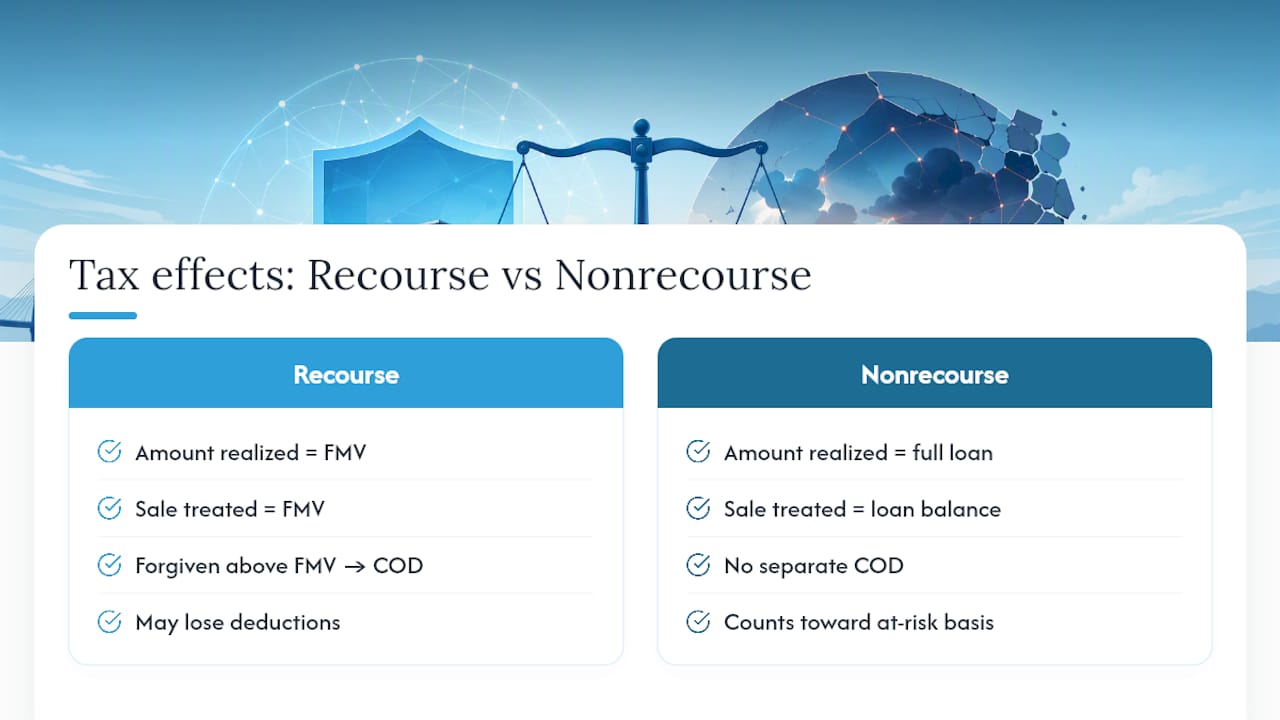
For partnerships and real estate investors, the distinction runs deeper. Qualified nonrecourse debt can count toward your at-risk basis, which affects how much loss you’re allowed to deduct. Get this wrong and you could lose deductions you were counting on. Preserve every closing document and loop in a CPA before you sign, not after you default.
Choosing Between Recourse and Nonrecourse Financing
Your decision should weigh risk tolerance, credit profile, project type, and how sensitive you are to interest costs.
- Assess your risk tolerance. Can you absorb personal liability if the project underperforms?
- Check your credit and collateral strength. Nonrecourse lenders demand more of both.
- Model the rate premium. Ask what the exact rate difference would be for nonrecourse terms versus recourse terms on the same deal.
- Confirm DSCR and down payment thresholds. Nonrecourse structures often require higher coverage ratios.
Bring these exact questions to any lender conversation: Does the promissory note allow deficiency judgments? Is there a personal guaranty or a carve-out buried in the fine print? What’s the expected rate premium for going nonrecourse? What down payment or debt-service coverage ratio do you require?
Pro Tip: If a lender hesitates to answer the deficiency-judgment question directly, treat that hesitation as your answer. Ambiguity in loan documents almost always favors the lender.
Why State Law and “Qualified Nonrecourse Debt” Both Matter
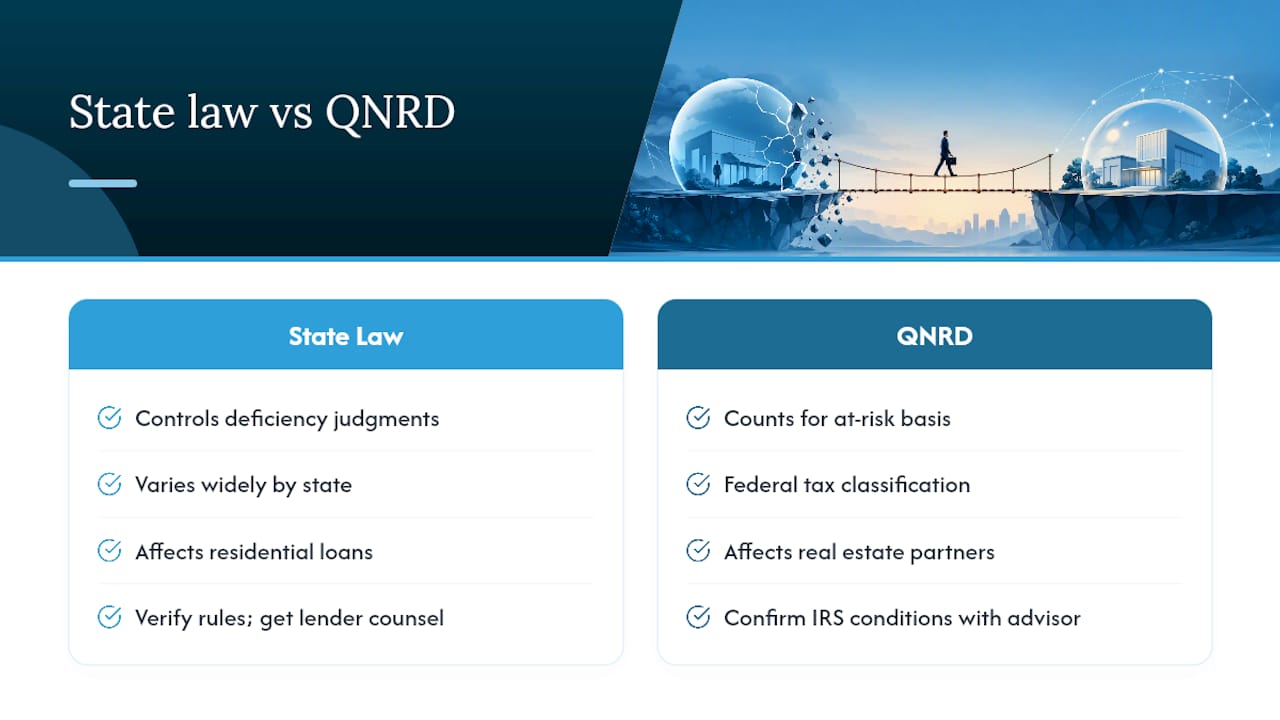
Mortgage anti-deficiency laws vary widely by state, and that variation changes what “nonrecourse” actually means for a residential loan in your jurisdiction. Some states bar deficiency judgments on purchase-money mortgages entirely; others allow them freely.
Qualified nonrecourse debt is a distinct tax classification that matters mainly to real estate partnerships. It allows nonrecourse financing to count toward a partner’s at-risk basis under specific IRS conditions, which directly affects loss deductibility, as real estate tax advisors note. If the loan amount is material to your business, verify your state’s anti-deficiency rules and get lender counsel to review the note before closing.
How CDC New England Applies This to SBA 504 Financing
CDC New England structures SBA 504 loans with a 10% down payment and fixed rates locked for up to 25 years, serving small business owners across New England who are buying commercial real estate or equipment. Because SBA 504 deals generally require personal guarantees from principal owners, you should plan for recourse-level exposure even while benefiting from below-market, government-backed terms. That trade-off, lower down payment and rate stability in exchange for personal liability, tends to favor established operators who value long-term cost certainty over avoiding a guaranty altogether.
What Borrowers Consistently Get Wrong
The most common mistake is assuming “collateral only” applies just because a lender calls a deal nonrecourse. Guarantees, carve-outs, and state law can quietly convert that promise into full personal exposure. Get the loan language reviewed before you sign, and model your worst-case deficiency scenario, not just your best-case projection.
— PHENYX
Get Started With SBA 504 Financing Through CDC New England
CDC New England’s SBA 504 program gives small business owners a lower-risk path into commercial property ownership: just 10% down, fixed rates for up to 25 years, and financing built for owner-occupied real estate or equipment purchases rather than speculative deals.

If you’re weighing a traditional recourse mortgage against SBA financing, run your numbers through the SBA 504 loan calculator to see how a fixed rate and lower down payment change your monthly obligation. Veteran-owned businesses can also review specific 504 benefits built into the program. When you’re ready to talk through guaranty terms, down payment assistance, or refinancing an existing loan, explore CDC New England’s SBA 504 program and connect with a loan officer to map out your next step.
Sources
- Recourse loan definition | Investopedia
- Nonrecourse debt definition | Investopedia
- Recourse vs Nonrecourse Debt and Why It Matters for Taxes | FitSmallBusiness
- Recourse vs Nonrecourse Debt: What to Know | JMCO
This article is general information, not a substitute for advice from a qualified financial advisor. Consult a qualified financial professional about your own circumstances before acting on anything here.
FAQ
What Is an Example of a Nonrecourse Loan?
Many commercial real estate loans and equipment financings are nonrecourse, along with loans held inside a self-directed IRA, which federal rules require to be structured this way.
Is an SBA Loan Recourse or Nonrecourse?
SBA 504 loans generally require personal guarantees from anyone owning 20% or more of the business, meaning they typically carry recourse-level exposure despite favorable government-backed terms.
What Are Some Examples of Recourse Debt?
Most personal loans, credit cards, many auto loans, and most residential mortgages qualify as recourse debt, depending on your state’s anti-deficiency laws.
Is a Car Loan Recourse or Nonrecourse?
Most auto loans are recourse, meaning the lender can repossess the vehicle and still pursue you for any remaining balance after the sale.
Which Loan Type Costs More: Recourse or Nonrecourse?
Nonrecourse loans typically carry higher interest rates because the lender takes on more risk by limiting recovery to the collateral alone.


