

Senior debt is lower-cost, secured, and repaid first in a default; mezzanine debt is subordinated, more expensive, and often carries equity-like features such as warrants. Choose senior debt for your core, long-term financing needs. Choose mezzanine when your senior lender has capped what it will lend and you want to avoid giving up ownership. The trade-off is simple: senior debt saves you money, mezzanine buys you flexibility and speed.
TL;DR:
- Mezzanine debt typically costs 12% to 30% annually, significantly more than senior debt due to its subordinated, unsecured status and added features like warrants.
- Senior debt receives priority in liquidation, secured by collateral, while mezzanine lenders often have no lien and rely on contractual protections.
- Businesses mainly use mezzanine financing for real estate gap funding, acquisitions, management buyouts, or growth bridging, not as a last resort.
- To minimize costs, borrowers should exhaust senior debt capacity first before relying on mezzanine to fill funding gaps.
- SBA 504 loans hold a senior position, with mezzanine debt bridging the gap when project costs exceed what SBA and bank loans can cover.
Table of Contents
- Mezzanine Vs Senior Debt: What Do These Terms Actually Mean?
- Where Does Each Debt Rank in a Liquidation?
- How Much More Expensive Is Mezzanine Debt Than Senior Debt?
- What Security and Covenants Come With Each Type of Debt?
- When Do Businesses Actually Use Mezzanine Debt Instead of Senior Debt?
- How Do You Decide Which One Fits Your Deal?
- How Does SBA 504 Financing Fit Alongside Mezzanine Debt?
- Why the Standard Advice on Mezzanine Debt Misses the Point
- Sources
- FAQ
Mezzanine Vs Senior Debt: What Do These Terms Actually Mean?
Senior debt is the loan sitting at the top of your capital structure. It’s typically issued by a bank or a certified development company, secured by a lien on real estate or equipment, and repaid on a fixed amortization schedule. Rates are usually fixed or tied to a floating benchmark, and senior bank loans are structured with a first claim on collateral, which is exactly why they’re the cheapest form of business borrowing available.
Mezzanine debt sits below senior debt but above equity. It’s unsecured or thinly secured, priced much higher, and frequently comes bundled with warrants or conversion rights that let the lender share in your company’s upside. The Investopedia primer on mezzanine financing describes it as a hybrid instrument, part loan and part equity bet, and that hybrid nature shows up in the paperwork: interest-only periods, payment-in-kind toggles, and equity kickers you won’t find in a standard senior term sheet. Some lenders even treat mezzanine as quasi-equity for certain leverage ratios, which can make your balance sheet look better even though the cash cost to you is higher.
Where Does Each Debt Rank in a Liquidation?
Picture a $10 million business that fails. The senior lender holding a $5 million secured loan gets paid first, in full, from asset sales, before anyone else sees a dollar. The mezzanine lender, holding a $2 million subordinated note, only recovers what’s left after the senior claim is satisfied. Equity holders are last, and often left with nothing.
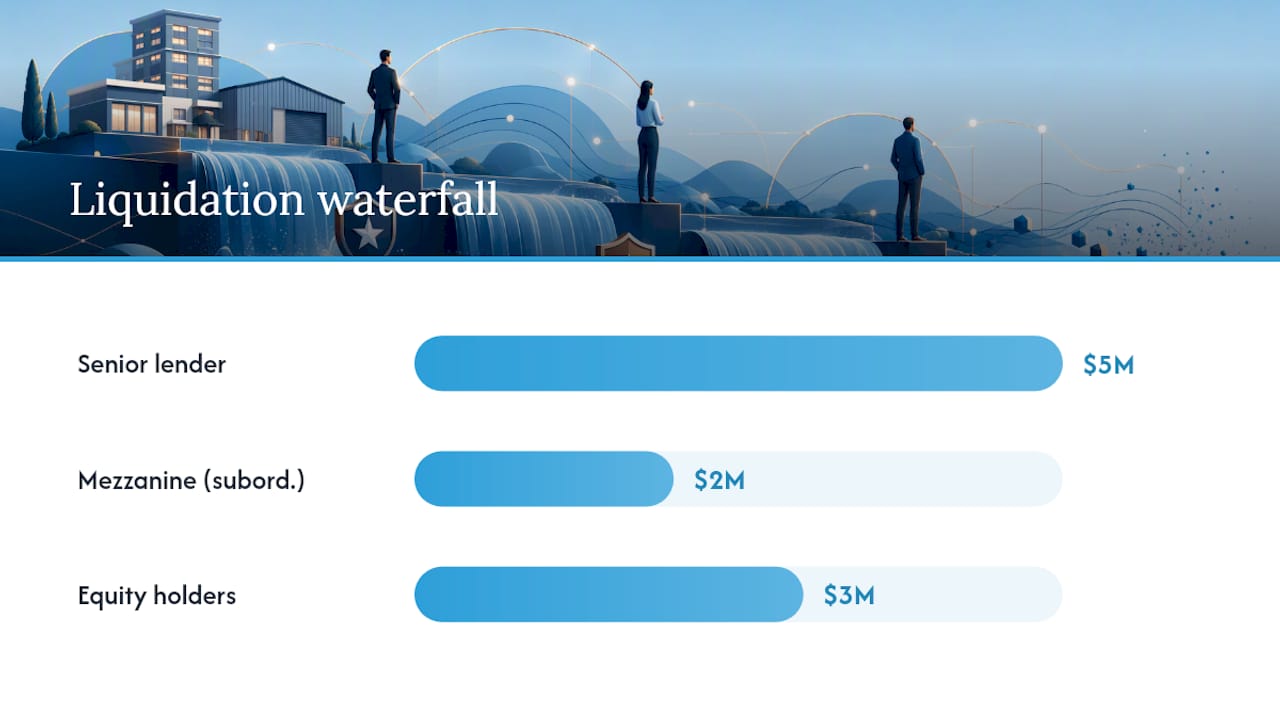
This ranking isn’t a guideline, it’s contractual. According to Maclear’s breakdown of senior, subordinated, and mezzanine debt, the repayment order runs senior creditors first, mezzanine lenders second, and equity last. Senior lenders enforce that priority through liens on specific collateral, real estate, equipment, receivables, giving them a direct claim on assets rather than just a place in line. Mezzanine lenders usually have no lien at all; their protection comes from contract terms and intercreditor agreements, not hard collateral.
There are exceptions worth knowing. Super-senior facilities can jump ahead of ordinary senior debt in some deals. Debtor-in-possession financing during a bankruptcy can leapfrog existing liens entirely. And priority at a subsidiary can differ from priority at a parent holding company, which matters if your mezzanine loan sits at a different entity level than your senior loan.
How Much More Expensive Is Mezzanine Debt Than Senior Debt?
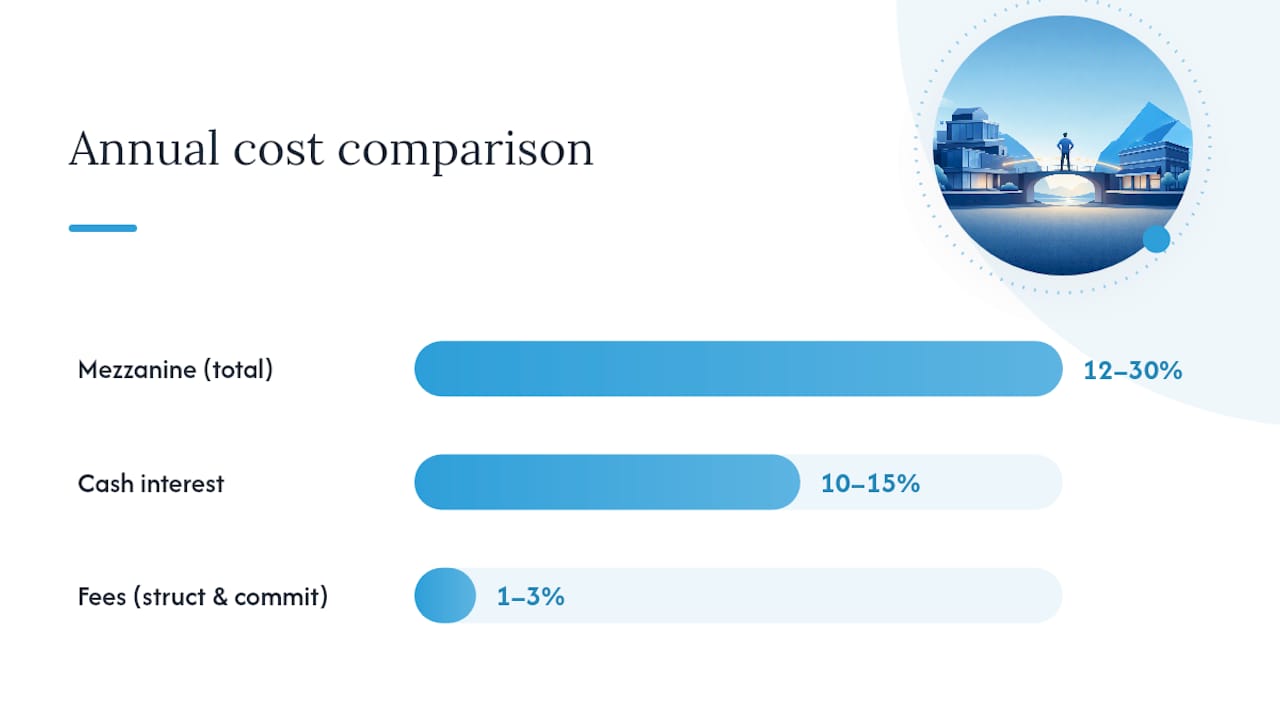
Mezzanine financing typically runs 12% to 30% in all-in annual cost, according to Investopedia’s mezzanine financing overview, compared to senior debt rates that are consistently a fraction of that because of the collateral and priority backing them. That spread isn’t arbitrary. It reflects the real risk gap between a secured first-lien position and an unsecured claim standing behind it.
The total cost of mezzanine debt comes from several stacked layers, not just a coupon rate:
- Cash interest, often 10% to 15% paid currently
- Payment-in-kind interest that accrues and compounds rather than being paid out
- Warrants or equity kickers that dilute you later even if the loan is repaid on time
- Structuring and commitment fees, frequently 1% to 3% of the facility
- Prepayment penalties that can erase early-payoff savings
Tax treatment cuts both ways. Interest on both senior and mezzanine debt is generally deductible, which softens the effective cost of mezzanine somewhat, but the deduction rarely closes the gap when the headline rate is two to three times higher than a senior facility. Fixed-rate senior products, like the structures used in volatile-rate environments, give you a predictable amortization cost that mezzanine simply can’t match.
What Security and Covenants Come With Each Type of Debt?
Senior lenders protect their position with hard assets. Mezzanine lenders protect their position with contract language, and that difference shapes almost everything about how the two loans behave day to day.
A typical senior package includes:
- First-lien security on real estate, equipment, or receivables
- Financial covenants tied to debt service coverage and leverage ratios
- Direct control over foreclosure and asset disposition in a default
A typical mezzanine package includes:
- No lien, or a subordinated lien with limited practical value
- Warrants, board observer rights, or information rights instead of collateral
- Covenant-lite terms on operations, but strict limits on additional senior borrowing
Intercreditor agreements decide who actually controls a workout. In most deals, the senior lender keeps the right to direct enforcement and foreclosure, while the mezzanine lender agrees to a standstill period before it can act on its own. That’s the price mezzanine lenders pay for a subordinate position, and it’s a term borrowers should read closely before signing.
Pro Tip: Negotiate the standstill period length and any cure rights before you close. A 90-day standstill instead of 180 can matter enormously if your business hits a rough quarter and you need room to fix it before creditors start pulling levers.
When Do Businesses Actually Use Mezzanine Debt Instead of Senior Debt?
- Commercial real estate gap financing. A developer secures a senior mortgage covering 65% of project cost, then layers mezzanine debt on top to close the remaining gap without bringing in a new equity partner.
- Acquisitions and management buyouts. When senior lenders cap their loan at a set loan-to-value or debt-service coverage threshold, mezzanine fills the shortfall so the buyer avoids selling off equity to close the deal.
- Growth bridges ahead of a refinance or exit. Mezzanine is rarely meant to be permanent capital. Industry guidance on mezzanine structures frames it as a medium-term bridge, used until the business grows enough, or refinances, to pay it down with cheaper senior capital.
From an investor’s chair, mezzanine offers a return profile that looks more like a corporate bond with an equity kicker attached, higher yield in exchange for real subordination risk. Senior lenders take a smaller return in exchange for a much stronger recovery position if things go sideways.
How Do You Decide Which One Fits Your Deal?
Start by figuring out how much senior capacity you actually have. If a bank or SBA-backed lender will cover most of your project cost, there’s rarely a reason to reach for mezzanine at all.
Run through this borrower checklist before you talk to a mezzanine lender:
- How much senior debt capacity is realistically available against your collateral?
- How much equity dilution are you willing to accept versus paying a higher rate?
- What’s your exit or refinance timeline, since mezzanine is a bridge, not permanent capital?
- Can your cash flow absorb payment-in-kind accrual if the loan toggles to non-cash interest?
If you’re on the investor side, weigh a different set of questions: what priority ranking are you actually getting, what yield justifies the subordination risk, and how much collateral due diligence has been done on the senior position ahead of you. Debt crowdfunding platforms apply similar due diligence logic when vetting subordinated positions for retail investors.
Pro Tip: If a lender pushes mezzanine before you’ve maxed out your senior options, ask why. Sometimes it’s genuinely the right structure. Sometimes it’s the more profitable product for them to sell.
The general rule holds: exhaust reasonably priced senior capacity first, then use mezzanine only for the gap that senior financing and your own equity tolerance can’t cover.
How Does SBA 504 Financing Fit Alongside Mezzanine Debt?
Cdcnewengland structures SBA 504 loans with a 10% down payment and fixed rates for up to 25 years, financing that occupies the senior position in your capital stack. When a project’s cost exceeds what SBA 504 and a bank’s senior piece will cover, mezzanine capital can bridge that remaining gap without forcing you to sell equity.
Over many years, CDC New England has invested a substantial amount into New England businesses, largely through senior-position SBA 504 lending paired with programs like down payment assistance and veteran-specific benefits. Understanding where mezzanine sits relative to that senior piece helps you structure a deal that keeps your borrowing cost as low as your project will allow.
Why the Standard Advice on Mezzanine Debt Misses the Point
Most comparisons treat mezzanine debt like a last resort, something you settle for when a bank says no. That framing gets the decision backward. Mezzanine isn’t a consolation prize for weak borrowers; it’s a tool for strong borrowers who don’t want to trade ownership for growth capital they could otherwise finance with debt.
The trade-off that actually matters isn’t “cheap versus expensive.” It’s dilution versus cost. A founder who gives up 20% equity to avoid a 20% mezzanine coupon may have made the more expensive choice, not the cheaper one, if the business grows the way they expect. Conventional advice rarely runs that math.
What should guide the decision instead is sequencing: max out senior capacity, because it’s the cheapest capital you’ll ever access, before treating mezzanine as the gap filler it was designed to be. The businesses that misuse mezzanine are usually the ones that reach for it first instead of last.
— PHENYX
Sources
FAQ
What Qualifies as Senior Debt?
Senior debt is any loan holding first priority for repayment, typically secured by a lien on collateral such as real estate or equipment, with lower rates than subordinated financing.
What Are Examples of Mezzanine Debt?
Common examples include subordinated notes with warrants, payment-in-kind loans used in leveraged buyouts, and gap financing layered above a senior mortgage in commercial real estate deals.
Who Typically Uses Mezzanine Financing?
Mezzanine financing is most common among businesses pursuing acquisitions, management buyouts, or real estate developments where senior lenders have capped their loan amount and the borrower wants to limit equity dilution.
What Are the Key Differences Between Mezzanine Debt and Convertible Debt?
Mezzanine debt is generally structured as a fixed-term loan with warrants attached for equity upside, while convertible debt is designed to convert directly into equity shares at a set trigger, usually a future financing round or valuation event.
Is Mezzanine Debt Riskier Than Senior Debt?
Yes. Mezzanine debt is subordinated and often unsecured, so it carries higher default risk and lower recovery prospects than senior debt, which explains why it’s priced significantly higher.


