

Mezzanine financing is a hybrid debt-equity capital instrument that sits between senior loans and equity in a company’s capital stack, priced higher than a bank loan but far less dilutive than selling shares outright. Businesses turn to it to fill a financing gap for growth capital, acquisitions, recapitalizations, or real estate development when senior lenders won’t cover the full amount needed. The trade-off is straightforward: you pay more for this capital than you would for a secured loan, but you keep more ownership than a straight equity raise would leave you.
TL;DR:
- Mezzanine financing usually targets blended returns of 15% to 20%, combining cash coupons with equity warrants, reflecting higher risk due to subordination.
- It is most appropriate when senior debt capacity is exhausted, and the borrower needs to avoid heavy equity dilution for acquisitions, buyouts, or real estate projects.
- The cost often includes low double-digit cash interest, PIK interest that compounds into balloon payments, arrangement fees, and warrant dilution, making it a costly financing option.
- Risks include low recovery rates in default, ballooning PIK interest, and restrictions from covenants and intercreditor agreements that can block payments or future financing.
- Alternative fixed-rate, collateralized options like SBA 504 loans typically provide similar leverage at lower cost without warrant dilution or PIK risks.
Table of Contents
- How Mezzanine Financing Is Structured
- What Mezzanine Financing Actually Costs
- Where Mezzanine Financing Shows Up in Real Deals
- The Risks Nobody Puts on the Term Sheet Cover Page
- Mezzanine vs. the Alternatives: A Decision Checklist
- What CDC New England Sees in the Financing Gap
- Our Take: Mezzanine Solves a Real Problem, but It’s Often the Expensive Default
- Consider a Lower-Cost Path Before You Sign a Mezzanine Term Sheet
- Sources
- FAQ
How Mezzanine Financing Is Structured
Mezzanine deals rarely look identical from one transaction to the next, but they draw from the same toolkit. Most mezzanine financing takes the form of subordinated notes, redeemable preferred equity, or a combination of debt with warrants or conversion rights attached, according to PGIM. That warrant piece is what makes mezzanine “hybrid.” The lender gets debt-like repayment priority over common equity, plus a small equity stake that pays off if the company performs well at exit.
The interest mechanics matter just as much as the legal form. Mezzanine loans are commonly interest-only with a bullet maturity, meaning the principal comes due in one lump sum rather than amortizing over the loan term, and many use Payment-in-Kind interest to defer cash payments, as Investopedia explains. Instead of writing a check every quarter, the borrower lets unpaid interest accrue onto the loan balance.
Here’s what typically shows up in a mezzanine term sheet:
- Subordinated notes ranking below senior debt but above equity in repayment priority
- PIK interest that compounds into the principal rather than requiring cash payments
- Warrants or conversion rights giving the lender upside tied to company value
- Bullet maturity structures, often five to seven years, with no scheduled amortization
- Intercreditor agreements that spell out exactly how senior and mezzanine lenders divide recovery rights
That last point deserves attention before you sign anything. Mezzanine sits junior to your bank debt, and the intercreditor agreement, not the mezzanine note itself, often determines what happens if the deal goes sideways.
What Mezzanine Financing Actually Costs
Mezzanine capital is expensive relative to a bank term loan, and the pricing reflects the risk the lender is taking on by sitting behind your senior debt.
Mezzanine lenders typically target blended returns in the mid-teens, roughly 15% to 20%, combining a cash coupon with an equity kicker like warrants, according to Investopedia. The cash coupon alone often lands in the low double digits, with the warrant component making up the difference between that coupon and the lender’s target blended return.
A few cost components you should expect to see quoted separately:
- Cash coupon: the portion paid in cash, typically in the low double digits annually
- PIK interest: additional accrued interest that compounds rather than gets paid out
- Arrangement or closing fees: usually a percentage of the facility size, paid at close
- Warrant coverage: equity rights sized to help the lender hit its target IRR
Why does mezzanine cost this much more than a senior loan? Subordination. If the company defaults, senior lenders get paid first, and mezzanine lenders absorb losses well before equity holders do but well after the bank does. Lenders price that gap in risk with a blended return that combines predictable cash yield with equity-linked upside, which is why warrants function less like a bonus and more like the mechanism that makes the math work for the lender in the first place.
Where Mezzanine Financing Shows Up in Real Deals
Mezzanine capital tends to appear in a handful of recurring scenarios. It’s often used to fund acquisitions, leveraged buyouts, recapitalizations, and real estate development when senior lenders cannot or will not provide the full capital amount, according to SoFi’s guide to mezzanine financing.
- Leveraged buyouts and acquisitions. A sponsor buying a business might fund 60% of the purchase price with senior debt, 20% with mezzanine, and 20% with equity, using the mezzanine layer to reduce how much cash the sponsor has to put in.
- Growth capital. A company expanding into a new market might not qualify for enough senior debt to fund the buildout, so mezzanine covers the gap between what the bank will lend and what the project needs, though some business owners also explore alternative funding methods like business growth strategies for small business owners to support expansion.
- Minority recapitalizations. An owner looking to take some chips off the table without selling control can use mezzanine to buy out a portion of ownership while keeping the balance sheet leaner than a full equity sale would.
- Real estate development. A developer might secure senior debt for 65% of project cost, then use mezzanine to reach 85% total leverage, filling the gap that would otherwise require a much larger equity check.
In each case, the borrower usually plans from day one to refinance or retire the mezzanine at maturity, often with cheaper senior debt once the project or acquisition has stabilized and generates enough cash flow to support it.
The Risks Nobody Puts on the Term Sheet Cover Page
Mezzanine financing solves a capital problem, but it introduces new ones you need to model before you close.
- Low recovery in default. Because mezzanine debt is subordinated, recovery rates for mezzanine lenders in default run well below what senior lenders recover, and intercreditor agreements can block mezzanine payments entirely if senior lenders exercise their rights.
- PIK compounding creates balloon risk. Deferred interest doesn’t disappear. It stacks onto your principal balance and comes due at maturity, so a company that leaned on PIK to preserve cash flow can face a much larger payoff than the original loan amount.
- Covenants and dilution. Restrictive covenants can limit additional borrowing or major operational decisions, and warrants dilute existing shareholders even though the dilution is smaller than a straight equity raise.
Pro Tip: Model your exit or refinancing scenario before you accept significant PIK terms. A loan that looks manageable at a 12% cash coupon can look very different once several years of compounded PIK interest hits the balloon payment.
Mezzanine vs. the Alternatives: A Decision Checklist
Mezzanine financing makes sense when you have exhausted your senior debt capacity, want to avoid heavy equity dilution, and have a credible path to refinance or exit within the loan term. It makes less sense when your project or business could instead qualify for collateralized, long-term financing at a fraction of the cost.
Before agreeing to a mezzanine facility, run through this checklist with your lender:
- What triggers repayment, and does the maturity align with your realistic exit timeline?
- What do the covenants restrict, and could they block a future financing round or sale?
- What are the intercreditor terms, and can senior lenders block your mezzanine payments?
- How is the warrant coverage calculated, and what dilution does that represent at exit?
- If your project qualifies for a fixed-rate, collateralized loan covering most of the capital need, that route is almost always cheaper than layering in subordinated debt.
- If the gap is modest and the asset has strong collateral value, explore whether a larger senior facility or a down payment assistance program closes it before you consider mezzanine.
What CDC New England Sees in the Financing Gap
Over more than 70 years and $2.3 billion invested in regional businesses, CDC New England has watched business owners weigh expensive gap capital against options that don’t require giving up equity or agreeing to PIK compounding.
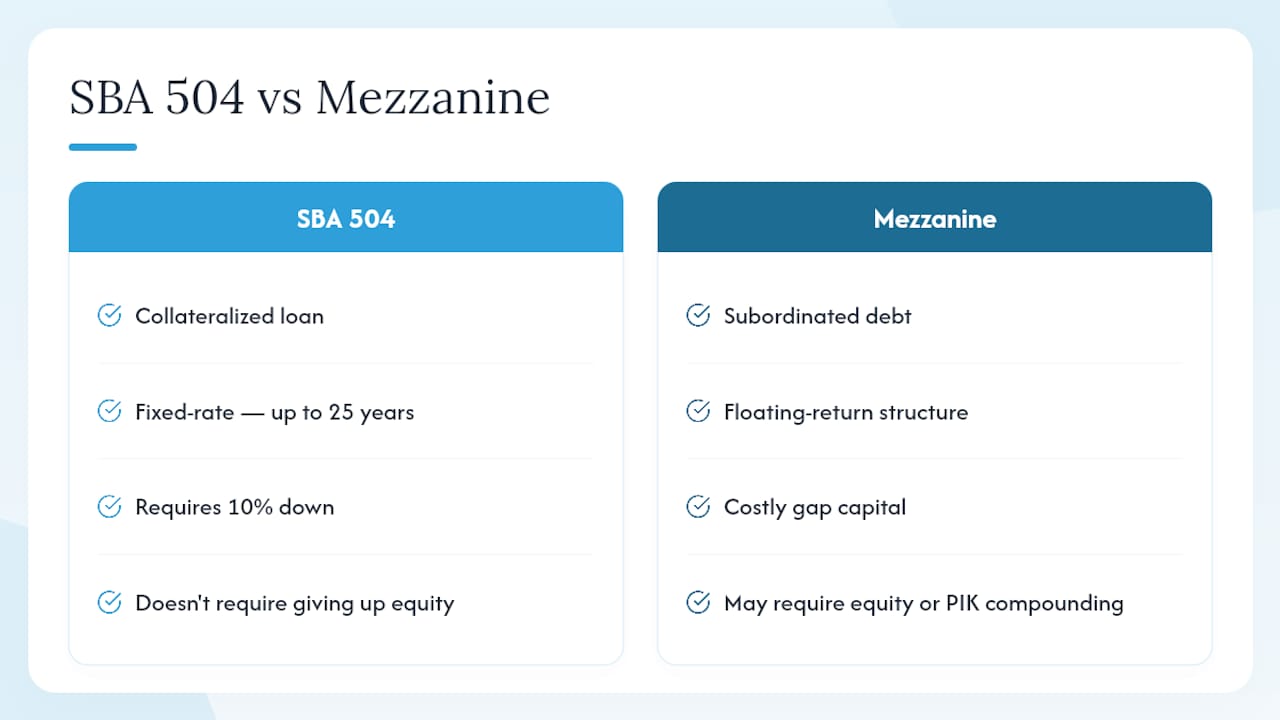
SBA 504 loans work fundamentally differently from mezzanine: they’re collateralized, fixed-rate for up to 25 years, and require just 10% down, compared to the subordinated, floating-return structure of mezzanine debt. For owners deciding between these paths, our SBA 504 vs. 7(a) comparison and our SBA 504 Loan Calculator are good starting points before you commit to costlier capital.
Our Take: Mezzanine Solves a Real Problem, but It’s Often the Expensive Default
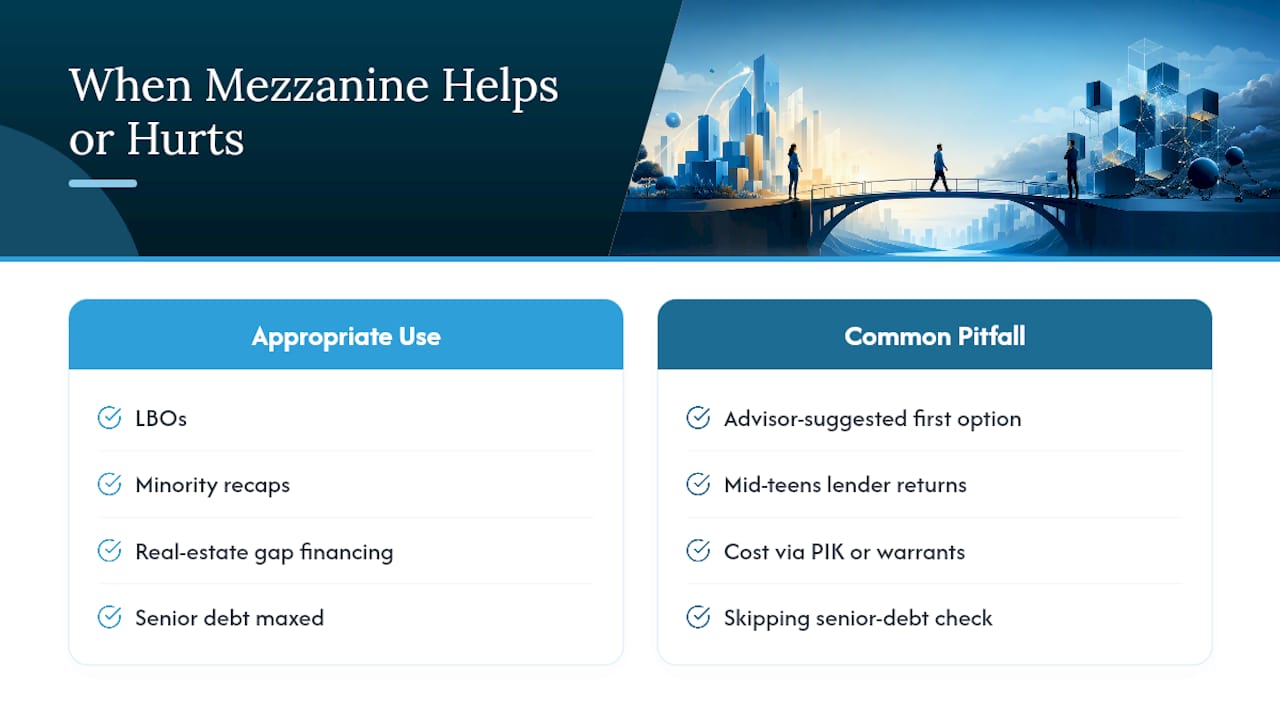
The conventional pitch on mezzanine financing treats it as a clever middle path, cheaper than equity, more flexible than a bank loan. That’s true in specific situations: leveraged buyouts, minority recaps, and real estate projects that genuinely can’t reach full leverage through senior debt alone. But too many business owners reach for mezzanine because it’s the option their advisor mentioned first, not because they’ve confirmed a bank or an SBA-backed structure couldn’t get them there for a fraction of the cost.
The math is the tell. A mezzanine lender targeting a mid-teens blended return is pricing in real subordination risk, and you’re the one paying for it, through PIK compounding, warrant dilution, or both. Before accepting those terms, confirm your senior debt capacity is genuinely maxed out. If a collateralized, fixed-rate structure like an SBA 504 loan can cover 85% or 90% of your project, that’s usually the better first move, not the fallback.
— PHENYX
Consider a Lower-Cost Path Before You Sign a Mezzanine Term Sheet
Mezzanine financing exists to close gaps that senior debt can’t reach, but for many commercial real estate and equipment purchases that gap closes faster with a collateralized structure instead of subordinated capital. CDC New England’s SBA 504 program offers fixed rates for up to 25 years with just 10% down, without the PIK compounding, warrant dilution, or intercreditor complexity that come with mezzanine debt.
If you’re weighing higher-leverage options, our 90% commercial real estate financing guide walks through how borrowers reach that leverage without a mezzanine layer, and our down payment assistance program can shrink the gap even further. Veterans and their spouses have additional options through our VetLoan Advantage program. Run your numbers through the SBA 504 Loan Calculator or start an SBA 504 loan application to see whether a fixed-rate structure gets you to your funding target without the cost of mezzanine capital.
Sources
- Mezzanine financing (Investopedia)
- Guide to Mezzanine Financing | SoFi
- Mezzanine financing (Ryan O’Connell, CFA)
FAQ
What is mezzanine financing in simple terms?
It’s a hybrid loan that ranks below senior debt but above equity, usually paid back through a mix of interest and an equity stake like warrants, used to fill a funding gap without a full equity sale.
What are the risks of mezzanine financing?
The biggest risks are low recovery in default because the debt is subordinated, PIK interest compounding into a large balloon payment at maturity, and dilution or restrictive covenants tied to the warrants and loan terms.
Who typically uses mezzanine financing?
Mezzanine financing is used primarily by middle-market companies pursuing acquisitions, leveraged buyouts, recapitalizations, or real estate development that can’t access the public high-yield debt market or secure enough senior financing alone.
Can you give me an example of mezzanine financing?
A common example is a real estate developer securing senior debt for 65% of project cost, then adding a mezzanine layer to reach 85% total leverage, avoiding a much larger equity contribution to fund the remaining portion.
Is mezzanine financing better than taking on more equity investors?
Mezzanine typically preserves more ownership than an equity raise because the lender’s upside is limited to warrants or conversion rights rather than a full ownership stake, though it costs more than senior debt and carries repayment obligations that equity does not.


