

If your priority is preserving cash and swapping equipment every few years, leasing usually wins. If you want to build equity and keep the asset producing revenue for a decade or more, an equipment loan usually wins. The equation shifts once you factor in Section 179 depreciation and the ASC 842 accounting rules, so run the numbers before you sign anything. The worked example below shows exactly where the breakeven point tends to land.
TL;DR:
- Leasing generally preserves working capital with little or no down payment, making it suitable for cash-strapped businesses or short-term needs.
- Buying becomes more economical than leasing after about four to five years of ownership, especially when taking advantage of Section 179 depreciation and bonus depreciation.
- The choice depends heavily on equipment lifespan, with long-use assets favoring loans, while fast-obsolescing categories are better leased.
- Tax rules like Section 179 and ASC 842 can significantly alter the financial impact of leasing versus buying, so calculations should include these considerations.
- For equipment retained beyond the breakeven point, a long-term fixed-rate SBA 504 loan with a 10% down payment offers a competitive ownership option.
Table of Contents
- Equipment Loan vs Lease: What Really Separates Them?
- How Do You Weigh Cash Flow Against Total Cost?
- What Tax Rules Change the Buy vs Lease Math?
- What Do Lease Types and End-of-Term Options Actually Mean?
- Should You Buy or Lease Your Equipment?
- What Does a Real Breakeven Example Look Like?
- How CDC New England Supports Buyers Who Choose Ownership
- Is the Cash Now or the Equity Later Worth More to You?
- Ready to Finance Your Next Equipment Purchase?
- Sources
- FAQ
Equipment Loan vs Lease: What Really Separates Them?
The core difference is simple: a loan buys the asset, a lease rents the right to use it. Everything else, cash requirements, tax treatment, balance sheet impact, flows from that one distinction.
An equipment loan puts the title in your name from day one, even though the lender holds a security interest until the balance is paid off. A lease keeps the title with the leasing company (or a bank acting as lessor) for the full term, and what happens at the end depends entirely on how the contract is written.
Here’s how the practical differences typically shake out:
- Ownership: Loans build equity you can sell or borrow against later; leases build nothing unless the contract includes a buyout.
- Upfront cost: Loans commonly require a down payment around 20%, while many leases ask for little or no money down.
- Monthly payment: Lease payments are often lower than loan payments for the same equipment, since you’re financing use rather than the full purchase price.
- Obsolescence risk: With a loan, you own the risk that the machine or laptop fleet becomes outdated; leasing frequently shifts that risk to the lessor, especially on tech-heavy categories.
- Maintenance: Many equipment leases bundle service and maintenance into the payment; loans leave upkeep entirely on you.
None of this makes one option universally better. A construction company buying a bulldozer that will run for 15 years has a very different calculation than a dental practice leasing imaging equipment that gets replaced every three years when the technology jumps.
How Do You Weigh Cash Flow Against Total Cost?
Cash flow and total cost pull in opposite directions, and that tension is the entire decision.
Leasing preserves working capital. Skipping a 20% down payment on a $150,000 CNC machine keeps $30,000 in your operating account for payroll, inventory, or an unexpected repair elsewhere in the shop. That flexibility matters most in a business’s early years or during a seasonal cash crunch.
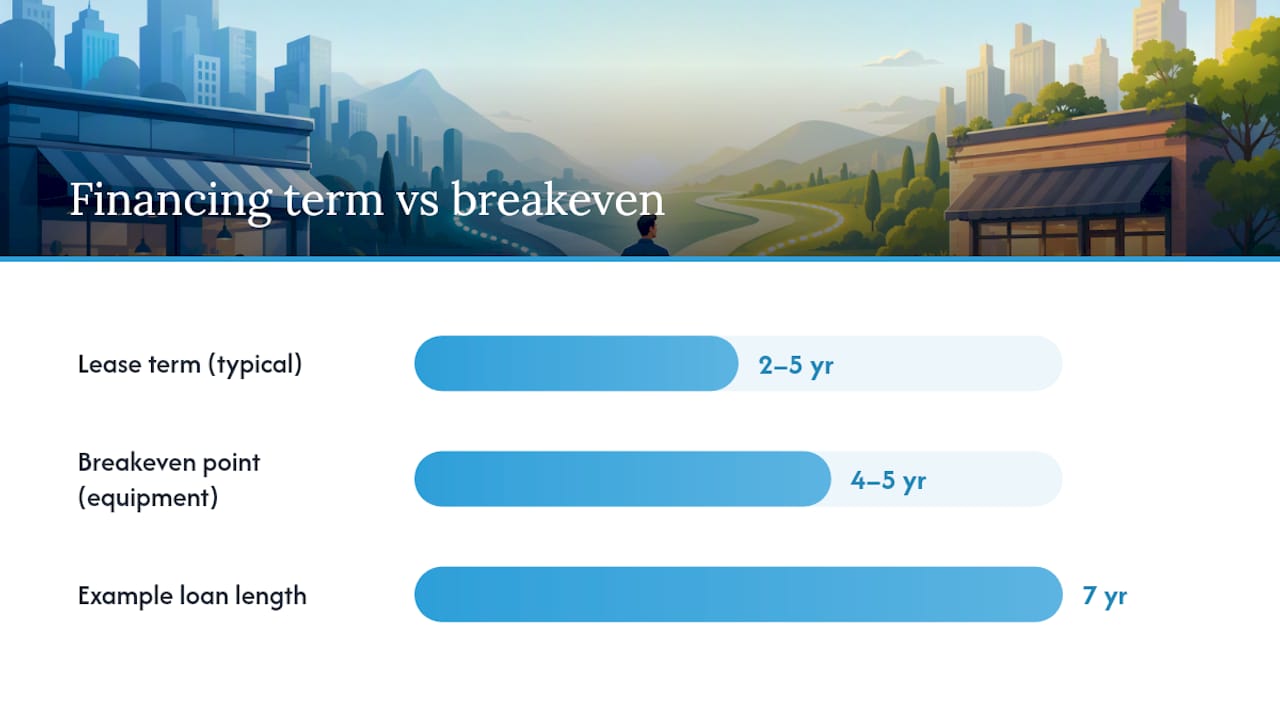
Buying tends to win on total cost once you keep the asset past the breakeven point, which typically lands around four to five years for standard equipment. Past that horizon, lease payments keep accumulating while a loan eventually ends and the asset becomes free equity on your books.
There’s also an opportunity-cost question worth asking honestly:
- Could that down payment earn more elsewhere in the business than the interest you’d pay on a loan?
- Will the equipment still be useful, or even resellable, once the loan is paid off?
- Does your lease term (often 24 to 60 months) roughly match how long you’d actually keep the asset if you owned it outright?
Pro Tip: Match the financing term to the equipment’s realistic useful life, not the other way around. A seven-year loan on a laptop fleet is a mismatch; a three-year lease on a delivery truck usually is too.
What Tax Rules Change the Buy vs Lease Math?
Tax treatment can flip the entire decision, especially for a business that’s profitable enough to use the deductions right away.
Section 179 lets you deduct the full purchase price of qualifying equipment in the year you buy it, up to the annual limit, rather than depreciating it over several years. For a growing business with real profit to shelter, that upfront deduction often outweighs the smaller, steady deduction leasing provides. Bonus depreciation compounds that advantage, though the percentage available is scheduled to step down through 2026, which shrinks the year-one benefit compared to prior years.
Leasing has its own tax logic. Operating lease payments are typically deductible as a straightforward operating expense, spread evenly across the term. That’s simple, but it forfeits the depreciation and interest deductions available on a purchase.
Two things to watch closely:
- A lease with a bargain purchase option, like a $1 buyout, is treated as a financed sale for tax purposes, converting your deduction from lease expense to depreciation and interest.
- Under ASC 842, most leases now generate a right-of-use asset and matching liability on your balance sheet, which erodes the off-balance-sheet advantage leasing once offered lenders evaluating your financials.
The equipment finance industry itself has grown past $1.3 trillion, a sign of how many financing structures now compete for your business, each with its own tax footprint.
What Do Lease Types and End-of-Term Options Actually Mean?
Not all leases work the same way, and the label on the contract determines your tax and accounting treatment.
An operating lease functions like a rental. You deduct payments as an operating expense and hand the equipment back at term’s end. A finance lease (sometimes called a capital lease) behaves like a purchase for accounting purposes, even though the lessor holds title. Certain contractual tests, roughly a present value of payments reaching 90% of the equipment’s fair value, a lease term covering 75% of its economic life, or a bargain purchase option like the $1 buyout, trigger that reclassification.
Your end-of-term options usually include:
- Return the equipment and walk away, common on operating leases for fast-changing technology.
- Renew the lease at a reduced rate, useful if the equipment still performs well.
- Buy the equipment at fair market value or a pre-set price, effectively converting the lease into ownership.
Read the early-termination clause before you sign. Many leases carry stiff penalties or restrict how you can use the equipment during the term, both of which erase the flexibility leasing is supposed to offer.
Should You Buy or Lease Your Equipment?
Run through this quick checklist before committing either way.
Buying tends to fit when:
- The equipment has a long useful life (10+ years) and won’t become obsolete quickly.
- You want to claim Section 179 or bonus depreciation against solid profits this year.
- Building equity matters because you’ll resell or keep using the asset after the loan ends.
Leasing tends to fit when:
- The category evolves fast (computers, diagnostic imaging, certain software-driven machinery).
- Cash is tight and preserving working capital outweighs long-term cost.
- Your need is short-term or seasonal, and ownership adds no real value.
Ask yourself three questions: How long will I actually use this? Do I have the down payment without straining cash flow? Am I profitable enough this year to benefit from Section 179? If your numbers land close to the breakeven line, model both scenarios or talk to a CPA before deciding.
What Does a Real Breakeven Example Look Like?
Picture a $100,000 piece of equipment with a seven-year useful life. Buying it with a loan (20% down, remainder financed) costs less than leasing once you keep it past year five, largely because Section 179 depreciation front-loads the tax benefit.
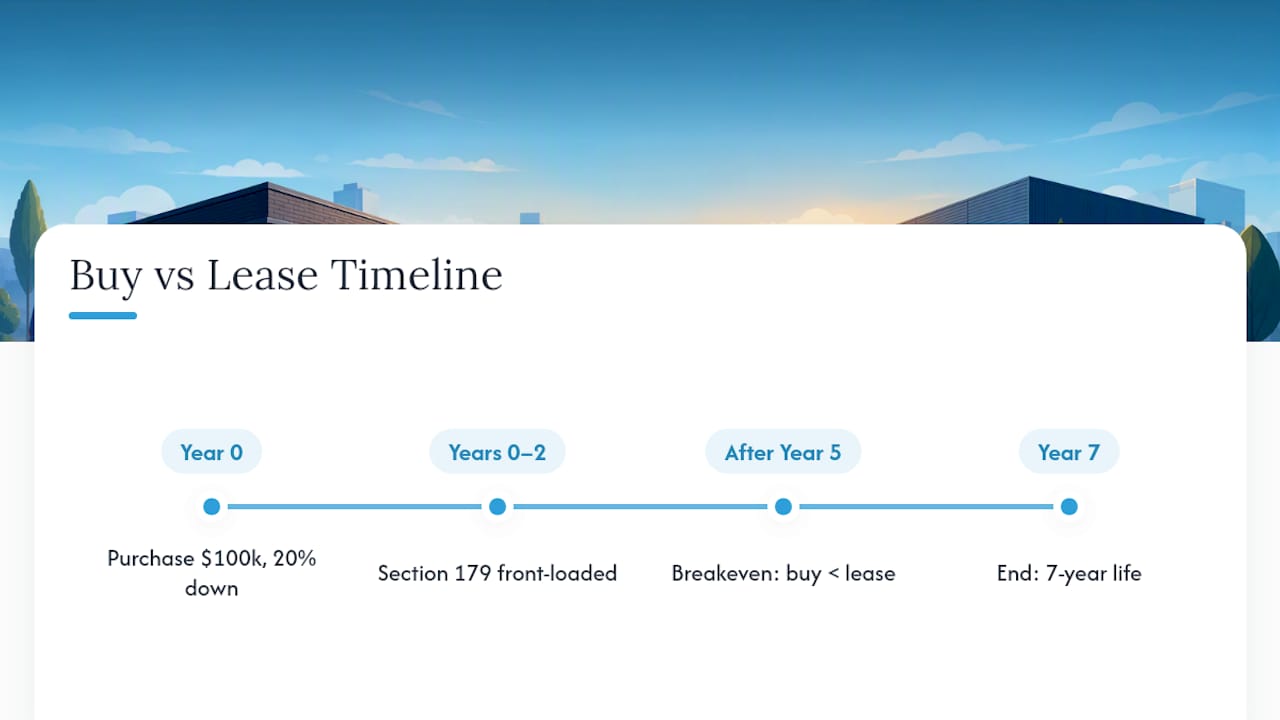
Change the residual value, tax rate, or term to fit your business, then confirm the math with the SBA 504 loan calculator.
How CDC New England Supports Buyers Who Choose Ownership
If the math points toward buying, Cdcnewengland’s SBA 504 program is built for exactly that decision. The Equipment 10-Year Fixed option requires as little as 10% down, well below the roughly 20% many conventional equipment loans demand, with a competitive fixed rate that protects your payment from rate swings. That structure suits growing businesses that want equity without draining cash, plus veteran-owned businesses eligible for additional program benefits.
Is the Cash Now or the Equity Later Worth More to You?
Most owners default to whichever option has the lower monthly payment, without ever running the five-year comparison. That’s backwards. The better question is where your business will be in year five, not what fits this month’s budget.
If the numbers sit close to the breakeven point, don’t guess. Model both scenarios and loop in a CPA and a lender before signing anything.
— PHENYX
Ready to Finance Your Next Equipment Purchase?
Cdcnewengland gives buyers a path to ownership that most conventional equipment loans can’t match: a 10% down payment instead of the 20% many lenders require, locked into a fixed rate for the life of the term. If the breakeven math in this guide pointed you toward buying, that lower down payment is the difference between straining your cash flow and keeping it intact.
The Equipment 10-Year Fixed program fits businesses replacing production machinery, vehicles, or other long-life assets they intend to keep well past the five-year breakeven mark. Veteran-owned businesses can also explore the VetLoan Advantage Program for additional support. Start by running your own numbers through the SBA 504 loan calculator, then reach out to discuss SBA 504 financing for your specific equipment purchase.
Sources
FAQ
What Are the Downsides of Equipment Leasing?
Leasing usually costs more over the life of the equipment than buying outright, and you build no equity unless the contract includes a buyout. You also face early-termination penalties and use restrictions that a loan doesn’t carry.
What Is the 90% Rule in Leasing?
If the present value of lease payments reaches 90% of the equipment’s fair market value, it’s typically classified as a finance lease rather than an operating lease.
Is It Better to Buy or Lease Equipment?
Buying tends to be better for equipment you’ll use past the four to five year breakeven point, especially when Section 179 depreciation applies. Leasing tends to be better for cash-strapped businesses or fast-obsolescing technology where ownership adds little value.
Is It Better to Lease or Get a Loan?
A loan is usually better if you want ownership, equity, and long-term tax benefits like Section 179.


