

Use a broker price opinion when you need a fast ballpark number, and use a certified appraisal when a lender, court, or formal transaction requires a defensible value. A BPO runs $30 to $300 and takes a few days; an appraisal costs more and takes weeks. The deciding factor is simple: does anyone with legal or lending authority need to rely on the number?
TL;DR:
- A broker price opinion is suitable for quick, low-cost estimates in straightforward residential markets but is rarely accepted for formal legal or lending purposes.
- Certified appraisals, mainly prepared by licensed professionals, are required for mortgage underwriting, legal disputes, or complex properties due to their documented, standardized approach.
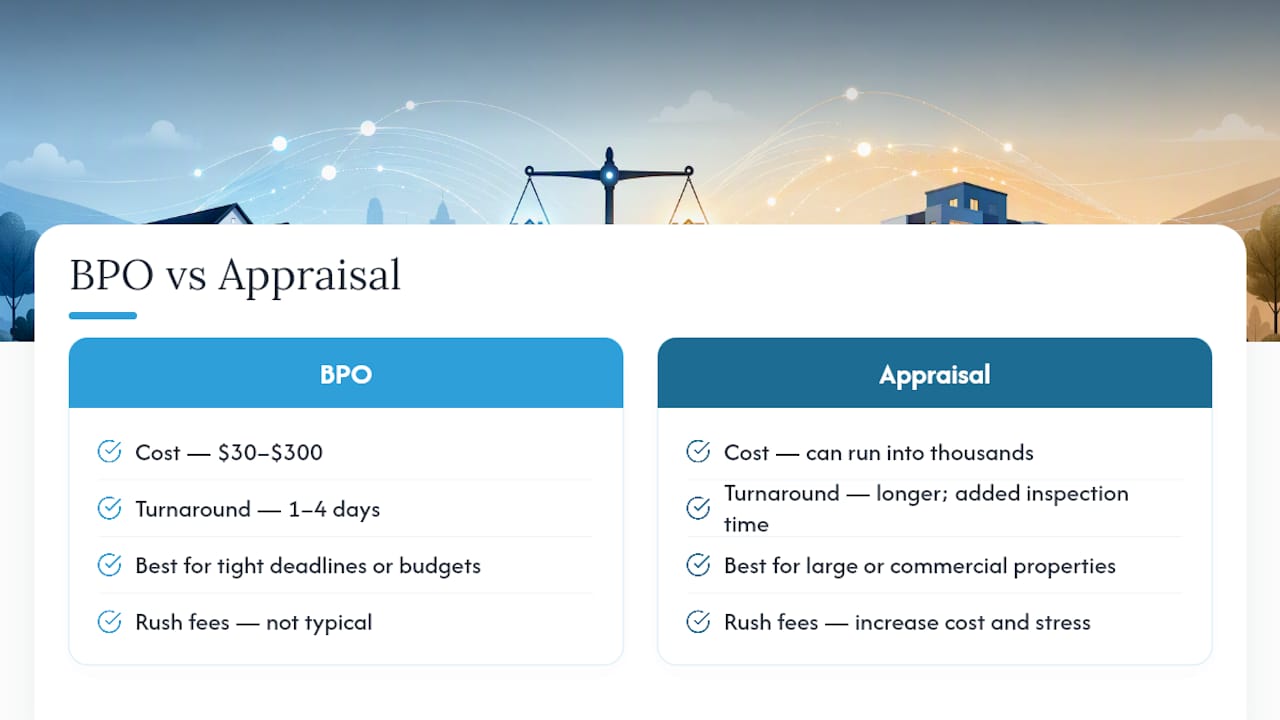
- The costs and turnaround times differ significantly, with BPOs costing $30 to $300 and taking 1 to 4 days, while appraisals can cost into the thousands and take weeks.
- Government-backed loans and legal cases demand certified appraisals, making BPOs inappropriate for mortgage applications, court proceedings, or property tax disputes.
- For refinancing or legal situations involving lenders or courts, a full appraisal is nearly always necessary, especially for property types that are unusual or complex.
Table of Contents
- BPO vs Appraisal: Side-by-Side Comparison
- Who Prepares Each Report, and Why Credentials Matter
- How to Decide Between a BPO and an Appraisal
- What BPOs and Appraisals Actually Cost, and How Long They Take
- When the Law or Your Lender Won’t Accept a BPO
- Real Scenarios: Matching the Method to the Moment
- Why CDC New England Treats Appraisals as Non-Negotiable
- Ready to Finance Your Commercial Property?
- Where to Verify the Rules Yourself
- Sources
BPO vs Appraisal: Side-by-Side Comparison
The two reports look similar on the surface, but they diverge on every axis that matters once money or legal standing is on the line.
| Factor | Broker Price Opinion (BPO) | Certified Appraisal |
|---|---|---|
| Preparer/credentials | Licensed real estate broker or agent | State-licensed or certified appraiser |
| Purpose/accepted uses | Pre-list pricing, portfolio review, distressed asset checks | Mortgage underwriting, legal proceedings, refinancing |
| Typical cost range | $30 to $300 | — |
| Turnaround time | 1 to 4 days | weeks |
| Detail/methods | Market comps, agent judgment, drive-by or desktop review | Full inspection, USPAP-compliant methodology, documented adjustments |
| Lender/legal acceptance | Rarely accepted for underwriting or court | Standard requirement for mortgages and legal disputes |
The nuance lives in the gray areas. A BPO on a straightforward suburban home in a fast-moving market can be remarkably accurate, partly because brokers often pull from active and pending listings rather than only closed sales. That recency helps with pricing strategy. It does nothing for a bank that needs a documented, legally defensible number. Complex properties (mixed-use buildings, unusual lot configurations, commercial parcels) push you toward an appraisal almost automatically, because a broker’s comp-based judgment breaks down when there’s nothing comparable nearby.
Who Prepares Each Report, and Why Credentials Matter
A certified appraiser holds a state license and follows the Uniform Standards of Professional Appraisal Practice (USPAP), the framework created under the Financial Institutions Reform, Recovery, and Enforcement Act. Appraisers complete ongoing continuing education and document their methodology so the report can withstand scrutiny in underwriting or court.
A BPO, by contrast, is prepared by a real estate broker or agent, often someone with a financial interest in the deal (a listing commission, a referral relationship, or a stake in a distressed sale moving quickly). That’s not necessarily bad faith, but it does introduce a bias risk that USPAP-compliant appraisals are structured to avoid. Some states restrict when brokers can charge for BPOs or limit how they’re used, so the rules aren’t uniform everywhere. If a report needs to hold up legally, the independent, credentialed appraiser carries far more weight than the broker’s opinion, regardless of how experienced that broker is.
How to Decide Between a BPO and an Appraisal
Run through this checklist before you order either report:
- Is a lender or court involved? If yes, you almost certainly need an appraisal.
- What’s the transaction type? Listing a home, checking equity, or evaluating a distressed asset leans BPO; financing, refinancing, or litigation leans appraisal.
- Is the property unusual? Custom builds, mixed-use buildings, and commercial properties need an appraiser’s documented methodology.
- What’s your timeline and budget? A BPO fits a tight window and a small budget; an appraisal requires more of both.
Before you order either one, ask these questions:
- Will my lender accept this report, or do they require a specific form?
- Who else will rely on this number, a bank, an attorney, a buyer?
- Is the property complex enough that comps alone won’t cut it?
- How fast do I actually need this?
- What’s the total cost, including any rush fees?
- Does my state restrict who can prepare a BPO?
A red flag worth flagging on its own: never submit a BPO in place of an appraisal for a mortgage application, a PMI removal request tied to a formal loan modification, or any court-ordered valuation. Lenders and judges expect USPAP compliance, and a BPO simply doesn’t meet that bar.
Pro Tip: Order the cheaper BPO first if you’re only trying to decide whether a full appraisal is worth the money, say, before listing a home for sale. If the BPO number is close to what you expected, you’ve saved yourself the appraisal fee. If it’s wildly off, you now know an appraisal is the safer next step.
What BPOs and Appraisals Actually Cost, and How Long They Take
The numbers vary by property type, but the ranges are consistent enough to budget around. A BPO typically costs $30 to $300 and turns around in one to four days, making it the go-to for anyone working against a tight deadline or a thin budget.
An appraisal’s cost climbs fast once you move into commercial territory. Fees on large or commercial properties can run into the thousands, driven by added inspection time, more complex income and cost approaches, and additional documentation lenders require. Rush ordering adds to both cost and stress, so building in a realistic timeline saves money you’d otherwise spend on expedited fees.
When the Law or Your Lender Won’t Accept a BPO
Government-backed loan programs and most mortgage originations require a certified appraisal, full stop. Lenders overwhelmingly prefer appraisals because the standardized methodology holds up under regulatory review in a way a broker’s opinion never will.

Legal contexts carry the same requirement. Estate settlements, divorce proceedings, and property tax appeals typically demand an appraisal because the number has to survive a challenge in court, not just a conversation between a buyer and seller. State rules add another layer of complexity: some states cap what brokers can charge for BPOs or restrict the situations where they’re usable at all. Check your state’s appraisal board or real estate commission before you assume a BPO will work for your situation.
Real Scenarios: Matching the Method to the Moment
- Removing PMI on a conventional mortgage. Most servicers require a full appraisal, not a BPO, before dropping mortgage insurance.
- Setting a listing price. A BPO (or a comparative market analysis from your agent) is usually enough to price a home competitively.
- Foreclosure or short sale evaluation. Banks often order BPOs internally for speed, though the final loan decision may still hinge on an appraisal.
- Refinancing a mortgage. Nearly always requires a certified appraisal.
- An investor deciding whether to buy a rental property. A BPO often suffices since the investor, not a lender, is the one relying on the number.
- Applying for SBA 504 financing on a commercial property. A certified appraisal is required as part of underwriting.
Walking through the checklist on scenario 4: a lender is involved, the transaction is a refinance, and the outcome affects loan terms. That combination points straight to an appraisal, no shortcuts.
Why CDC New England Treats Appraisals as Non-Negotiable
We’ve underwritten commercial real estate financing across New England for more than 70 years, deploying over $2.3 billion into regional businesses. Every SBA 504 loan we arrange requires a certified appraisal, not a BPO, because the loan structure, a 10% down payment paired with a 25-year fixed rate, depends on a defensible valuation. We guide borrowers through that requirement early so it never becomes a closing-day surprise.
— PHENYX
Ready to Finance Your Commercial Property?
Once you know a certified appraisal is required, the next question is how to structure financing around it. Cdcnewengland arranges SBA 504 loans built for exactly this moment: a 10% down payment, fixed rates locked for up to 25 years, and programs including down payment assistance and veteran-specific benefits that traditional lenders rarely offer.
An appraisal establishes the number; Cdcnewengland helps you turn that number into a closed deal without draining your working capital on a large down payment. If you’re weighing whether a property purchase pencils out, run the numbers through the SBA 504 loan calculator or review SBA 504 loan options to see current rates and terms. Veterans should also check the VetLoan Advantage program for additional benefits tied to SBA 504 financing.
Where to Verify the Rules Yourself
- Broker Price Opinion basics — Experian’s consumer explainer
- BPO guide and lender context — Rocket Mortgage
- CMA vs BPO vs appraisal differences — RealAnalytica
- Comparative market analysis fundamentals — for pricing strategy context
- SBA 504 appraisal requirements — Cdcnewengland
This article is general information, not a substitute for advice from a qualified financial advisor. Consult a qualified financial professional about your own circumstances before acting on anything here.
Sources
- What Is a Broker Price Opinion (BPO?) — Experian
- A guide to broker price opinion (BPO) — Rocket Mortgage
- Property Appraisal vs. Broker Price Opinion: 2026 Guide — NJ Appraisal Insights


