In this article, “trade cycle financing” refers to SBA 504 long-term, fixed-rate financing for buying or refinancing commercial real estate and heavy equipment. It fits you if you want a low down payment, a rate that never moves, and terms of 10 to 25 years instead of a short-term loan you have to renew every year. One direct provider you can work with to get there.
TL;DR:
- SBA 504 loans offer fixed interest rates and terms of 10 to 25 years, matched to the asset’s useful life, for real estate and heavy equipment.
- To qualify, all owners must be U.S. citizens or nationals with a principal residence in the United States, effective from March 2026.
- The program covers long-term assets and excludes working capital, inventory, and short-lived equipment, with refinancing requiring prior eligible use and payment history.
- Typical down payment is around 10%, with most fees financed into the loan, and timelines can extend weeks or months due to documentation and approval processes.
- Preparing a complete application with financial statements, business plans, and asset documentation significantly speeds up approval and closing.
Table of Contents
- What Is Trade Cycle Financing Under the SBA 504 Program?
- Who Qualifies: Ownership, Residency, and Occupancy Rules
- What 504 Financing Will and Won’t Cover
- How 504 Refinancing Works and What to Expect on Timeline
- Costs and Fees: What a 504 Project Really Runs
- How to Prepare and Apply: Documents and Realistic Timing
- Common Pitfalls and Decision Checkpoints Before You Commit
- What “Trade Cycle Financing” Actually Means Here
- The Different Structures Within Long-Term Fixed Asset Financing
- How This Differs From Short-Term Working Capital Financing
- Eligibility Criteria Specific to This Type of Financing
- Where CDC New England Fits Into Your Financing Plan
- Where to Verify Program Rules Yourself
- Get Fixed-Rate Financing Built for Your Growth Plan
- Sources
- FAQ
What Is Trade Cycle Financing Under the SBA 504 Program?
The SBA 504 program funds major fixed assets with a maximum loan amount of $5.5 million, paired with fixed-rate terms that stay flat for the life of the loan. Equipment purchases typically carry a 10-year term, while real estate deals run 20 or 25 years. That maturity length is the entire point: you’re not scrambling to refinance a line of credit every 12 to 36 months while your equipment or building keeps generating revenue for decades.
The structure behind every 504 deal is a three-party split:
- A private lender covers roughly 50% of the project in a first-lien position.
- A Certified Development Company (CDC), like CDC New England, funds about 40% through an SBA-guaranteed debenture.
- You contribute the remaining 10% as borrower equity.
That split is why banks are often willing to finance a bigger share of your project. Their exposure sits in first position, so the risk profile looks better than a conventional commercial mortgage.
Who Qualifies: Ownership, Residency, and Occupancy Rules
Eligibility hinges on three things: who owns the business, where they live, and how the property gets used. Confirm each before you invest time in an application.
- Ownership and residency. Starting March 1, 2026, SBA requires that every direct and indirect owner of the applicant business be a U.S. citizen or U.S. national with a principal residence in the United States. Lawful Permanent Residents no longer qualify to hold an ownership stake in a 7(a) or 504 borrower.
- Business purpose. The program exists to fund growth and support job creation for owner-operated small businesses, not passive investors.
- Occupancy thresholds. New construction projects require you to occupy 60% of the space, with room to lease out the rest over time. Acquisitions of existing buildings require 51% owner occupancy at closing, and any leased portion must stay within program limits.
Check the ownership rule carefully if your company has foreign investors or partners holding equity, since that single requirement disqualifies otherwise strong applicants.
What 504 Financing Will and Won’t Cover
SBA 504 dollars go toward fixed assets that support long-term operations, not day-to-day cash flow. eCFR §120.882 spells out what qualifies:
- Land and building acquisition or construction
- Machinery and equipment with a useful life of at least 10 years
- Professional fees tied directly to the project (appraisal, legal, architectural)
- Contingency reserves for construction overruns
- Repayment of eligible interim or bridge financing in qualifying cases
What’s off the table matters just as much. The program won’t fund working capital, inventory, speculative real estate investment, short-lived equipment, or general consulting costs unrelated to the fixed asset itself. The 504 program is built around growth and job creation, not liquidity management. If your actual need is inventory financing or bridging seasonal trade credit, this is the wrong tool. Refinancing existing qualified debt is allowed under specific conditions, covered next.
How 504 Refinancing Works and What to Expect on Timeline
Refinancing existing debt through 504 isn’t automatic. The original loan must have funded eligible fixed assets, the debt has to be secured by those same assets, and the loan generally needs a track record of on-time payments over a set period before you qualify. CDC guidance also outlines appraisal-based loan-to-value limits that cap how much of the new project value the refinance can cover.
Documentation is where refinance applications usually stall. Successful applicants need to prove the original debt paid for eligible assets and itemize any additional eligible costs rolled into the new loan.
Expect these mechanics:
- An appraisal establishes current project value and sets the LTV ceiling.
- SBA project approval often happens well before the final closing.
- Construction completion, occupancy certification, and final underwriting can extend the timeline by weeks or months beyond initial approval.
Pro Tip: Start gathering your original loan documents, payment history, and asset-use records the same week you contact a lender. Refinance files with clean paper trails close noticeably faster than ones assembled after underwriting begins.
Costs and Fees: What a 504 Project Really Runs
Every 504 deal includes several standard fees in addition to the loan itself. These typically comprise CDC processing fees, SBA guarantee fees on the debenture, bond issuance costs, appraisal and environmental report fees, legal and title charges, and a separate lender fee from your first-lien bank.
The good news: most of these fees can be financed into the total project cost rather than paid entirely out of pocket at closing. That preserves your working capital for the parts of the business the loan itself can’t touch, like inventory or payroll during a transition.
Fee schedules change year to year. SBA publishes updated figures, including its 504 fee notice for fiscal year 2026, so don’t rely on numbers you saw quoted a year ago.
- Ask your CDC for a written, itemized fee estimate before you commit.
- Run the total financed amount, fees included, through an SBA 504 loan calculator so you can compare the true all-in cost against a conventional commercial mortgage.
- Confirm which fees are rolled into the loan versus due at closing, since that split affects your cash position on day one.
How to Prepare and Apply: Documents and Realistic Timing
A complete application package moves faster than a partial one resubmitted three times. Gather these before you contact a lender:
- Two to three years of business and personal financial statements and tax returns
- A business plan or a clear, written statement of how the loan proceeds will be used
- Proof of qualified debt and payment history if you’re refinancing
- A current appraisal and, where applicable, an environmental report on the property
- Contractor bids for any construction or renovation work
- Ownership and formation documents confirming the citizenship and residency status of every owner
The process itself runs through three parties working in sequence: your private lender pre-qualifies the deal and commits to its first-lien share, the CDC packages the file and submits it to SBA through the E-Tran system for authorization, and closing follows once both approvals are in place.
Pro Tip: Loop in your lender, your CDC, and your contractor at the same time, not sequentially. Projects that wait to bring in the contractor until after SBA approval routinely lose a month or more to bid delays.
Common Pitfalls and Decision Checkpoints Before You Commit
Long closing timelines catch the most first-time applicants off guard, especially on construction deals where certification of completion has to happen before final closing. Refinance files stall when documentation of the original loan’s eligible use is thin or missing. Occupancy violations show up after the fact when a borrower leases out more space than the program allows and doesn’t catch it until an SBA compliance review flags it. For real estate projects, failing to meet occupancy percentages after closing can trigger compliance action, so structure your leases around those thresholds from day one, not as an afterthought.
The most common outright mistake: trying to stretch 504 dollars to cover working capital or inventory, both of which the program explicitly excludes.
Before you commit, run through four checkpoints:
- Confirm every owner meets the citizenship and residency requirement.
- Get a preliminary term sheet from your private lender.
- Submit to a CDC for intake review and initial feedback.
- Rebuild your cost contingency estimate after you have real contractor bids, not early guesses.
What “Trade Cycle Financing” Actually Means Here
The phrase gets used loosely across lending websites, often to describe short-term working capital tied to inventory turns or receivables. That’s not what this article covers, and it’s worth being direct about the distinction so you don’t apply for the wrong product.
Here, trade cycle financing describes the SBA 504 structure: fixed-rate, long-term debt sized to a major fixed asset’s actual useful life. A piece of equipment with a 10-year service life gets a 10-year loan. A building you’ll occupy for decades gets a 20 or 25-year term. The financing cycle matches the economic cycle of the asset itself, not a 90-day sales cycle or a seasonal inventory swing.
That match matters more than it sounds. A business that finances a $2 million building on a 5-year balloon note is betting it can refinance on favorable terms in five years, with no guarantee rates will cooperate. A business that finances the same building through 504 locks a rate for 20 or 25 years and removes that bet entirely. The three-party structure that makes this possible, with a bank in first lien and the CDC’s SBA-guaranteed debenture behind it, is what lets a small business access rate certainty usually reserved for much larger companies with investment-grade credit.
Standard commercial lending vocabulary calls this asset-based, long-term fixed financing. You’ll also see it referred to as owner-occupied real estate financing or equipment term financing, depending on which asset class you’re funding. All three point to the same mechanism this article describes.
The Different Structures Within Long-Term Fixed Asset Financing
Not every 504 project looks the same, and the program flexes across a few distinct use cases.
Real estate acquisition and construction. This covers buying an existing building, constructing a new one, or expanding a facility you already occupy. Terms run 20 or 25 years, and the occupancy rules described earlier apply directly.
Equipment and machinery financing. Heavy equipment, manufacturing lines, and other assets with at least a 10-year useful life get matched to a 10-year term. This category excludes equipment with shorter functional lifespans, like most computers or vehicles, which don’t fit the program’s long-life asset requirement.

Debt refinancing. Businesses carrying qualified debt on eligible fixed assets can convert variable or short-term financing into a fixed 504 structure, subject to the eligibility conditions covered earlier.
Down payment assistance. Some CDCs, including CDC New England, offer supplemental programs that reduce the cash a borrower needs at closing beyond the standard 10% equity requirement.
Veteran-specific programs. Programs like VetLoan Advantage layer additional benefits, such as reduced fees, onto the standard 504 structure for veteran and military-spouse-owned businesses.
Each structure uses the same underlying three-party funding split. What changes is the asset class, the term length, and occasionally the fee treatment. None of these variants function like a revolving line of credit or a receivables-based facility. They’re all built around a single large purchase or refinance event, not ongoing transactional cash flow.
How This Differs From Short-Term Working Capital Financing
The clearest way to understand SBA 504 financing is by what it isn’t. It isn’t a revolving credit line, a receivables facility, or any product designed to smooth out short-term cash timing gaps.
A working capital line gets drawn down and repaid repeatedly within a single operating cycle, often 30 to 90 days. Rates on those products usually float with a benchmark like prime, and the lender expects the balance to cycle, not sit static for two decades. SBA 504 does the opposite: you draw the full amount once, at closing, and pay it down on a fixed schedule for 10 to 25 years at a rate that never changes.
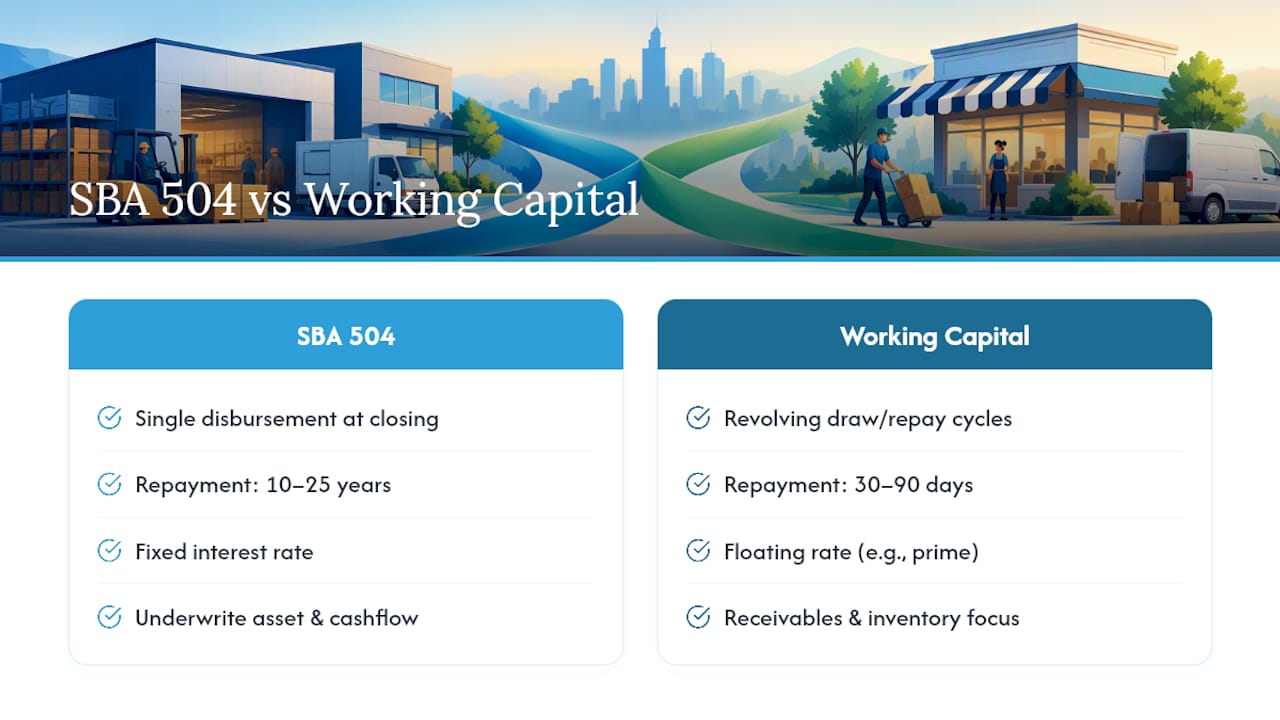
The risk profile differs too. Working capital lenders evaluate your receivables aging, inventory turns, and cash conversion cycle. A 504 lender and CDC evaluate the fixed asset itself, its appraised value, your ownership structure, and your capacity to service a fixed payment over a long horizon. The underwriting questions aren’t the same, and neither is the paperwork.
Cost structures diverge as well. Short-term facilities often carry higher effective rates to compensate for revolving risk, plus renewal fees each time the line resets. The 504 program trades that flexibility for a lower, fixed rate locked in once, with fees you largely finance into the loan itself rather than pay repeatedly. If your business needs both, and many growing companies do, expect to pair a 504 loan for the building or equipment with a separate working capital facility for inventory and receivables. They solve different problems and shouldn’t be forced into one product.
Eligibility Criteria Specific to This Type of Financing
Three eligibility layers stack on top of each other, and missing any one of them stops an application cold.
The first layer is ownership and residency, covered earlier: every direct and indirect owner needs U.S. citizenship or national status with a principal U.S. residence as of March 1, 2026. The second layer is business size and purpose. SBA caps eligibility based on net worth and net income limits for small businesses, and the loan proceeds must support job creation or retention tied to the specific fixed asset being financed.
The third layer is asset-specific. Real estate must meet the 51% or 60% owner-occupancy thresholds depending on whether it’s an acquisition or new construction. Equipment must carry a useful life of at least 10 years to qualify for the standard term. Refinance applicants face an additional layer: the original debt must have funded an eligible fixed asset, must be secured by that asset, and generally needs a documented history of timely payments before SBA will consider it for the qualified-debt refinance track.
None of these thresholds are negotiable inside the program rules, but they’re also knowable in advance. A short conversation with a CDC before you submit paperwork usually surfaces any disqualifying issue, whether that’s an ownership structure problem or an occupancy plan that doesn’t pencil out. That’s a far better place to find a problem than three weeks into underwriting.
Where CDC New England Fits Into Your Financing Plan
If your project matches the profile this article describes, real estate or equipment, long-term hold, need for a fixed rate. There are specific products built for it such as Equipment 10-Year Fixed, Real Estate 20-Year Fixed, Real Estate 25-Year Fixed, the SBA 504 Refinance Program, and veteran and military-spouse-specific programs.
One CDC has operated in the region for decades and invested substantial capital into New England businesses, demonstrating experience relevant to working with SBA’s E-Tran system. Some CDCs publish funding rates monthly, providing transparency for timing a closing or comparing costs against alternatives. Down Payment Assistance Programs can help reduce the cash needed at closing beyond the standard equity contribution.
If any of this matches your situation, the practical next step is a pre-qualification conversation to get a real estimate of your rate and fees.
— PHENYX
Where to Verify Program Rules Yourself
Don’t take secondhand summaries as the final word on program rules. Check the SBA’s 504 loan page for current limits and terms, review eCFR §120.882 for eligible project costs, and confirm the ownership and residency rule directly through SBA’s own procedural notice before you assume your ownership structure qualifies.
Get Fixed-Rate Financing Built for Your Growth Plan
Cdcnewengland gives you a lower barrier to entry than most conventional commercial lenders: a roughly 10% down payment instead of the 20 to 30% many banks require for owner-occupied real estate or equipment purchases. That difference alone can be the gap between buying your building this year or waiting three more years to save additional cash.
Some CDCs offer fixed rates locked for up to 25 years, so payments on buildings or equipment purchases remain stable regardless of benchmark rate changes. The SBA 504 Refinance Program converts existing qualified debt into that same fixed structure, and the VetLoan Advantage Program adds targeted benefits for veteran and military-spouse-owned businesses, including a processing fee of 1.0%. Regional, hands-on support means someone reviews your specific ownership structure and project details before you submit anything to SBA.
If you are interested, consider reaching out to a CDC for a pre-qualification conversation and an estimate of rates and fees.
This article is general information, not a substitute for advice from a qualified financial advisor. Consult a qualified financial professional about your own circumstances before acting on anything here.
Sources
- U.S. Small Business Administration — 504 loans
- SBA Procedural Notice — revised applicant ownership/citizenship/residency requirements
- eCFR § 120.882 — Eligible project costs for 504 loans
FAQ
What Is Trade Cycle Financing in the SBA 504 Context?
In this context, it’s fixed-rate, long-term financing for major fixed assets like commercial real estate and heavy equipment, with the loan term matched to the asset’s useful life. Terms typically run 10 years for equipment and 20 or 25 years for real estate.
How Much Down Payment Does SBA 504 Financing Require?
Programs like Down Payment Assistance can reduce that upfront cash requirement further.
Who Can Own a Business Applying for a 504 Loan?
As of March 1, 2026, every direct and indirect owner must be a U.S. citizen or U.S. national with a principal residence in the United States. Lawful Permanent Residents can no longer hold ownership in an applicant business under this rule.
Can I Use a 504 Loan for Working Capital or Inventory?
No. The program funds fixed assets like land, buildings, and long-life equipment, and it explicitly excludes working capital, inventory, and most short-lived equipment purchases.
Does CDC New England Publish Its Rates?
Yes, CDC New England publishes monthly funding rates, including its current Equipment 10-Year Fixed, Real Estate 20-Year Fixed, and Real Estate 25-Year Fixed offerings. Contact the team directly for a current fee estimate, since program fees change periodically.