The main SBA 504 fees are the upfront guaranty fee, the annual service fee, the CDC processing fee, a small funding fee, and standard closing costs. Almost all of these apply only to the CDC (SBA-backed) portion of your loan, not the bank’s first-lien piece, and most get financed into the debenture instead of paid out of pocket. For FY2026, qualifying manufacturers can have several of these fees waived entirely.
TL;DR:
- Most FY2026 SBA fees for non-manufacturers are waived, including the upfront guaranty fee, annual service fee, and certain closing costs.
- The CDC processing fee can reach up to 1.5% of the debenture amount, often financed into the loan, significantly increasing the effective cost.
- Financed fees typically total around 3% of the CDC debenture, raising the loan’s effective interest rate by a few tenths of a point.
- Manufacturer NAICS codes 31 through 33 qualify for fee waivers, substantially reducing costs for equipment or facility purchases.
- Borrowers should verify exact fees and eligibility early, and utilize fee estimation tools since actual costs vary based on project size and program specifics.
Table of Contents
- What Are the SBA-Level Fees on a 504 Loan?
- How Much Does CDC Charge in Fees and Closing Costs?
- How Do These Fees Change Your Total Loan Cost?
- Which Waivers and Exceptions Change What You Pay?
- What Should You Ask Your CDC Before You Sign?
- Why CDC New England’s Tools Make Fee Estimates Easier
- Ready to See Your Actual Fee Breakdown?
- Where to Confirm Current 504 Fee Rates
- Sources
- FAQ
What Are the SBA-Level Fees on a 504 Loan?
Two fees come directly from the SBA and apply to your CDC debenture balance. Understanding SBA 504 fees at this level starts with the upfront guaranty fee, since it sets the tone for everything else you’ll pay.
The upfront guaranty fee is charged once, calculated against your CDC debenture amount, and rolled into your loan at closing. For FY2026, most non-manufacturer borrowers pay 0.50% of the debenture, while qualifying manufacturers (NAICS codes 31 through 33) get this fee waived completely.
The annual service fee, sometimes called the ongoing guaranty fee, accrues yearly against your outstanding CDC balance rather than the original loan amount. It runs around 0.209% for FY2026 and shrinks in dollar terms as you pay down principal. Manufacturers again catch a break here, with this fee waived under the same FY2026 provision.
A third, smaller charge is the funding fee, paid to the trustee or fiscal agent who handles the debenture pooling and sale on the secondary market. It typically runs a fraction of a percent and gets bundled into closing costs rather than billed separately.
Three points matter for your budget:
- All three SBA-level fees apply strictly to the CDC portion, never your bank’s first-mortgage piece.
- Rates change every fiscal year, so always confirm current figures against the SBA’s official FY2026 fee notice.
- Lender guides like Lendio’s breakdown of guarantee fees confirm the same structure applies whether you’re financing real estate or equipment.
How Much Does CDC Charge in Fees and Closing Costs?
Beyond the SBA’s own fees, your Certified Development Company adds its own layer of charges, and these are the ones borrowers most often underestimate.
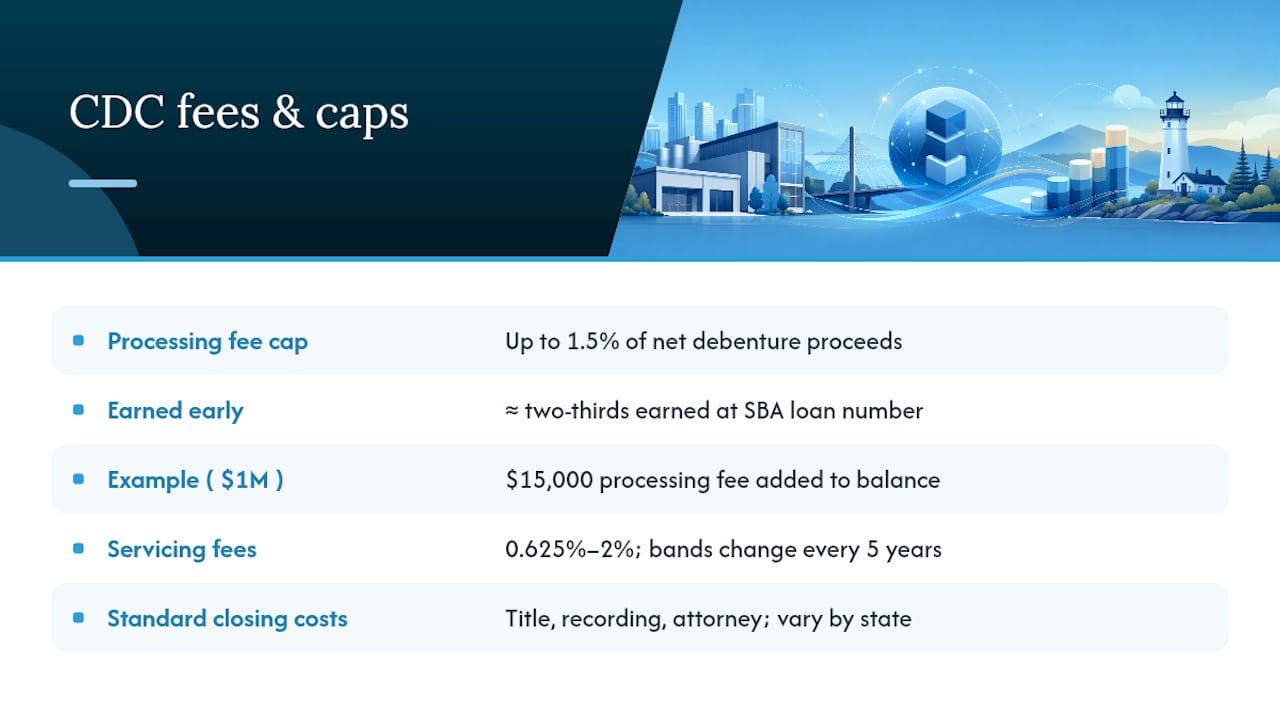
The CDC processing fee is capped by federal regulation at up to 1.5% of net debenture proceeds as set by 13 CFR § 120.971, and many CDCs charge near this maximum. Roughly two-thirds of this fee is considered earned once the SBA issues your loan number, well before closing, which matters if you’re timing cash flow around the transaction.
Standard closing costs include title insurance, recording fees, and attorney charges. These vary by state and project size, and while some line items are capped under the same CFR section, others float with local market rates.
The 1.5% ceiling matters: a $1 million CDC debenture can carry up to $15,000 in processing fees alone, and that figure gets added straight into your financed balance rather than billed separately at closing.
CDC servicing fees run in bands set by regulation, generally between 0.625% and 2%, and can shift at five-year intervals over the life of the loan. Late fees and assumption fees are similarly capped. Nearly all of these amounts get folded into the debenture, so few borrowers write a check for them directly.
How Do These Fees Change Your Total Loan Cost?
Add every one-time fee together and you typically land between 2.5% and 3.5% of the CDC debenture amount, according to market analyses of 504 loan structures. That range accounts for the SBA guaranty fee, the CDC processing fee, and the smaller closing and funding charges layered on top.
Because these fees get financed rather than paid in cash, they raise your effective CDC rate above the stated debenture coupon. A stated rate near 6.1% to 6.3% for typical 25-year debentures can effectively run several tenths of a point higher once amortized fees are baked in.
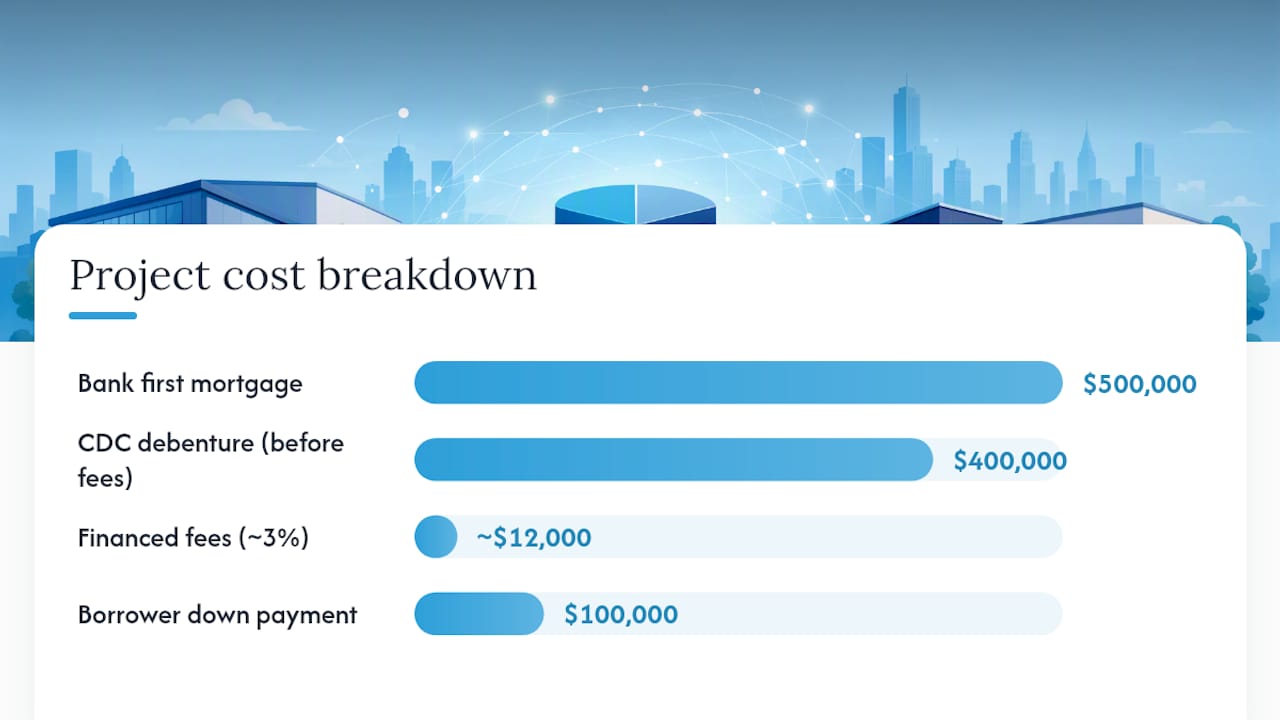
Here’s how that plays out on a standard 50/40/10 structure, where a bank covers 50% of the project, the CDC debenture covers 40%, and you put down 10%:
- Total project cost: $1,000,000 for a commercial building purchase.
- Bank loan (50%): $500,000, carrying its own separate closing fees you’ll need to budget outside the CDC piece.
- CDC debenture (40%): $400,000, before fees are added.
- Financed fees (roughly 3% of the debenture): about $12,000, added to the $400,000 base, bringing your actual CDC obligation closer to $412,000.
- Your cash down payment (10%): $100,000, unaffected by CDC fee financing since fees roll into the loan balance, not your equity injection.
| Component | Amount | Fees Applied |
|---|---|---|
| Bank first mortgage | $500,000 | Separate bank fees, not CDC fees |
| CDC debenture (before fees) | $400,000 | SBA and CDC fees layered in |
| Financed fees (~3%) | ~$12,000 | Rolled into debenture balance |
| Borrower down payment | $100,000 | No fees applied |
Your monthly payment reflects the $412,000 effective balance, not the original $400,000, which is why two borrowers with identical debenture amounts can see different payments if one qualifies for manufacturer waivers and the other doesn’t.
Which Waivers and Exceptions Change What You Pay?
FY2026 brought real changes worth checking before you assume standard pricing applies to your deal.
- Manufacturers classified under NAICS codes 31 through 33 get both the upfront guaranty fee and annual service fee waived for FY2026, a meaningful savings on larger equipment or facility purchases.
- Borrowers using the Debt Refinance Without Expansion option may face a supplemental annual fee if they’re not classified as manufacturers, a small addition that raises servicing costs slightly over the loan’s life.
- Program option and NAICS classification both need verification early, because these rules shift the math enough to change whether a 504 loan beats other financing paths for your specific project.
What Should You Ask Your CDC Before You Sign?
A short checklist keeps you from discovering fee surprises at the closing table.
- What exact percentage will the CDC processing fee run for my debenture amount?
- Which closing costs will be paid from debenture proceeds versus billed separately?
- What annual service fee applies to my loan, and does my NAICS code qualify for any FY2026 waiver?
- Is the funding fee itemized separately, or bundled into overall closing costs?
- Are all fees financed into the loan, or will any require cash at closing?
Request an itemized estimate at the commitment stage, not just at application, since final numbers often shift once your CDC locks in debenture terms.
Pro Tip: Confirm your NAICS classification with your CDC before you apply. A manufacturer designation under codes 31 through 33 can eliminate two of your largest fees for FY2026, and it costs nothing to check early.
Why CDC New England’s Tools Make Fee Estimates Easier
Real numbers beat guesswork, and that’s the whole point of Cdcnewengland’s approach to fee transparency. With extensive experience in regional financing, the organization has built tools to help borrowers translate fee schedules into real dollar figures.
The 504 loan calculator lets you model financed fees against your specific project size, while historical rate charts show how debenture yields have moved over time. For borrowers wondering how the CDC portion’s rate compares to today’s market, the explainer on 504 loan rates walks through how bank spreads and debenture pricing combine into your effective cost.
Ready to See Your Actual Fee Breakdown?
Reading fee percentages on a page is one thing. Seeing what they mean for your specific project is another, and that’s where Cdcnewengland’s tools do the real work.
Cdcnewengland is the practical alternative to guessing at fee math from a rate sheet. Run your numbers through the SBA 504 loan calculator or start your application directly at Cdcnewengland to see how manufacturer waivers, financed fees, and your specific project size add up to a real monthly payment.
Where to Confirm Current 504 Fee Rates
- SBA FY2026 504 fee notice for current guaranty and service fee rates.
- SBA FY2025 504 fee notice for year-over-year comparison.
- 13 CFR § 120.971 for statutory CDC fee caps.
- Data for primary program data and rulemaking documents.
This article is general information, not a substitute for advice from a qualified financial advisor. Consult a qualified financial professional about your own circumstances before acting on anything here.
Sources
- 504 Fees for Fiscal Year 2026
- 13 CFR § 120.971 - Allowable fees paid by Borrower
- SBA guarantee fees: Current costs for 7(a) and 504 loans
- SBA 504 Loan Rates 2026: Calculator & True Costs
FAQ
What Is the SBA 504 Rate Today?
SBA 504 debenture rates change monthly based on Treasury-linked auctions, with typical fixed effective rates for 25-year debentures running near 6.1% to 6.3% in mid-2026 once fees are factored in, according to market rate analyses. Check Cdcnewengland’s historical rate chart for the most current published figures.
Is It Hard to Get a 504 SBA Loan?
The process involves more documentation than a standard bank loan because both a lender and a CDC underwrite the deal, but it’s not inherently harder to qualify for than other SBA programs.
Can You Pay Off an SBA 504 Loan Early?
Yes, but 504 debentures carry a prepayment penalty that declines over roughly the first half of the loan term before disappearing entirely. Borrowers refinancing or selling early should ask their CDC for the exact declining schedule tied to their specific debenture issue date.
What Are the Disadvantages of an SBA 504 Loan?
Compared with an SBA 7(a) loan, which carries its own guaranty fee structure but allows more flexible use of funds, 504 fees are more predictable but the process itself moves slower due to involving both a CDC and a bank lender.