A finance lease is any lease that meets at least one of five ASC 842 tests, and that classification decides everything downstream. Both finance and operating leases put a right-of-use asset and a lease liability on your balance sheet, but a finance lease splits your expense into separate interest and amortization, while an operating lease books one straight-line lease expense. That single difference reshapes your income statement, your EBITDA, and how a lender reads your covenants.
TL;DR:
- A lease that meets even one of ASC 842’s five criteria is classified as a finance lease, significantly impacting expense recognition and financial ratios.
- Finance leases typically involve specialized assets or those with purchase options near certain, while operating leases are common for flexible-use assets like office space or vehicles.
- The accounting differences result in front-loaded expenses and higher early-period EBITDA for finance leases, contrasting with the steady expense pattern of operating leases.
- Many companies overlook embedded leases and mid-term modifications, which can lead to misclassification and audit issues without a consistent lease inventory and documentation.
- Tax treatment and international standards like IFRS 16 may differ from financial reporting classification, requiring separate tracking and reconciliation efforts.
Table of Contents
- Operating Lease vs Finance Lease: Definitions and Core Differences
- The Five ASC 842 Finance-Lease Criteria, Explained
- Accounting Mechanics: Journal Entries and Financial-Statement Impact
- The Short-Term Lease Exception Most Teams Miss
- Weighing the Business Tradeoffs
- How to Classify a Lease and Document It for Audit
- What Lessors Face on the Other Side of the Table
- Tax Treatment Doesn’t Always Follow the Accounting Answer
- Where Lease Classification Goes Wrong in Practice
- Real-World Impact: Two Company Scenarios
- A Practitioner’s View on ASC 842 Implementation
- Where to Go for the Original Guidance
- Sources
Operating Lease vs Finance Lease: Definitions and Core Differences
A finance lease, what most controllers still call a capital lease out of habit, transfers the economic substance of ownership to you even though the title stays with the lessor. You’re using the asset the way you’d use one you bought outright: you bear the wear, the obsolescence risk, and often the residual value exposure. An operating lease, by contrast, is a rental in substance. You get the use of the equipment or space for a defined term, and the lessor keeps the ownership risk.
Under ASC 842, this distinction determines how you recognize expense, not whether you recognize the lease at all. Both structures now land on your balance sheet.
Businesses tend to gravitate toward each structure for predictable reasons:
- Finance leases show up when a company wants a piece of specialized manufacturing equipment for most of its useful life, or when a purchase option at the end is close to a foregone conclusion.
- Operating leases dominate office space, vehicle fleets, and short-cycle technology, where flexibility to walk away at term-end matters more than building equity in the asset.
- Hybrid situations arise often, where a lease starts as operating, but a mid-term modification (an extended renewal, a bargain purchase option added later) pushes it into finance-lease territory.
Worth flagging for readers working across borders: IFRS 16 collapses this distinction entirely and treats nearly every lease like a finance lease. US GAAP kept the dual model, which is exactly why the classification question still matters here.
The Five ASC 842 Finance-Lease Criteria, Explained
Meeting even one of these five criteria makes it a finance lease. There’s no partial credit and no averaging. The FASB’s ASC 842 classification framework lists them as:
- Transfer of ownership. The lease agreement transfers ownership of the asset to you by the end of the term. This one is rarely ambiguous.
- Purchase option reasonably certain to be exercised. If you hold an option to buy the asset at a price low enough that exercising it is a foregone conclusion, the lease is a finance lease even before you sign the purchase paperwork.
- Major part of the asset’s remaining economic life. The lease term covers most of what the asset has left to give.
- Present value substantially all of fair value. The discounted value of your lease payments is close to what the asset would cost to buy today.
- Specialized asset, no alternative use. The asset is built or modified so specifically for you that the lessor would gain little to no value leasing it to anyone else at term-end.
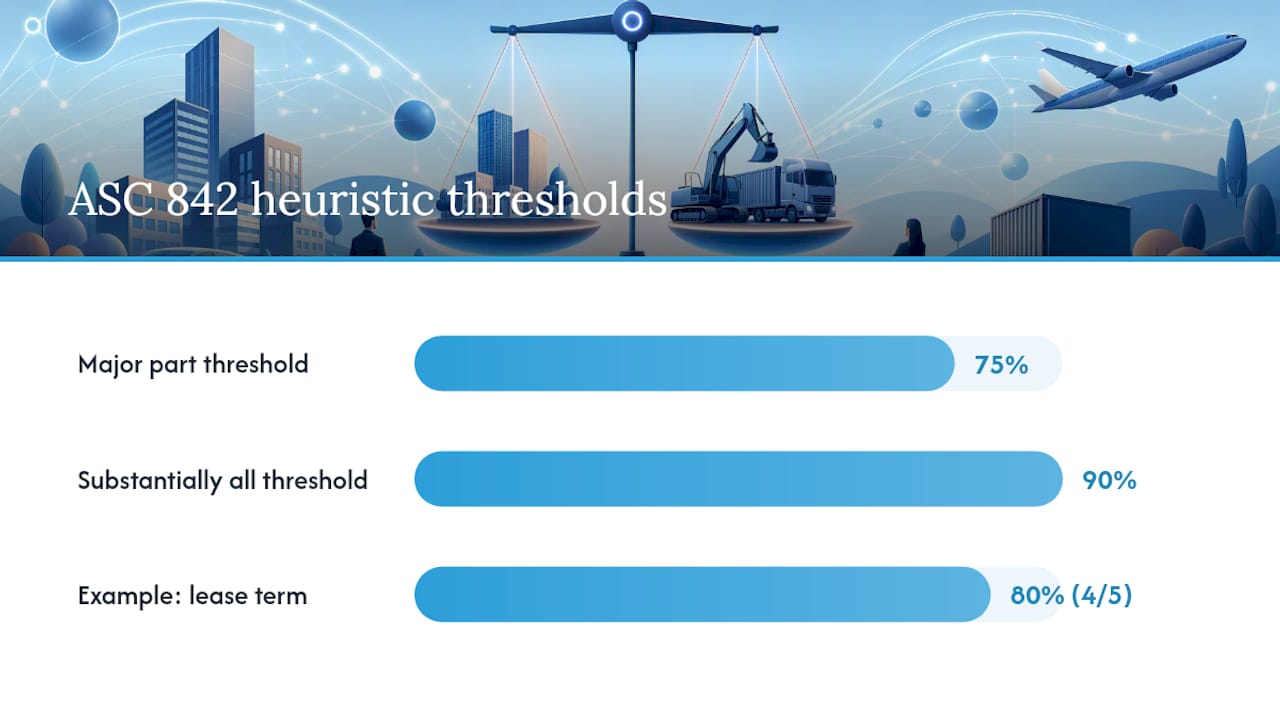
ASC 842 dropped the old bright-line percentages that ASC 840 used, but that doesn’t mean the numbers disappeared. PwC’s lease classification guidance confirms it’s reasonable for an entity to keep using familiar thresholds, commonly 75% for “major part” and 90% for “substantially all,” as a consistently applied accounting policy rather than a rigid rule.
Here’s how the numbers actually work. Say a piece of equipment has a five-year remaining economic life and you sign a four-year lease. Four divided by five is comfortably over the commonly used heuristic, so criterion three is met. Now check present value: if the equipment’s fair value is a certain amount and the discounted value of your lease payments comes close to that, you’ve cleared the commonly used substantially-all threshold too. Either test alone is enough to trigger finance-lease treatment.
Pro Tip: When you run the present-value test, don’t just plug in the base rent. FinQuery’s guidance on the PV calculation for lease classification notes that certain fixed payments, like a portion of property taxes or insurance embedded in the lease, count as lease payments and belong in that discounted cash flow.
Accounting Mechanics: Journal Entries and Financial-Statement Impact
At commencement, both lease types record the same opening entry: debit right-of-use asset, credit lease liability, both measured at the present value of future lease payments. That’s where the similarity ends.
For a finance lease, you amortize the ROU asset (typically straight-line) and separately accrue interest expense on the declining lease liability balance, the same mechanics as a loan amortization schedule. FinQuery’s ASC 842 comparison walks through this split in more detail.
For an operating lease, you record one number: a single, level lease expense that combines the interest and amortization components into a straight line over the term. The journal entry each period is simply debit lease expense, credit ROU asset (a “plug” for the amortization portion) and lease liability. No investor sees interest expense sitting on your income statement.
This produces genuinely different expense shapes over time:
| Metric | Finance lease | Operating lease |
|---|---|---|
| Balance sheet recognition | ROU asset + lease liability, both recognized | ROU asset + lease liability, both recognized |
| Income statement pattern | Separate interest + amortization, front-loaded | Single straight-line lease expense, level |
| Typical term / use case | Specialized equipment, near-ownership arrangements | Office space, vehicles, short-cycle tech |
| Ratio / covenant impact | Higher early-period expense hits EBITDA; interest excluded from EBITDA calculation | Lease expense embedded in operating expenses; steadier EBITDA impact |
Practitioner analysis from UHY confirms that finance leases tend to front-load total expense in early years because interest is calculated on a higher outstanding balance, while operating leases spread expense evenly. If your lender calculates EBITDA by adding back interest and depreciation, a finance lease can actually flatter that metric relative to an operating lease’s undifferentiated expense line, even though both carry the same liability.
The Short-Term Lease Exception Most Teams Miss
If your lease term is 12 months or less, with no purchase option you’re reasonably certain to exercise, you can skip the balance-sheet recognition entirely by leveraging the short-term rental tax loophole, which provides practical expedients for such leases. The short-term lease practical expedient lets you expense payments straight-line and keep the whole arrangement off the balance sheet.
This is an election, not an automatic outcome, and you make it by asset class, not lease by lease. Other common policy elections worth knowing:
- Package of practical expedients, which lets you skip reassessing whether existing contracts are or contain a lease, and skip reclassifying leases that transitioned from ASC 840.
- Discount-rate practical expedient, available to private companies, which allows use of a risk-free rate instead of computing an incremental borrowing rate for every lease.
Whichever elections you make, write them down. Auditors will ask for your policy memo, not just your conclusion.
Weighing the Business Tradeoffs
A finance lease behaves like ownership on your books, which comes with both the upside and the expense timing that ownership implies. Depreciation and interest hit differently than rent does, and early-year expense tends to run higher.
An operating lease keeps things simpler for planning purposes: expense is level, cash outflow is often lower in the short term, and you can walk away at term-end without a residual-value headache.
- Finance lease advantages: builds asset control similar to ownership; interest expense may be deductible; often makes sense for assets you’ll use for most of their useful life.
- Finance lease disadvantages: front-loaded expense pattern; less flexibility to exit early; residual value risk in some structures.
- Operating lease advantages: operational flexibility; predictable level expense; frequently lower near-term cash requirements.
- Operating lease disadvantages: no equity build in the asset; renewal terms can shift with market rates; still creates a balance-sheet liability post ASC 842.
Pro Tip: If a covenant caps your debt-to-EBITDA ratio, model both structures before you sign anything. The lease that looks cheaper on a monthly payment basis isn’t always the one that keeps you inside your covenant.
How to Classify a Lease and Document It for Audit
Work the classification decision in order, and don’t skip steps just because the answer seems obvious.
- Separate lease and non-lease components. Strip out maintenance, service charges, and other bundled costs that aren’t really rent for the asset.
- Determine the discount rate. Use your incremental borrowing rate, or the risk-free rate if you’ve elected the private-company expedient, and apply it consistently.
- Calculate present value of payments. Include fixed payments, any reasonably certain purchase option price, and applicable taxes or insurance embedded in the contract.
- Compare against the term and value tests. Run the major-part-of-life and substantially-all-of-fair-value checks against your policy thresholds.
- Assess specialized-use and ownership-transfer criteria. Ask whether the lessor could realistically re-lease or resell the asset to someone else at term-end.
For your workpapers, include the discount-rate rationale, useful-life assumptions, and the specific evidence behind any “reasonably certain” purchase-option conclusion, since Deloitte’s lessee accounting guidance notes auditors expect this documented at commencement, not reconstructed later. Red flags that draw scrutiny: discount rates that shift between similar leases with no stated reason, and “reasonably certain” conclusions with no supporting analysis behind them.
What Lessors Face on the Other Side of the Table
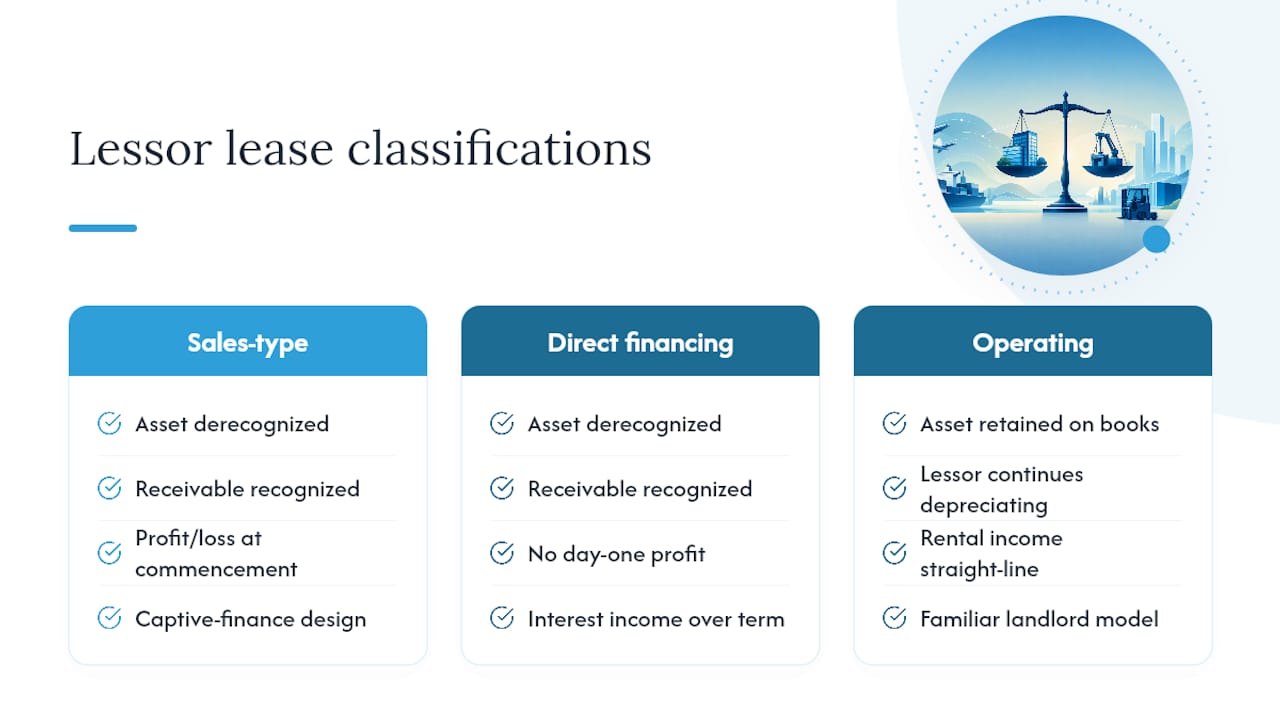
Lessors run a parallel but distinct classification exercise, and it doesn’t have to match yours. A lessor classifies a lease as sales-type, direct financing, or operating, and PwC’s lessor-side guidance confirms that a lessor can land on a different answer than the lessee for the same contract, because collectibility and residual-value assumptions differ by side.
A sales-type lease functions economically like a sale for the lessor. The lessor derecognizes the underlying asset, recognizes a receivable, and books any profit or loss at commencement, much like recognizing revenue on a financed sale. A direct financing lease sits in between: the lessor doesn’t record day-one profit but does recognize interest income over the term.
Operating leases keep the asset on the lessor’s own balance sheet. The lessor continues depreciating it and recognizes rental income on a straight-line basis, which is the more familiar landlord model.
This asymmetry matters for equipment vendors and commercial landlords structuring lease programs. A lessor building a captive finance arm around specialized equipment often designs contracts to land in sales-type territory, recognizing profit up front rather than spreading it as rental income over years. It also explains why your own finance-lease classification as a lessee doesn’t automatically tell you how your counterparty is booking the same contract on their side.
Tax Treatment Doesn’t Always Follow the Accounting Answer
Here’s where a lot of controllers get tripped up: your ASC 842 classification for financial reporting and your tax treatment for the IRS are two separate questions, and they don’t have to agree.
For US federal tax purposes, whether a lease is treated as a “true lease” (deductible rent) or a conditional sale (depreciation and interest deductions instead) depends on tax-specific factors like bargain purchase price and equipment life, not on the ASC 842 five-criteria test. A lease can be an operating lease on your balance sheet and still be treated as a financed purchase for tax purposes, or the reverse. That mismatch creates a deferred tax difference your tax team needs to track separately from your lease accounting team’s ledger.
For businesses operating across borders, the complexity compounds. Corporate Finance Institute’s comparison of US GAAP and IFRS points out that IFRS 16 largely eliminates the operating lease category for lessees, treating nearly every lease as finance-lease-like. A multinational reporting under both frameworks can end up with the same contract generating a straight-line expense on one set of books and a split interest-and-amortization expense on another, purely because of which standard applies. If you’re consolidating financials across US and international entities, build a reconciliation process now rather than discovering the variance during year-end close.
Where Lease Classification Goes Wrong in Practice
The most common failure point isn’t a hard judgment call. It’s an incomplete lease inventory. Companies routinely miss embedded leases buried inside service contracts, storage agreements, or equipment-with-operator arrangements where a lease exists even though the word “lease” never appears in the contract.
Inconsistent discount rates across similar leases is the second recurring problem. If two office leases signed six months apart use meaningfully different incremental borrowing rates with no documented reason, that’s exactly the kind of inconsistency Deloitte’s implementation guidance flags as a policy-application weakness.
A third pitfall shows up around lease modifications. A renewal option that gets exercised, or a mid-term amendment that extends the term or adds a purchase option, can flip an operating lease into a finance lease mid-contract. Teams that classify once at commencement and never revisit miss these triggers entirely.
Finally, weak support for “reasonably certain” conclusions on purchase options creates exposure at audit time. Concluding an option will be exercised because “it seems likely” isn’t documentation. Auditors want to see the economic analysis: the bargain price relative to expected fair value, the company’s historical pattern with similar options, and the specific facts driving the judgment.
Real-World Impact: Two Company Scenarios
Picture a regional trucking company leasing 20 tractor units. The company books a single, level lease expense across the fleet, and its EBITDA calculation keeps that expense embedded in operating costs.
Now picture a manufacturer leasing a custom-built stamping press configured specifically for its product line. The equipment has no realistic alternative use for another lessee. That single criterion, specialized asset with no alternative use, classifies it as a finance lease regardless of term length or price ratios. The manufacturer now splits its expense into interest and amortization, and because interest gets excluded from most EBITDA calculations, the finance-lease structure can actually produce a more favorable EBITDA figure than an operating lease with an identical cash outflow.
Both scenarios show the same lesson: classification follows the substance of the arrangement, not the label on the contract, and the downstream financial-statement effects are real enough to change how a lender or investor reads your numbers.
A Practitioner’s View on ASC 842 Implementation
The teams that struggle with ASC 842 almost always have the same root problem: an incomplete lease inventory built during a rushed transition, not a genuine classification puzzle. Embedded leases in service contracts get missed for years.
Fix it with a central lease register, a written discount-rate policy applied consistently, and a re-evaluation cadence tied to renewal dates and contract modifications, not just annual close. Document every “reasonably certain” judgment the day you make it, not during audit season. Those three habits close most of the audit-risk gap teams create for themselves.
— PHENYX
Where to Go for the Original Guidance
For the classification tests themselves, start with FinQuery’s ASC 842 breakdown. For implementation policy decisions and documentation expectations, Deloitte’s DART lessee accounting roadmap is the deeper reference. PwC’s lease classification guidance covers both lessee and lessor considerations in more technical detail.
If your business is weighing a finance lease against simply buying the real estate or equipment outright, that math often favors ownership more than teams expect once you account for the full lease term’s interest cost. Cdcnewengland structures SBA 504 loans with a 10% down payment and fixed rates for up to 25 years, which gives New England business owners a real path to ownership instead of a lease liability that never converts to equity. Run the numbers on your own scenario with the SBA 504 loan calculator before your next lease renewal comes up for negotiation.
This article is general information, not a substitute for advice from a qualified financial advisor. Consult a qualified financial professional about your own circumstances before acting on anything here.