

Secured lines of credit use collateral, and that collateral usually buys you a lower rate and a higher limit. Unsecured lines rely on your credit profile alone, and they usually cost more but close faster. Picture a homeowner comparing a HELOC against a plain personal line of credit, or a business owner weighing an asset-backed line against a fast, unsecured credit line: the trade-off is the same in both cases, cost against speed.
TL;DR:
- Secured lines of credit typically offer lower interest rates and higher limits because they are backed by assets such as real estate or equipment, while unsecured lines rely solely on creditworthiness and often have higher costs.
- Collateral valuation and loan-to-value ratios limit the maximum credit available on secured facilities, but many unsecured lines still require personal guarantees or blanket liens that expose personal assets.
- Secured credit is advantageous for businesses with frequent, heavy draws or significant assets to pledge, whereas unsecured lines suit small, urgent needs with faster approval times.
- Fees such as origination, appraisal, and annual facility costs can make secured lines more expensive initially than unsecured options, especially if the collateral value drops or renewal terms are unclear.
- For long-term purchases like property or equipment, fixed-rate SBA 504 loans provide a stable alternative to revolving lines, with predictable payments and terms up to 25 years.
Table of Contents
- Loc Secured vs Unsecured: A Side-by-Side Comparison
- How Lenders Set Your Rate and Limit
- When Secured Financing Actually Makes Sense
- Your Lender Comparison Checklist
- Misconceptions Worth Clearing Up
- How Small Businesses Usually Decide
- An Alternative for Long-Term Secured Financing
- Sources
- FAQ
Loc Secured vs Unsecured: A Side-by-Side Comparison
Lenders use the term “line of credit,” often shortened to LOC, for a revolving credit facility you draw against as needed rather than a lump sum you repay on a fixed schedule. The core distinction inside that category comes down to collateral. A secured line of credit is backed by an asset, home equity, business receivables, equipment, or a savings account, that the lender can claim if you default. An unsecured line of credit is backed by nothing but your promise to repay, priced entirely on your credit score, income, and business history.
That collateral changes the math on every other term. The Consumer Financial Protection Bureau notes that personal lines of credit are unsecured by default, while a home-equity line of credit (HELOC) is secured by a mortgage lien, which is why HELOCs typically carry lower rates than a standard personal line.
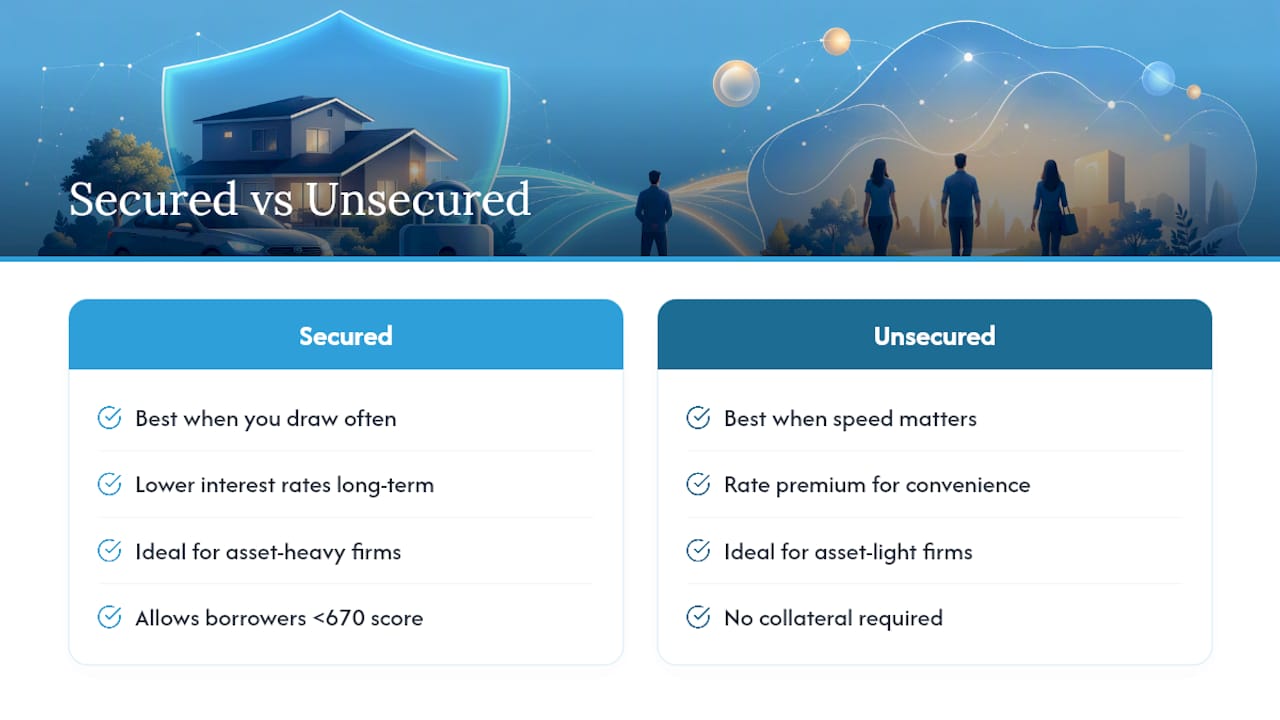
- Interest rates: Secured LOCs generally cost less because collateral reduces the lender’s risk, while unsecured LOCs rely on creditworthiness and typically carry higher rates.
- Credit limits: Secured limits scale with the appraised value of the pledged asset; unsecured limits scale with income and credit history, and usually top out lower.
- Eligibility: Secured lines can work for borrowers with a lower credit score if the collateral is solid; unsecured personal lines at major banks commonly require a FICO score in the high 600s or better.
- Speed to fund: Unsecured approval can take a day to a week; secured approval waits on appraisal and lien filing.
- Default consequences: Miss payments on a secured line and the lender can seize the pledged asset. Miss payments on an unsecured line and you face collections, credit score damage, and possibly a lawsuit, but no specific asset is at risk unless a personal guarantee changes that.
Representative ranges for 2026 back this up: secured business lines of credit can start around 3% to 8.5% for well-qualified borrowers, while unsecured business facilities commonly run from about 8% into the double digits depending on the lender and the borrower’s profile.
How Lenders Set Your Rate and Limit
Most lenders don’t pull a rate out of thin air. Pricing on a line of credit is usually tied to a public benchmark, either the Prime Rate or SOFR, plus a margin the lender adds based on your risk profile. A stronger credit file or solid collateral narrows that margin; a thinner file widens it.
Collateral valuation drives the ceiling on a secured line. Lenders typically cap your limit at a percentage of appraised value, the loan-to-value ratio, so a receivables line might advance 70% to 85% of eligible invoices, while an equipment-backed line advances against depreciated equipment value.
Here’s where the “unsecured” label gets misleading:
- Many unsecured business lines still carry a personal guarantee, putting your personal assets on the hook even without a specific pledge.
- Lenders frequently file a blanket UCC-1 lien on business assets even on facilities marketed as unsecured, preserving recourse without naming one asset.
- Origination fees, appraisal costs, and lien filing fees on a secured line can offset the lower rate in year one.
Practitioner data on secured facilities shows origination and annual fees can make a secured line cost more than a higher-rate unsecured line in its first year, which is why comparing APR alone misses the full picture.
When Secured Financing Actually Makes Sense
Secured credit tends to win when you draw often and heavily. If your business pulls significant capital month after month, the rate spread between secured and unsecured compounds fast, and a secured line suits businesses that draw repeatedly since lower rates translate into real savings over time. Asset-heavy businesses, think equipment fleets, inventory-heavy retailers, or commercial property owners, usually have collateral sitting idle that a secured line puts to work. It also opens doors for borrowers under a 670 credit score who couldn’t qualify unsecured on their own.
Unsecured lines make more sense when speed matters more than rate, or when the amount needed is modest enough that a small rate difference barely registers. Asset-light businesses, consultancies, agencies, service providers, often have nothing meaningful to pledge anyway.
Pro Tip: Ask your lender how often they revalue collateral on a secured facility. Some recheck annually and adjust your limit down if asset values drop, which can catch you off guard mid-project.
Budget for the operational side too: appraisal timelines run two to four weeks on secured lines, and many carry an annual facility fee based on your committed capital, whether you draw it or not.
Your Lender Comparison Checklist
Before you sign anything, run through these questions with every lender quoting you a line of credit:
- What’s the exact index and margin? Ask whether pricing follows Prime or SOFR, and get the current margin in writing.
- What fees stack on top of the rate? Origination fees, appraisal costs, annual facility fees, and draw fees all affect true cost.
- What’s the collateral LTV, and how often is it reappraised? A drop in asset value can shrink your available credit mid-term.
- Does the personal guarantee language apply even to “unsecured” facilities? Read the fine print before assuming your personal assets are protected.
- How flexible is draw availability, and what triggers renewal or non-renewal?
To calculate true annual cost, add your expected APR on drawn balances to origination fees amortized over the first year, plus any annual facility fee. A $50,000 secured line at 6% with a $500 origination fee and $200 annual fee costs meaningfully more in year one than the bare rate suggests.
Pro Tip: Model your actual draw pattern, not just the credit limit. A line you draw in small, repeated amounts costs differently than one you draw once in a lump sum, and lenders price these scenarios differently behind the scenes.
Watch for red flags: vague personal guarantee clauses, unclear renewal terms, and fees disclosed only after you’ve applied.
Misconceptions Worth Clearing Up
The biggest myth is that “unsecured” means no risk to your personal assets. Many unsecured business lines still require a personal guarantee or a blanket UCC lien, which gives the lender recourse even without a named asset. Second myth: secured always costs less overall. Once you add origination and annual fees, a secured line can cost more than an unsecured one in its first year.
- Unsecured debt doesn’t automatically mean unlimited personal protection.
- Lower APR doesn’t automatically mean lower total cost after fees.
- High utilization on either type can drag down your credit score, so draw only what you need and pay down balances between draws.
— PHENYX
How Small Businesses Usually Decide
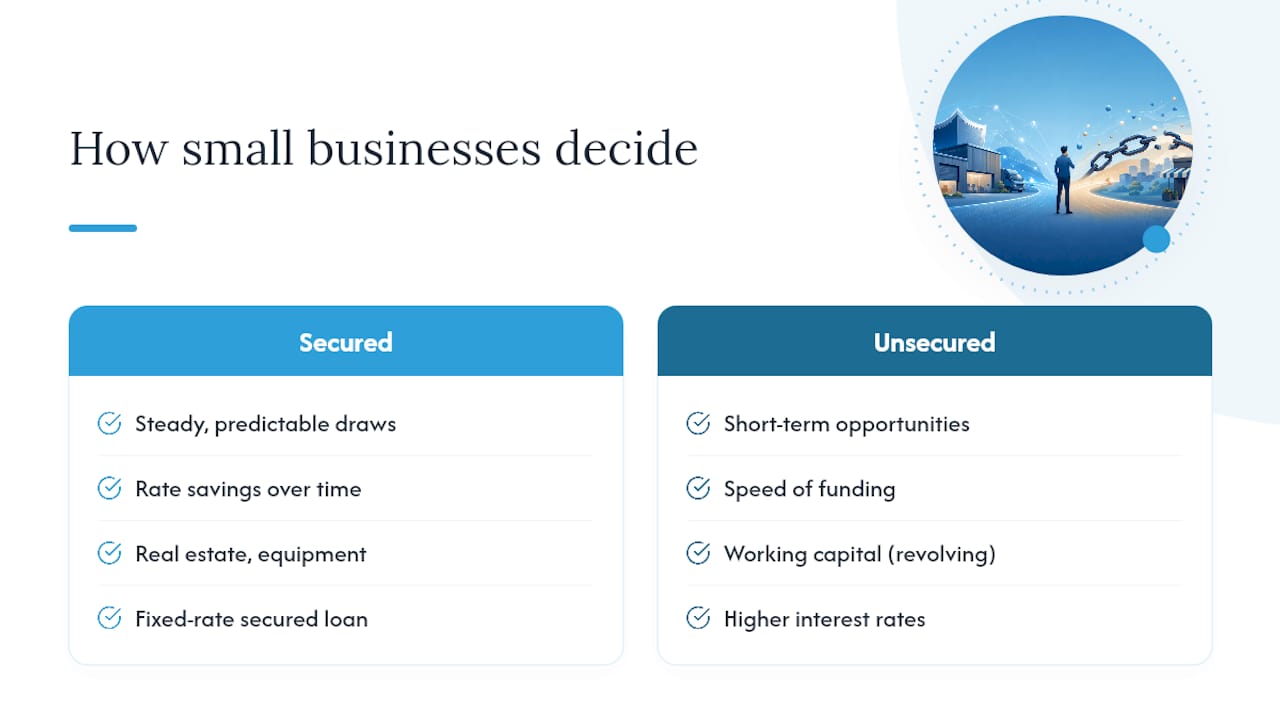
Watching businesses navigate financing decisions, the pattern is consistent: companies with steady, predictable draws lean toward secured credit because the rate savings add up, while companies chasing a short-term opportunity reach for unsecured credit because speed wins. If you’re planning a long-term purchase, real estate or major equipment, that’s a different conversation from day-to-day working capital, and it usually points toward a fixed-rate secured loan rather than a revolving line at all.
An Alternative for Long-Term Secured Financing
A revolving line of credit is built for ongoing, flexible needs, not a one-time purchase of commercial real estate or heavy equipment. That’s where SBA 504 loans work differently: Certain financing programs offer secured, fixed-rate loans with terms up to 25 years and down payments starting around 10%, designed for businesses buying or refinancing owner-occupied property or major equipment.
If your business is outgrowing a revolving line and eyeing a building purchase, equipment upgrade, or a refinance of existing secured debt, a 504 loan locks in predictable payments instead of a variable rate tied to Prime or SOFR. Some lenders provide down payment assistance and programs aimed at veteran-owned businesses. Run your numbers through the SBA 504 loan calculator to see how a fixed-rate secured loan compares to what you’re paying on a line of credit today.
Sources
- What is a personal line of credit? | Consumer Financial Protection Bureau (CFPB)
- Secured vs. Unsecured Lines of Credit: Key Differences … | Investopedia
- Secured vs Unsecured Line of Credit: Guide for SMBs | Drip Capital
- Personal line of credit | Unsecured loans | U.S. Bank
FAQ
Is it better to have unsecured or secured debt?
Neither is universally better. Secured debt usually costs less and offers higher limits, while unsecured debt funds faster and doesn’t tie up a specific asset, so the right choice depends on how much you need, how fast, and what you’re willing to pledge.
Is it better to have secured or unsecured credit?
Secured credit tends to win for larger, recurring needs where the rate savings compound over time, while unsecured credit fits smaller, urgent draws where speed matters more than the rate.
Is there a downside to a line of credit?
Yes. Carrying a high balance on either type can hurt your credit utilization ratio, and a secured line puts a specific asset at risk if you default, while an unsecured line can still carry a personal guarantee despite the name.
Do secured loans hurt your credit?
Not inherently. A secured loan affects your credit the same way any credit account does, through payment history and utilization, but missing payments risks losing the pledged collateral on top of the credit score damage.


