For most long-term borrowers, a fixed rate is the safer bet, and a variable rate earns its keep only when you have a short, well-defined exit plan. Your choice should hinge on four factors: how long you’ll hold the loan, where you think rates are headed, how much payment uncertainty you can absorb, and how confident you are in your exit strategy.
TL;DR:
- The difference in purchase price and origination costs can significantly impact the total borrowing expense, making APR comparisons crucial.
- A fixed-rate loan offers payment stability for the entire term, while a variable rate can drop initially but risks payment increases at reset.
- Borrowers planning to hold a property long-term should favor fixed rates unless the market spread between fixed and variable rates narrows substantially.
- For short-term exits within five to seven years, adjustable-rate mortgages can sometimes provide savings, but only if a clear and funded exit plan is in place.
- Monitoring current spreads, stress-testing budgets at the fully indexed rate, and asking lenders for detailed cap and amortization data are key steps before choosing a rate structure.
Table of Contents
- Fixed vs. Variable Rates: What They Are and How They Work
- Advantages and Disadvantages of Fixed vs. Variable Rates
- How Adjustable-Rate Mortgages Actually Adjust
- A Step-by-Step Framework for Choosing Your Rate
- What to Ask For When Comparing Lender Offers
- A Worked Example: Fixed vs. 5/1 ARM Over Five Years
- Why Rate Monitoring Matters for Business Borrowers
- Where to Read More on Fixed vs. Variable Rates
- The Real Trade-Off Behind Fixed vs. Variable Rates
- Sources
Fixed vs. Variable Rates: What They Are and How They Work
A fixed-rate loan locks your interest rate for the entire term. Your principal and interest payment never moves, even if the broader market swings hard in either direction. That predictability is what a fixed interest rate is built to deliver, and it’s why fixed-rate structures dominate long-term commercial and residential financing.
A variable, or adjustable, rate works differently. It’s calculated as index + margin. The index is a benchmark that moves with the broader market. The margin is a fixed spread the lender adds on top, set at closing and rarely negotiable after the fact. Most conforming adjustable-rate products today reference SOFR, the benchmark replacing LIBOR as of 2023, though some commercial lenders still tie variable pricing to the prime rate.
When you’re comparing offers, don’t stop at the quoted interest rate. The APR bundles in fees, points, and other closing costs, giving you a truer read on total borrowing cost. Two loans with identical nominal rates can carry very different APRs once you factor in what it actually costs to originate each one.
- Fixed rate: same rate, same payment, for the life of the loan
- Variable rate: index + margin, resets on a schedule
- APR: the number that captures total cost, not just the sticker rate
Advantages and Disadvantages of Fixed vs. Variable Rates
Fixed rates buy you certainty. Your payment is the same in year one and year twenty, which makes budgeting straightforward and protects you completely if rates climb after you close. That protection comes at a price: fixed loans typically start with a higher rate than a comparable adjustable product, and if rates fall after you lock, you’re stuck paying more unless you refinance, which brings its own closing costs and paperwork.
Variable rates flip that trade-off. You get a lower starting rate, often meaningfully lower, and if benchmark rates drop, your payment can drop with them. That makes variable structures attractive for borrowers who plan to sell, refinance, or pay off the loan well before the first adjustment hits. The risk is payment shock: once the introductory period ends, your rate resets to the index plus margin, and lenders are required to qualify you on that fully indexed rate rather than the low teaser number, per CFPB guidance.
- Fixed pros: predictable payments, protection against rising rates, simpler budgeting
- Fixed cons: higher starting rate, missed savings if rates fall, refinancing friction
- Variable pros: lower initial rate, savings if rates drop, good fit for short holding periods
- Variable cons: payment shock at reset, qualification tied to the fully indexed rate
Pro Tip: Never qualify yourself mentally at the teaser rate. Run your budget at the fully indexed rate from day one, because that’s the number that determines whether you can actually afford the loan two or three years out.
How Adjustable-Rate Mortgages Actually Adjust
The math behind an ARM is simpler than the acronym soup suggests. Your rate equals the index value plus the margin, and the margin is locked in at origination. Modern ARMs typically track a 30-day average SOFR index, since SOFR replaced LIBOR as the industry standard benchmark a few years back. Two borrowers can start with the same initial rate but end up paying very different amounts after the first reset if their margins differ, which is why it’s worth negotiating the margin the same way you’d negotiate the rate itself.
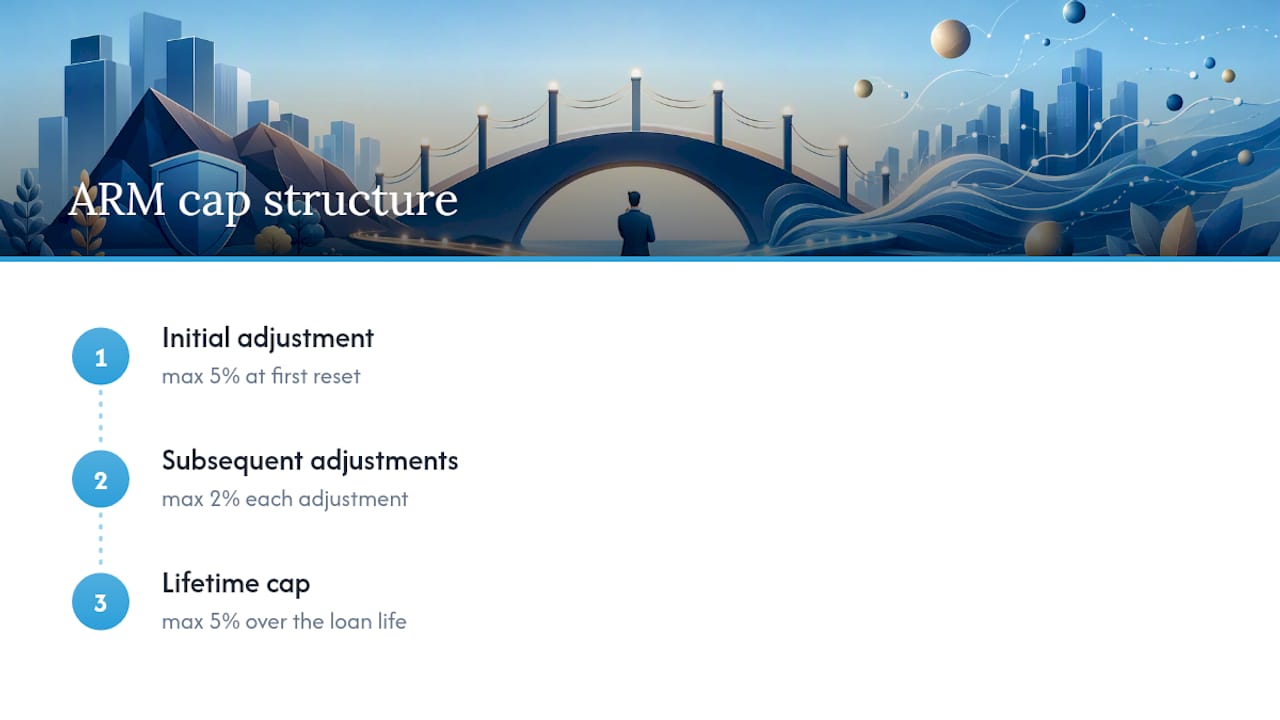
Caps limit how far your rate can move. They’re usually written as three numbers, like 5/2/5: the first adjustment can’t exceed 5%, each subsequent adjustment is capped at 2%, and the rate can never rise more than 5% over the life of the loan. Understanding how these cap structures protect borrowers matters more than memorizing the ARM type, since the caps determine your actual worst-case payment.
A Step-by-Step Framework for Choosing Your Rate
Work through these four steps in order, and don’t skip the stress test even if you’re confident in your timeline.
- Pin down your holding period. If you’re financing commercial real estate or equipment you plan to keep for 15 to 25 years, a fixed rate almost always wins. If you have a confirmed exit inside 5 to 7 years, a variable rate deserves a serious look.
- Check the current spread. Freddie Mac’s Primary Mortgage Market Survey data shows the gap between 30-year fixed and comparable ARM rates has historically run between 0.5% and 1.5%. When that spread narrows toward the bottom of the range, fixed rates often become the better deal even for shorter holds, since you’re not saving much for the risk you’re taking on.
- Stress-test your budget. Calculate your payment at the fully indexed rate and again at the lifetime cap. If either number would strain your cash flow, the variable option isn’t as cheap as it looks.
- Confirm your exit strategy in writing. Selling, refinancing, or paying off the loan all carry costs. Build those into your math before you assume the ARM’s early savings will hold up.
The spread between fixed and adjustable pricing isn’t fixed itself; it shifts with the market, so treat the current gap as a live input to your decision, not a rule you memorize once and reuse for years.
What to Ask For When Comparing Lender Offers
Don’t compare loans on the headline rate alone. Ask every lender for the same package of numbers so you’re comparing apples to apples: the APR, the initial rate, the margin, the index used, the full cap structure, and whether the loan has a rate floor.
Request an amortization schedule that shows your payment at the fully indexed rate, not just at the introductory rate. A proper Loan Estimate should show you what you’d owe if the rate adjusted to its cap tomorrow. Also, factor in closing costs and likely refinancing costs when you’re weighing two APRs against each other. A slightly higher rate with lower fees sometimes beats a lower rate loaded with points.
- Ask for APR, index, margin, and full cap structure in writing
- Request amortization at the fully indexed rate, not just the teaser rate
- Include closing and refinancing costs in any APR comparison
- Watch for red flags: missing cap disclosures, vague margin language, or asymmetric caps that limit decreases more than increases
For a plainer look at how business borrowers weigh these same trade-offs, this partner explainer on fixed vs. variable rates for small business loans covers similar ground from a lending-specific angle.
A Worked Example: Fixed vs. 5/1 ARM Over Five Years
Numbers make this easier to picture. Take a $200,000 loan compared under a 30-year fixed rate versus a 5/1 ARM.
| Loan type | Starting rate | Monthly payment | Interest paid, years 1–5 |
|---|---|---|---|
| 30-year fixed | Higher of the two | Higher, but constant | Higher, but predictable |
| 5/1 ARM | Lower of the two | Lower for 5 years | Lower during fixed period |
Amortization comparisons across recent market snapshots show a 5/1 ARM saving roughly $200 to $300 a month versus a comparable 30-year fixed during that first five-year window on a $200,000 balance. That’s real money if your exit plan holds. But picture the ARM adjusting upward by even 2 points at the first reset: the payment jumps immediately, and you’re now qualifying for a materially higher monthly obligation with no fixed-rate protection left. Run your own figures through a calculator using your actual loan amount and quoted rates before you commit to either path.
Why Rate Monitoring Matters for Business Borrowers
Cdcnewengland has spent more than 70 years financing commercial real estate and equipment purchases for New England businesses, with over $2.3 billion deployed through SBA 504 loans.
Cdcnewengland publishes monthly SBA 504 funding rates, which gives borrowers a real tool for timing a fixed-rate lock instead of guessing. Before you lock any rate, ask your lender for amortizations at the fully indexed level and check current funding-rate posts, including recent coverage on securing fixed-rate financing during volatile markets.
If a 25-year fixed rate with a 10% down payment fits the long-term ownership plan you’ve mapped out, explore Cdcnewengland’s SBA 504 loan options or run your own numbers with the SBA 504 loan calculator before you commit to either a fixed or variable structure.
Where to Read More on Fixed vs. Variable Rates
For primary guidance beyond this article, the CFPB’s explainer on fixed and variable APRs covers disclosure rules in plain language. Freddie Mac’s PMMS data tracks the fixed-ARM spread over time, and Investopedia’s fixed interest rate explainer is a solid refresher on the basics.
The Real Trade-Off Behind Fixed vs. Variable Rates
The conventional advice on this topic treats the choice as a coin flip between “safe” and “risky,” and that framing undersells how much the decision actually depends on math you can run yourself. The spread between fixed and adjustable pricing is the number that should drive your decision, not a gut feeling about where rates are headed. When that spread is narrow, the case for a variable rate weakens fast, because you’re absorbing real reset risk for savings that barely move the needle.
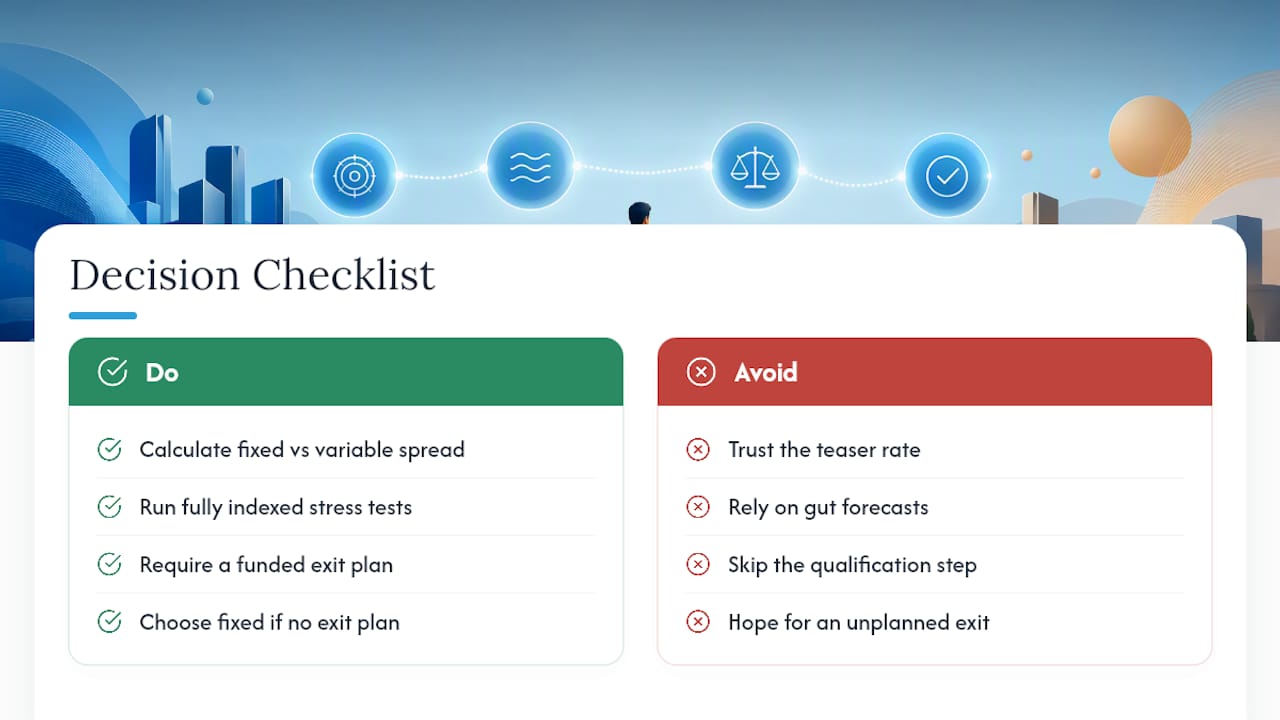
What gets underestimated most is the qualification step. Borrowers fixate on the teaser rate and skip the fully indexed stress test, then get surprised when the first reset lands. That’s not a market failure; it’s a planning failure, and it’s avoidable.
If there’s one thing to prioritize, it’s this: treat your exit strategy as a real commitment, not a hope. A variable rate only makes sense if you can point to a specific, funded plan to sell, refinance, or pay off the loan before the caps start working against you. Absent that plan, fixed financing remains the more defensible default, especially for the 25-year horizons common in commercial real estate.
— PHENYX
Sources
- CFPB — What is the difference between a fixed APR and a variable APR?
- Investopedia — fixed interest rate
- Amortio — ARM mortgage explained (May 2026)